


Keir Starmer’s decision to step down as UK prime minister has opened a race for Downing Street just as Britain enters the final stages of building one of its most consequential financial regulatory frameworks in years.
On June 22, Starmer said that he would remain in office until Labour selects a successor, ending a premiership that lasted less than two years.
He acknowledged that the party needed new leadership before the next general election, which must be held by 2029, and said he wanted to devote more time to his family.
Andy Burnham, the newly elected member of Parliament for Makerfield, quickly emerged as the overwhelming favorite to replace him.
His ascent has generated cautious optimism among cryptocurrency executives who view the former Greater Manchester mayor as more receptive to digital assets and blockchain technology than much of Labour’s senior leadership.
Burnham returned to Parliament after winning the Makerfield by-election last week, clearing the procedural barrier that had prevented him from challenging for the Labour leadership.
He confirmed his candidacy shortly after Starmer’s announcement and called for the party to maintain its focus on economic growth, housing, public services, and the cost of living during the transition.
His path narrowed further when Wes Streeting, previously considered one of Burnham’s strongest potential opponents, ruled himself out and endorsed the former Manchester mayor. Streeting urged Labour members to unite behind Burnham rather than spend the summer fighting over relatively narrow policy differences.
Labour will open nominations on July 9. The process could conclude in mid-July if Burnham faces no challenger, while a contested election would extend the handover until September.
Crypto traders have already priced in a rapid succession. Burnham carried an implied probability of about 97% of becoming Britain’s next prime minister on Polymarket on Monday. Traders had placed roughly $12.5 million on the contract.
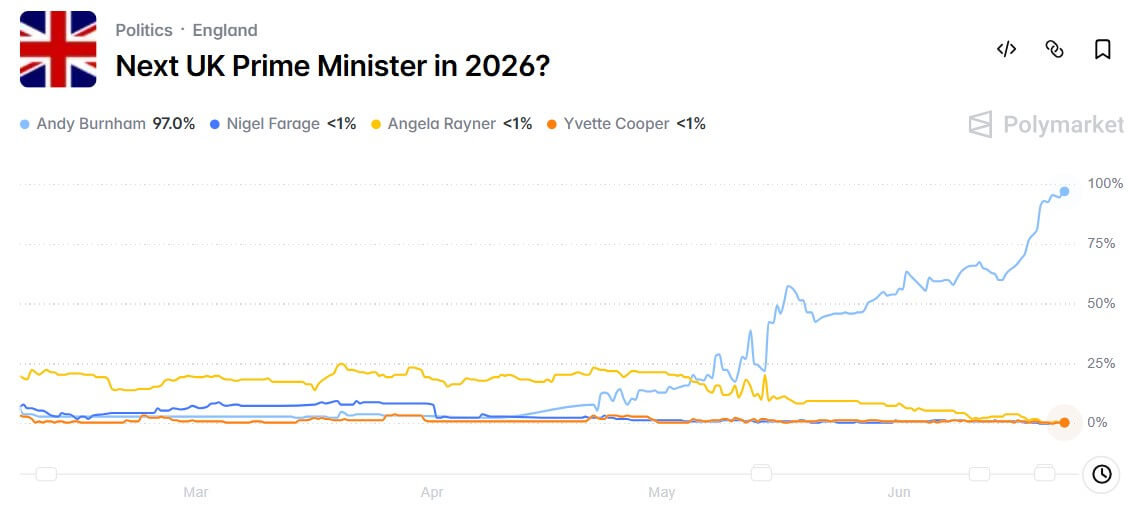
The price represents the conviction of participants willing to risk capital on the outcome rather than a scientific measure of public opinion. It nevertheless shows how decisively the market shifted after Streeting withdrew from the race.
Traditional financial markets showed little immediate alarm. Sterling and UK government bonds registered limited moves following Starmer’s announcement, suggesting investors had largely anticipated his departure. Longer-term attention has instead turned to Burnham’s fiscal position and the identity of the next chancellor.
His arrival would make him Britain’s seventh prime minister in a decade, extending a period of leadership turnover that began with the 2016 Brexit referendum.
The next prime minister will inherit a regulatory program that has progressed beyond broad political promises.
Legislation approved in February expanded Britain’s regulated financial-services perimeter to cover crypto activities, including operating trading platforms, issuing qualifying stablecoins, safeguarding customer assets, and dealing in digital assets.
The Financial Conduct Authority (FCA) must still complete the accompanying rulebook. It has published consultations covering custody, stablecoins, prudential requirements, market abuse, consumer protection, and the authorization process for companies seeking to serve UK customers.
The regulator expects the framework to begin on Oct. 25, 2027. Once it takes effect, businesses carrying out covered activities will generally need FCA authorization even when they already hold other financial services permissions or registrations.
A new prime minister could influence the government’s political priorities, appoint different Treasury ministers, or seek amendments to parts of the framework. The transition alone would not cancel the legislation or force the FCA to restart its work.
However, the more immediate risk involves administrative momentum. A cabinet reshuffle could replace ministers familiar with the regime at a point when regulators and companies are preparing for authorization. Political attention could also shift toward more urgent issues, including public spending, economic growth, and Labour’s electoral position.
Those distractions could affect secondary legislation or unresolved policy areas. The central architecture, however, has already moved far enough that an outright reversal appears unlikely without a deliberate intervention by the new government.
That distinction puts Britain in a different position from earlier stages of the debate. Companies now need clarity on implementation and compliance rather than another broad promise to turn the UK into a digital-asset hub.
Burnham’s public record on cryptocurrency remains limited, but his previous statements have encouraged parts of the industry.
Freddie New, the CEO of CEO of BHODL plc (and co-founder of Bitcoin Policy UK), told CryptoSlate that Burnham’s expected rise creates an opportunity to recast the industry as a potential source of investment.
According to him:
“I’m most interested to see how a potential Burnham administration will look at the Bitcoin and cryptocurrency industry as a potential for growth in the UK economy rather than, as has previously been the case, something to be throttled and feared.”
New pointed to Bitcoin treasury companies that have pursued listings in London, arguing that digital-asset businesses could bring new capital and international attention to a stock market that has struggled to attract initial public offerings.
He added:
“New companies listing in London should be welcomed and supported, not discouraged, and I hope Burnham will understand that.”
Industry executives are likely to press the next government for proportionate capital requirements, a workable authorization process, and clearer treatment of staking, lending, and stablecoin payments. They also want the FCA to apply the government’s economic-growth mandate more visibly when setting rules.
Despite the optimism surrounding Burnham, the digital asset industry remains wary of certain factions within the broader Labour Party.
New notes that domestic financial regulators have yet to fully embrace the “growth” mandate previously outlined by Rachel Reeves.
In view of this, he added:
“The sooner our politicians and regulators really embrace and understand an industry where the U.K. should be a leader, with our long history of expertise in both finance and in computer technology, the better.”
The post Andy Burnham emerges as UK Prime Minister favorite, sparking crypto industry hopes for policy reset appeared first on CryptoSlate.








Ethereum is back in a level-by-level technical fight after a TradingView analyst mapped out a short-biased setup that puts the market’s attention on whether ETH
A new paper from Google DeepMind argues that disagreements over whether AI is conscious could spill into politics, law, and public institutions.
The debut comes as Fundstrat’s Tom Lee cautions that a wave of major AI-related public offerings could create significant market turbulence later in 2026. The
Ethlabs was formed with support from SharpLink, Bitmine and Consensys CEO Joe Lubin as the network’s development is expanding beyond the Ethereum Foundation.