


After four years of promises, X Money is a real product. X began releasing it to a subset of US Premium+ subscribers on June 25, and by June 29 access was spreading to a broader group of verified users. Within hours of the first release, a user sent Elon Musk $25 to prove the peer-to-peer rail worked. Musk confirmed receipt. That was the launch.
The feature set is conventional to the point of being anticlimactic for anyone who expected Musk’s everything app to arrive with a token attached. X Money is a dollar wallet embedded in the X client. Users can hold a USD balance, send money to any @handle, link an external bank account, take direct deposit, and spend on a metal Visa debit card stamped with their username. The advertised terms are 6% annual yield on balances, 3% cashback on card spending, no foreign transaction fees and free ATM withdrawals. Dhruv Batura, who runs the product, described the June 25 release as a deliberately small one, intended to surface problems before a wider launch.
There is no bitcoin, no dogecoin, no stablecoin, and no on-ramp. For a product that spent two years accumulating crypto expectations, the fiat-only launch is the story’s first real signal.
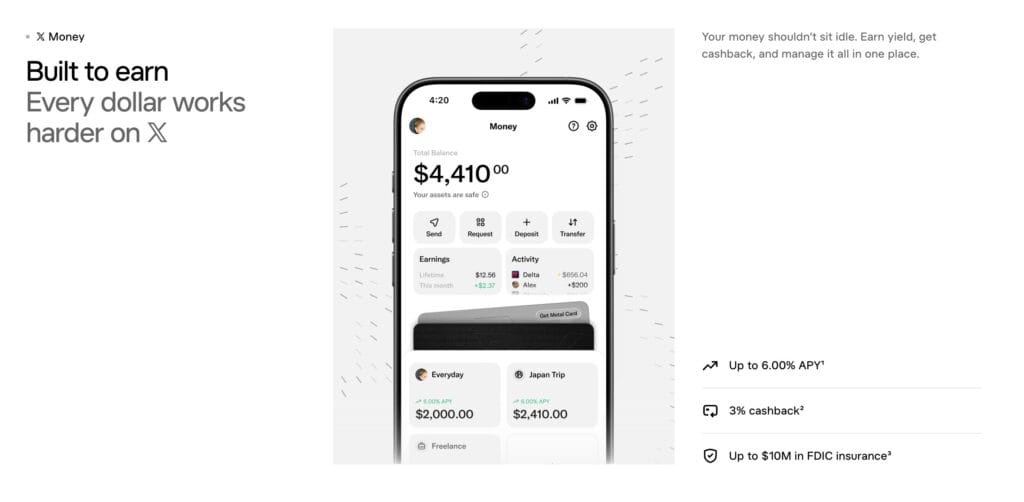
Up to 6.00% APY¹, source: X Money
X is not a bank and does not hold a banking charter. It operates through X Payments LLC, which holds money transmitter licenses in 41 states and the District of Columbia. The service is unavailable in New York and Massachusetts, two of the largest financial markets in the country, pending state approvals.
Customer deposits sit at Cross River Bank, the New Jersey lender that has spent the past decade as the balance sheet behind a long list of fintechs. That structure delivers FDIC coverage to $250,000 as standard. The widely quoted $10 million figure comes from the X Cash Sweep Program, which distributes balances across a network of insured institutions and is reserved for Premium+ subscribers, a tier that costs $395 a year.
The federal funds target range sits at 3.5% to 3.75% ahead of this week’s FOMC meeting. A 6% yield on demand deposits is therefore roughly 225 basis points above the risk-free rate, which is not something a bank funds out of net interest margin. It is a customer acquisition expense, funded by subscription revenue, interchange, or the parent’s willingness to buy distribution. Marketing yields are legal and common. They are also promotional, and X has not published a Truth in Savings disclosure setting out how the rate is calculated or under what conditions it can be withdrawn. Until it does, 6% is an advertisement rather than a term.
The uncomfortable part of the banking story is jurisdictional as the Consumer Financial Protection Bureau is the federal agency that would ordinarily supervise a consumer payments product of this kind. It was substantially dismantled in 2025 under Acting Director Russ Vought, a process in which Musk’s Department of Government Efficiency played a documented role.
Senator Elizabeth Warren, the ranking member on Senate Banking, wrote to Musk on April 14 with a list of questions about the launch. She asked whether Musk understood the CFPB would have had jurisdiction over X Money when he posted “CFPB RIP.” She flagged Cross River’s 2023 FDIC enforcement order over its lending practices. And she asked whether X intends to issue a stablecoin under what she called a suspicious carveout in the GENIUS Act, one that lets private commercial companies issue payment stablecoins without approvals that would apply to comparable public companies. Warren requested written answers by April 21. None have been made public.
Federal oversight of X Money is therefore thin by design, and the effective supervisors are 41 state regulators plus whatever conditions the FDIC imposes on Cross River.
The GENIUS Act carveout matters more than the absence of a dogecoin button. As BNC has previously argued, the legislation’s real effect is to determine who gets to sit on the float. Stablecoins now settle more annualized value than Visa and Mastercard combined, and issuance is the most attractive business in payments because the issuer keeps the reserve yield.
X has the two inputs that matter: distribution across roughly 560 million monthly users, and a statutory path to issuance that does not require a charter. What it would give up is the FDIC wrapper. A balance held in an X-issued stablecoin backed by X Corp is not an insured deposit, whatever the reserve composition. That is the trade the product will eventually have to name, and it is the single thing worth watching over the next twelve months.
SpaceX’s IPO filing disclosed that xAI, which now contains X, lost $6.4 billion in 2025 on $3.2 billion of revenue, with the gap widening year over year. Advertising remains the bulk of X’s income and remains well below the pre-acquisition peak. The filing also put paid subscribers at 6.3 million across the ecosystem, of which 4.4 million are on the legacy X Premium tiers.
That last number is the honest ceiling on X Money’s addressable market today. A payments product gated behind a paid subscription in 41 states, competing against Cash App and Venmo, is not a threat to anyone’s deposit base yet. What it is instead is optionality: a licensed money transmission stack, a bank partner, a card program and 560 million distribution endpoints, assembled in the one jurisdiction where the relevant consumer regulator has been hollowed out.



NEAR Protocol has reported a remarkable achievement, having settled over $24 billion in human-initiated cross-chain swaps across more than 30 networks. This milestone signals significant
BitGo emphasizes the urgent need for the CLARITY Act to provide a comprehensive federal framework for digital asset markets. The organization believes that overlapping regulations

B HODL’s share buyback strategy enhances Bitcoin exposure per share, potentially increasing investor value and influencing treasury management trends. The post B HODL repurchases 618K
Netanyahu’s claims could strain US-Iran relations, reducing chances for diplomatic resolutions and impacting geopolitical stability. The post Netanyahu claims Iran expanding nuclear program, deceiving negotiators