
BIP-110’s author has told Bitcoin users to stop running Bitcoin Core, warning it becomes insecure once mandatory signaling begins. Michael Saylor says the opposite, urging the proposal’s backers to stand down.
Both men are describing the same event at block 961,632. They disagree entirely on which side of it Bitcoin ends up.
BIP-110 is a temporary rule change, or soft fork, that caps how much data a Bitcoin transaction can carry. It ships in Bitcoin Knots, a smaller rival to Bitcoin Core.
Dathon Ohm, the pseudonymous developer who wrote the proposal, said mandatory signaling would start in 290 blocks. After that, miners must set versionbit 4, a flag in the block header.
Blocks without it become invalid to BIP-110 nodes.
He told miners and users to install Knots, then went further.
“It is not recommended to run Bitcoin Core, as it will become insecure when mandatory signaling begins, and miners getting their templates from Core may produce invalid blocks on an incoherent chain that keeps being wiped out, along with any earnings,” Ohm wrote.
Nothing on the project’s own website calls Core insecure. Ohm also described BIP-110 as a fix for critical vulnerabilities, a claim absent from bip110.org.
The site presents it as a curb on arbitrary data, the argument behind the Bitcoin blockspace spam debate.
Follow us on X to get the latest news as it happens
Ohm thanked the many miners he said are now signaling readiness. The monitor his project cites shows a modest uptick, not a breakthrough.
At block 961,022 on August 4, Saylor counted 38 signaling blocks, a rate of 2.70%. By block 961,421 the monitor logged 47 of 1,806 blocks, or 2.60%.
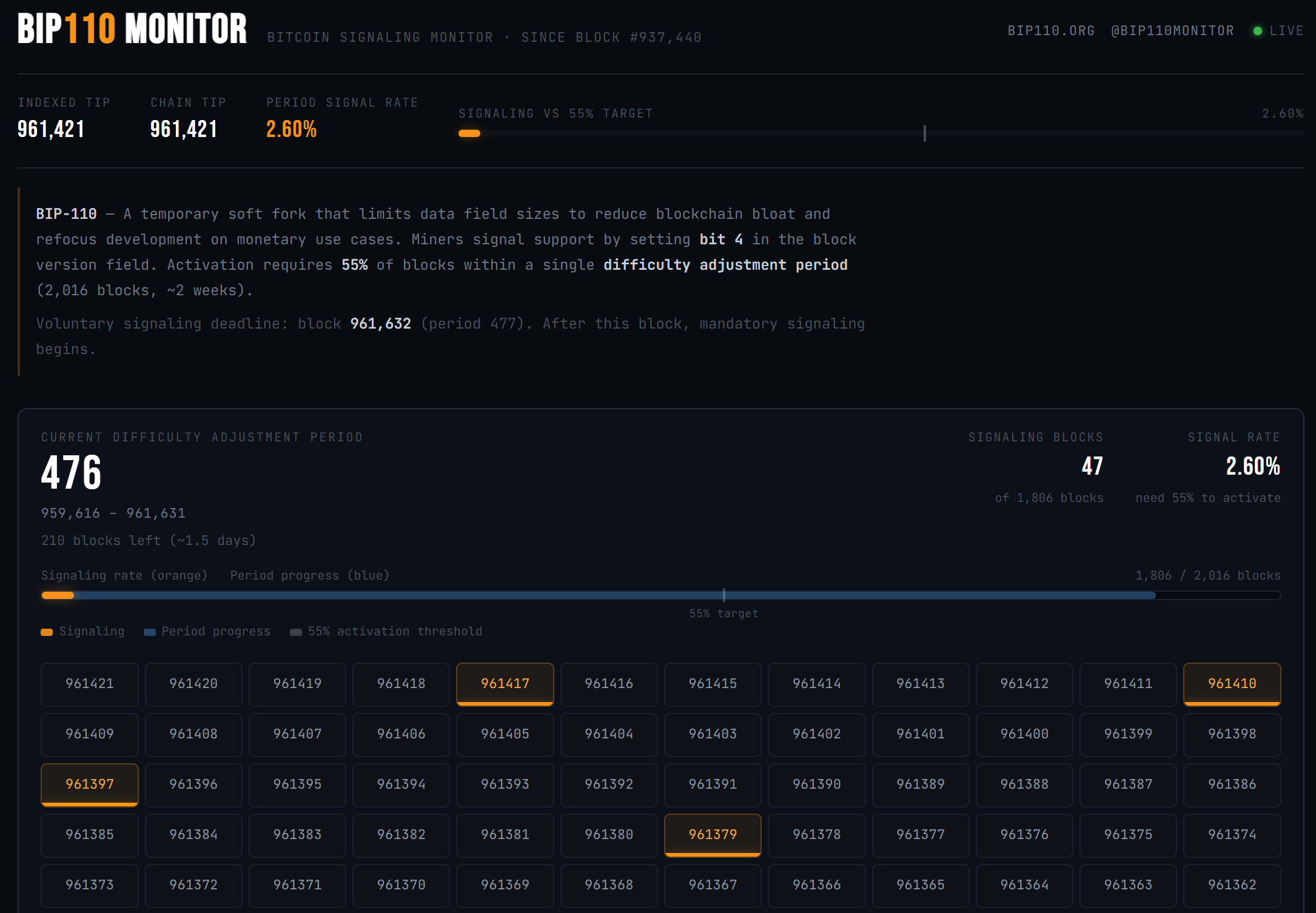
That is eight new signals in 392 blocks. The period rate has slipped rather than climbed.
Early lock-in needs 1,109 signaling blocks. With 217 left in the period, the highest reachable total is 263. No completed two-week stretch since December has finished above 1.29%.
Luke Dashjr, who maintains Bitcoin Knots, told BeInCrypto the outcome is already settled. Any miner who refuses to signal loses their block rewards entirely, he said, and the invalid blocks they produce serve only to mislead nodes that have not yet updated.
Dashjr added that shipping a Knots release without BIP-110 would not change the schedule, and said there is no material opposition to the change.
Saylor reads the same mechanism and reaches the opposite conclusion.
…At 961,632, BIP-110 nodes reject non-signaling blocks. Unless major miners reverse, Bitcoin continues normally while BIP-110 stalls or forks into irrelevance. Its backers should stand down,: the MicroStrategy executive said in a post.
He has warned about Bitcoin neutrality for weeks. Blockstream chief executive Adam Back has flagged chain split risk over the low threshold.
BeInCrypto reported this week that voluntary activation was already impossible. With about a day and a half left, the question is whether miners capitulate or BIP-110 nodes end up mining alone.
The post Bitcoin Could Split in Two This Weekend: What Holders Need to Know appeared first on BeInCrypto.






Grok AI predicts a Bitcoin bottom is in, with potential prices reaching $120,000 to $150,000 by the end of 2026. The post Elon Musk Grok
Arthur Hayes warns an AI-driven credit crisis will force Federal Reserve money printing, making Bitcoin the primary beneficiary with a potential $1M price target. The
On August 6, 2026, community-backed digital assets are demonstrating sustained market momentum, led by Pudgy Penguins’ massive content milestone and Maxi Doge’s $4.83 million capital

Kitesurf’s efficiency could revolutionize AI web interactions, reducing computational costs and enhancing scalability for automated tasks. The post Cloudflare launches Kitesurf, a browser built for