


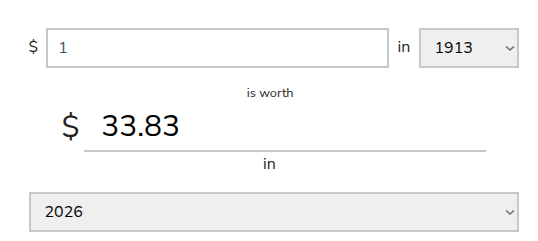
Since the Federal Reserve was created in 1913, the US dollar has lost about 97% of its purchasing power, according to the Bureau of Labor Statistics CPI-U.
A 1913 dollar buys roughly 3 cents’ worth of today’s goods, meaning $1 back then is worth about $33 to $34 in 2026.
That figure is not a slogan. It reflects the official price index compounded over 113 years, through two world wars, the Great Inflation of the 1970s, and the 2021-23 spike. The 1971 end of gold convertibility accelerated the dollar’s stretch, and cash left idle was quietly taxed by inflation the entire time.
“Check out the biggest, kosher ponzy scam in recent history. The US dollar has lost 97% of its purchasing power since the Federal Reserve was created in 1913. A $3 item in 1913 would cost $100 today,” one user said on X.
Follow us on X to get the latest news as it happens.
Bitcoin was designed in response to that system: a 21 million-coin cap paired with a declining issuance schedule. It did not exist in 1913, so the comparison is not one-for-one. As a store of value, though, its record since 2009 has been extreme in both directions.
Early buyers saw their purchasing power explode. Later buyers, by contrast, endured drawdowns of 50% to 80% within single cycles.
As of early September 2026, Bitcoin trades near $79,852, well below its October 2025 peak of $126,080. Since its inception, the token’s price has soared more than 59,000%, and over full market cycles, it has beaten cash and often beaten gold.
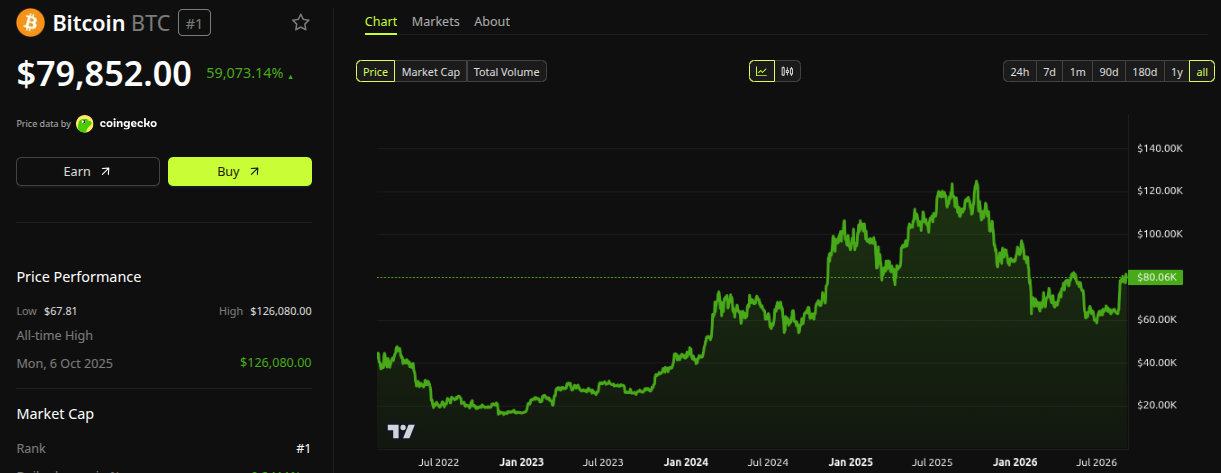
Inside any single cycle, though, it can erase years of gains within months — the trade-off inherent to a scarce, non-yielding, narrative-driven asset.
Utility has reshaped Bitcoin’s role since then. Spot Bitcoin ETFs, approved in the United States in 2024, turned a bearer asset into a ticker that pensions, RIAs, and balance-sheet allocators can hold without managing private keys.
Those products have accumulated $55.62 billion in cumulative net inflows as of September 4, according to SoSoValue data, with total net assets across the category reaching $101.25 billion, equal to roughly 6.33% of Bitcoin’s entire market cap.
Adoption remains incomplete in several respects. Volatility stays high, regulation varies widely across jurisdictions, and energy and custody risks are real and unresolved. The US dollar still clears most global trade, prices most debts, and pays most wages worldwide. Bitcoin has not replaced that role as a unit of account.
What Bitcoin has done is offer savers an exit from a currency that official statistics say lost 97% of its purchasing power since 1913. Whether that exit functions as a genuine reserve asset, pure speculation, or some combination of both depends heavily on the investor’s time horizon.
Cash loses value slowly and predictably. Bitcoin can lose value fast, sometimes dramatically so, but over the long run, it has, so far, compounded gains faster than either cash or gold.
Subscribe to our YouTube channel to watch leaders and journalists provide expert insights.
The post The US Dollar Has Lost 97% of Its Value Since 1913: Is Bitcoin the Way Out? appeared first on BeInCrypto.






Moscow’s rhetoric heightens geopolitical tensions, influencing market perceptions and potentially escalating military actions in Ukraine by 2026. The post Moscow ramps up rhetoric, markets eye
Arsenal’s strong start boosts their title aspirations, intensifying competition with Manchester City and highlighting Chelsea’s early struggles. The post Arsenal defeats Chelsea 2-1 at Emirates
Microsoft’s efficient skill distillation method democratizes AI capabilities, reducing costs and enhancing accessibility for broader applications. The post Microsoft paper reveals efficient skill distillation for

Solana is experiencing a notable surge in market cap, primarily driven by real-world assets (RWAs) that added $123.8 million over the past week. This growth