
VTHO’s move looks different from most sudden double-digit gas-token pumps that are just noise chasing a headline that fades by the weekend.
It’s the fee token of a ten-year-old, EVM-compatible Layer 1 that’s about to force every node operator on its network to upgrade before Wednesday, whether the market notices or not.
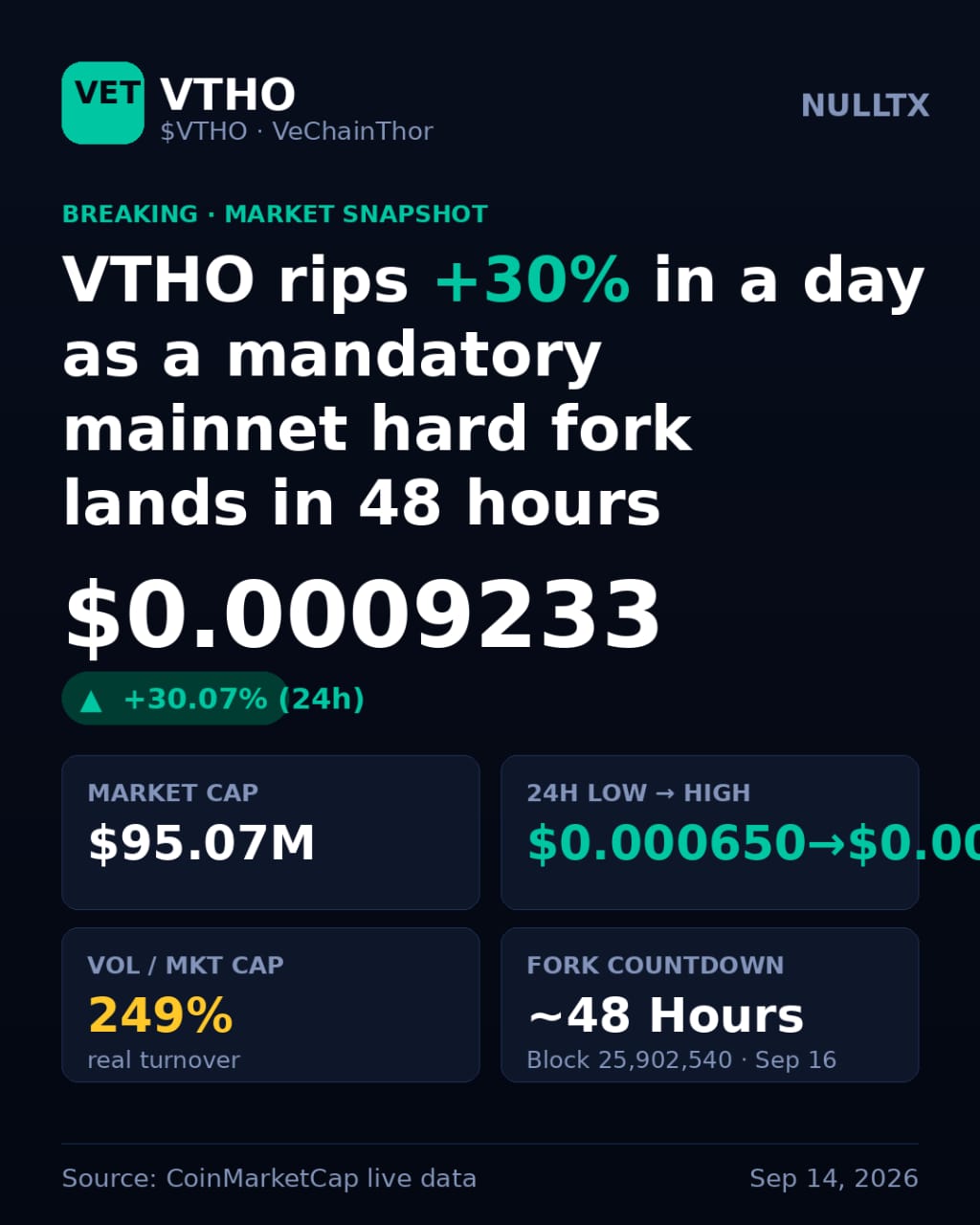
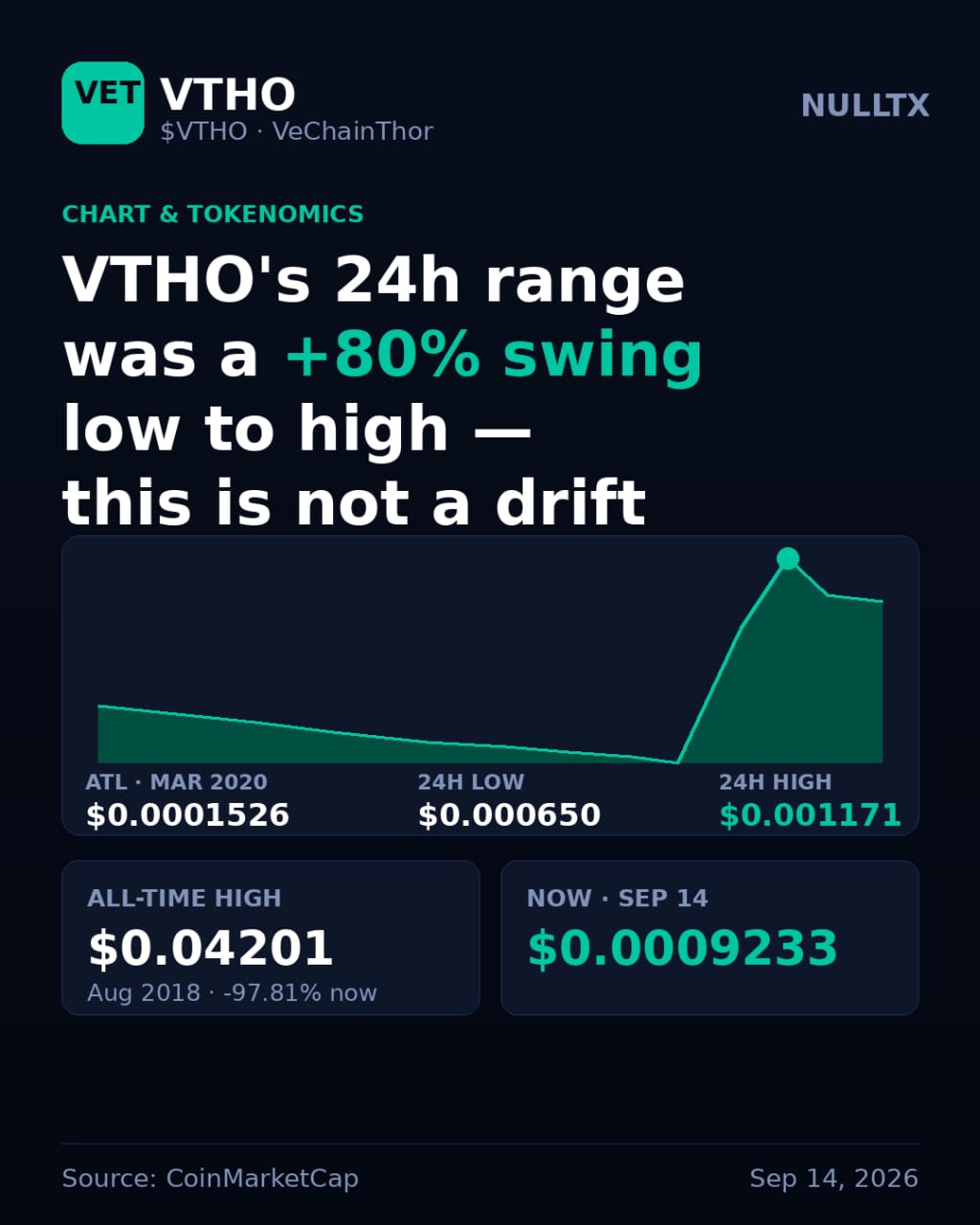
Look at where the numbers sit right now: VTHO at $0.0009233, market cap at $95.07 million, both up over 30% in a single day. Circulating supply is essentially the entire theoretical float here since VTHO has no fixed max supply, so this isn’t a token getting squeezed by a low float, it’s demand showing up against an asset whose issuance is already governed by a separate mechanism entirely. The 24-hour range alone tells the story: VTHO swung from a low of $0.0006498 to a high of $0.001171, an unusually wide band for a token that’s spent most of its life quietly ticking along in the background as VeChainThor’s gas asset.
Start with the piece of news that’s easiest to verify because it comes with an exact block height attached: on September 3, VeChain’s engineering team published the v2.5.0 “Interstellar” release on its official GitHub, confirming the network’s mainnet hard fork activates at block 25,902,540, roughly 11:15 UTC this coming Wednesday, September 16. This isn’t a proposal anymore, it’s a mandatory upgrade; the release notes state plainly that every validator, exchange, and node operator running VeChainThor must be on v2.5.0 before that block or fall off the canonical chain entirely.
What the fork actually does matters for VTHO specifically, because VTHO is the token that pays for every one of these newly unlocked operations. Interstellar, specified under VIP-255 and explained in VeChain’s own Interstellar breakdown, brings VeChainThor’s EVM up to Ethereum’s Cancun, Prague, and Osaka standards in a single hop, adding transient storage, native BLS12-381 and secp256r1 cryptography, and cheaper memory operations. The secp256r1 addition in particular opens the door to passkey and hardware-backed wallet logins, the same authentication standard behind Apple’s Secure Enclave and Android Keystore, which is a meaningfully bigger unlock for onboarding non-crypto users than it might sound.
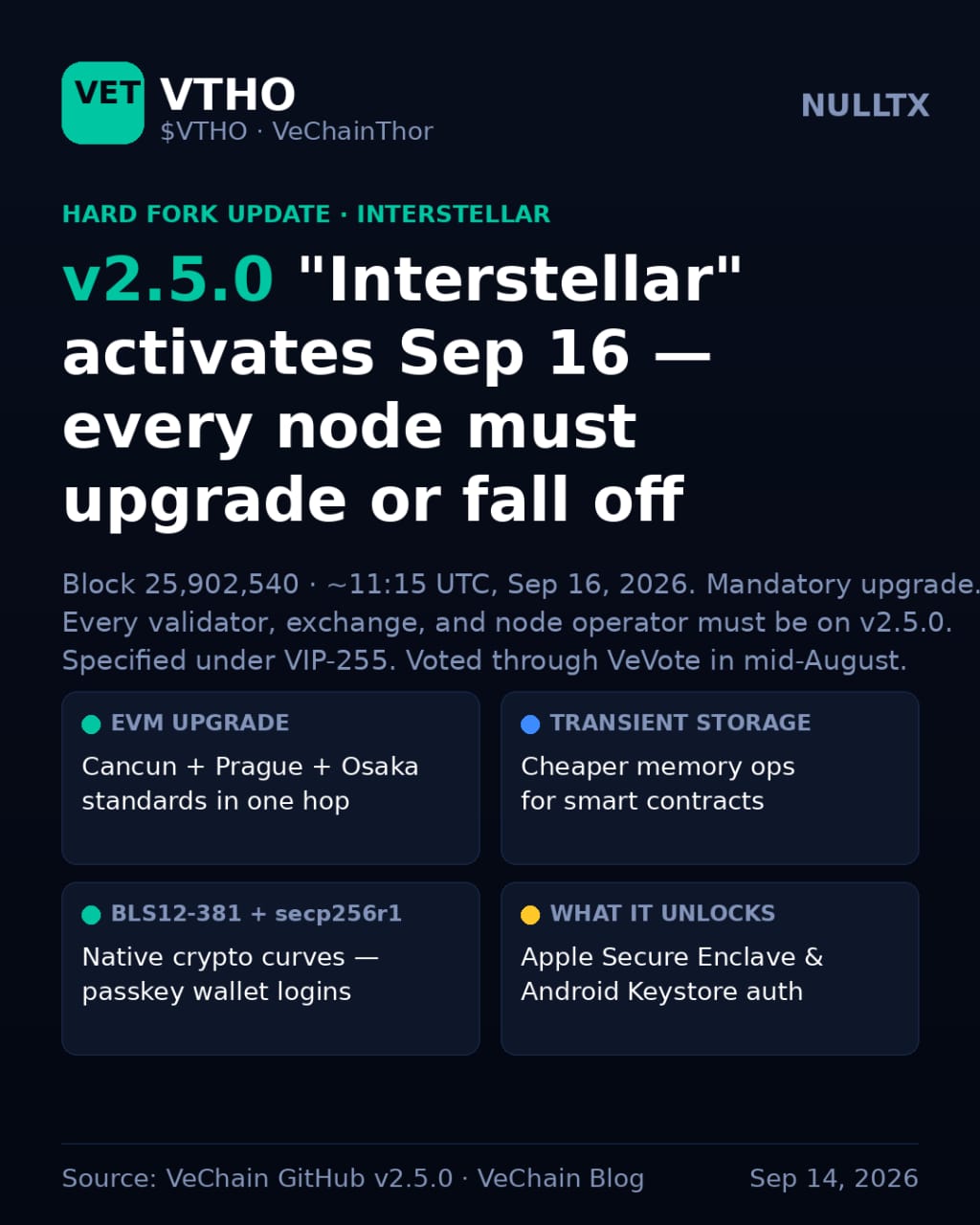
The vote to get here ran on VeChain’s own VeVote platform through mid-August, with validators and StarGate NFT holders casting the ballots that ultimately cleared the upgrade for this week’s mainnet activation.
Here’s the part of the story that predates this week’s fork and explains why VTHO was primed to react this hard. VeChain’s own 2026 roadmap post lays out two prior upgrades that changed how VTHO behaves at the protocol level. Galactica, live since July 2025, introduced an EIP-1559-style dynamic fee market with a 100% base-fee burn, meaning a real, permanent chunk of VTHO used in every transaction is removed from supply rather than recycled. Hayabusa, live since December 2025, went further and killed the old model where simply holding VET generated free VTHO; issuance is now tied exclusively to actively staked VET through the StarGate platform, and total VET staked there has grown from 2.52 billion to 13 billion tokens since launch. That’s a token whose supply-side has been getting structurally tighter for the better part of a year while price sat mostly ignored.
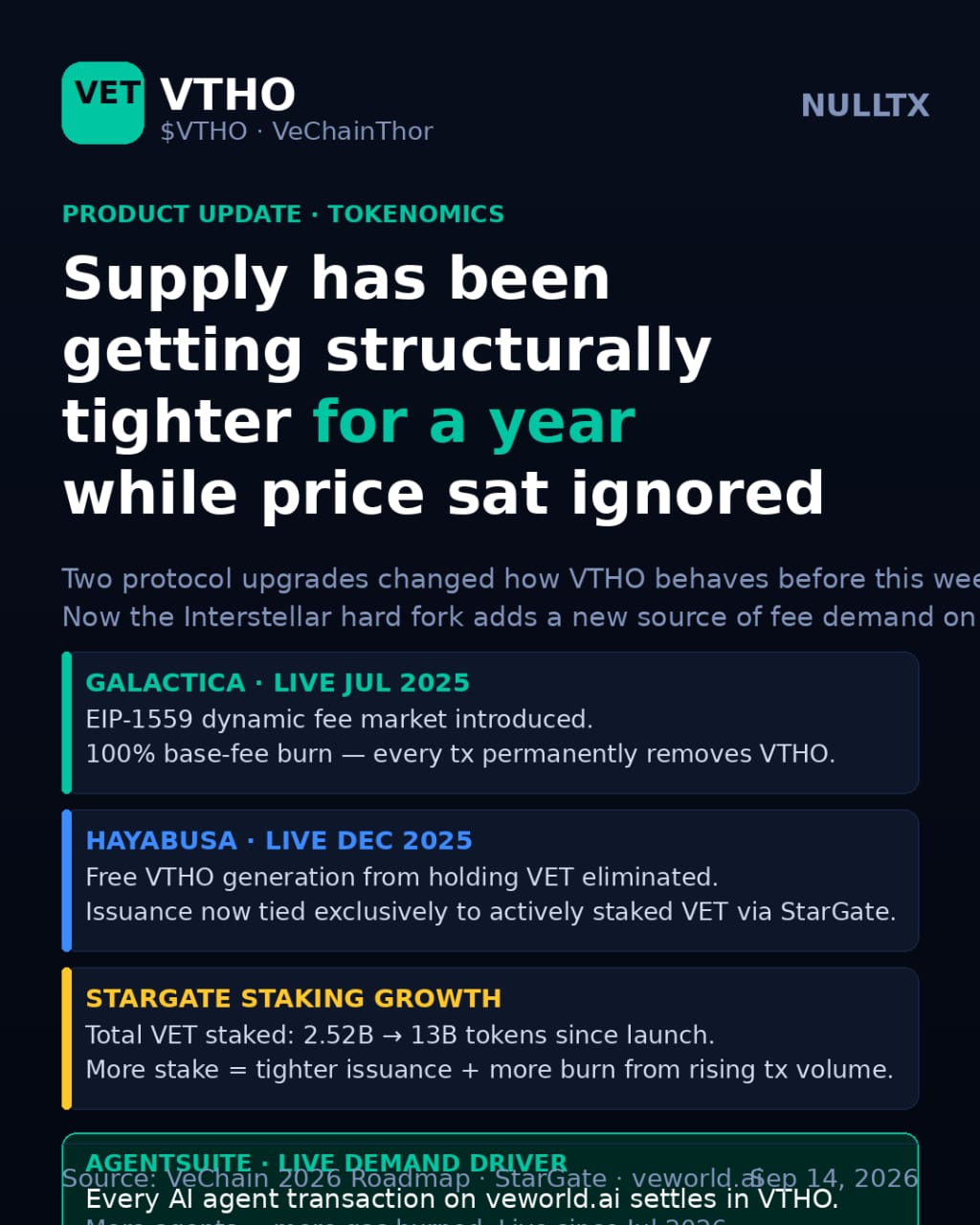
Layer the AI angle on top. VeChain opened early access to AgentSuite via its veworld.ai portal in July, a marketplace where anyone can build, host, and sell an AI agent with every transaction settled and verified on VeChainThor. More agents transacting on-chain means more VTHO consumed and burned as gas, directly connecting a live AI narrative to actual network fee demand rather than just a roadmap slide.
The move itself has the shape of a market re-rating fast rather than a slow grind. Fully diluted valuation sits at $95.07 million, identical to market cap since there’s no capped supply to dilute against, and that 249% volume-to-market-cap ratio over the last 24 hours is not something you typically see on a token quietly drifting higher. For context on how far VTHO still has to travel if sentiment keeps building, it remains 97.81% below its August 2018 all-time high of $0.04201, while sitting more than 500% above its March 2020 low of $0.0001526. VET itself, the sister token on the same chain, has moved far more modestly in the same window, which suggests this repricing is specifically a gas-token story tied to Wednesday’s fork and the deflationary mechanics underneath it, not just broad-market beta lifting everything at once.
I’m not going to pretend a 30%-in-a-day move is something to chase blindly, especially in a token with no supply ceiling where volatility cuts both directions fast. But the near-term setup here is about as clean as gas-token catalysts get: a mandatory, dated mainnet hard fork landing in roughly 48 hours, sitting on top of a burn-and-stake tokenomics model that’s already been tightening supply for months, with a live AI-agent product adding a fresh source of on-chain fee demand. If Wednesday’s activation goes through without incident, and if AgentSuite and StarGate activity keep climbing the way VeChain’s own numbers suggest, the more likely near-term path is continued upside into and just past the fork window, with the real confirmation coming from post-activation network usage data rather than the hype cycle around the date itself. Watch VeChain’s own blog and the Thor GitHub directly for that confirmation once the dust settles.
Figures reflect live CoinMarketCap data as of today, September 14, 2026, and will move quickly given current volatility.
Disclosure: This is not trading or investment advice. Always do your research before buying any cryptocurrency or investing in any services. Follow us on X @nulltxnews