
CoinEx’s shutdown notice didn’t feel like the typical legal document written to survive a lawsuit rather than reach a human being, standing out from the many I’ve read over the years.
Buried inside the technical withdrawal schedule was a personal letter from its CEO that admitted, in plain language, that the exchange never became what he’d hoped it would be. That kind of honesty is rare in this industry, and it’s part of why I think this closure deserves a closer look than just another line in the growing list of exchanges shutting their doors this year.
CoinEx framed its decision around a familiar but genuinely accurate set of pressures, a prolonged market downturn, shrinking industry-wide trading volume and liquidity, and regulatory and compliance costs that have climbed past what the company considers a rational trade-off against its revenue. I don’t think that explanation is spin. Running a centralized exchange today means carrying open-ended legal and security liability in exchange for a business that’s gotten measurably thinner over the past year, and CoinEx said as much directly, choosing to begin what it’s calling an orderly cessation process starting September 15, 2026, rather than limp along under conditions it no longer sees as sustainable.
What I appreciate about this notice is how specific the dates are, because vague wind-downs are usually the ones that end in user complaints. Starting September 15, new registrations stop, referral rewards end, futures move into reduce-only mode, and no new positions can be opened across fiat, margin, loans, earn, staking, or strategic trading. By September 22, every non-spot service shuts off entirely, along with on-chain deposits, except CET deposits which get a one-week grace period until September 29.
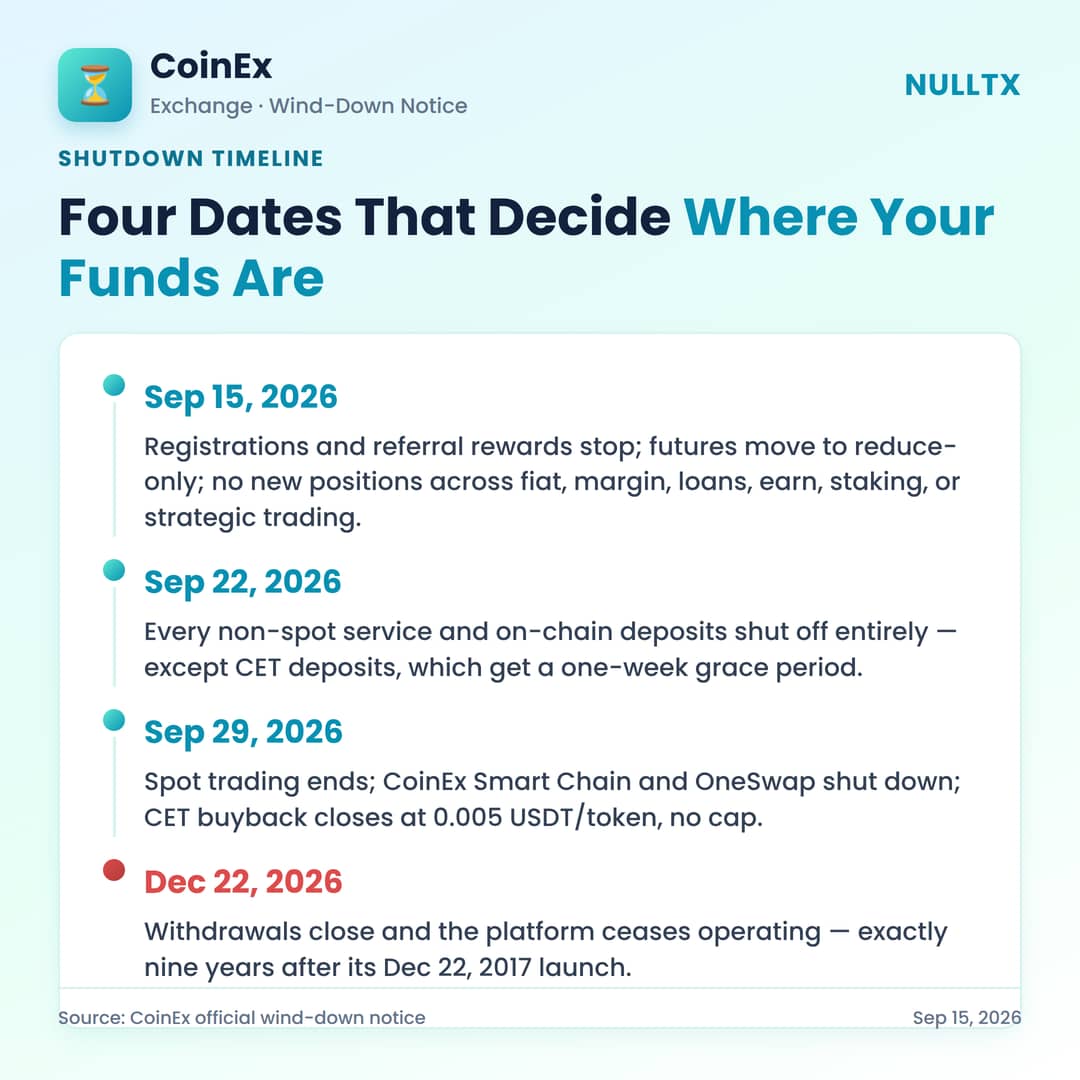
That same date, September 29, is when spot trading ends completely, non-USDT assets get processed, CoinEx Smart Chain and OneSwap shut down, and the CET repurchase window closes after buying back any remaining CET at 0.005 USDT per token with no cap. The final deadline is December 22, 2026, when withdrawals close and the platform ceases operating entirely. CoinEx says its reserve ratio sits above 100%, with proof of reserves published for anyone who wants to verify it themselves, and I think publishing that link alongside the shutdown notice, rather than just asserting solvency, is exactly the kind of transparency this industry needs more of during an exit, not less.
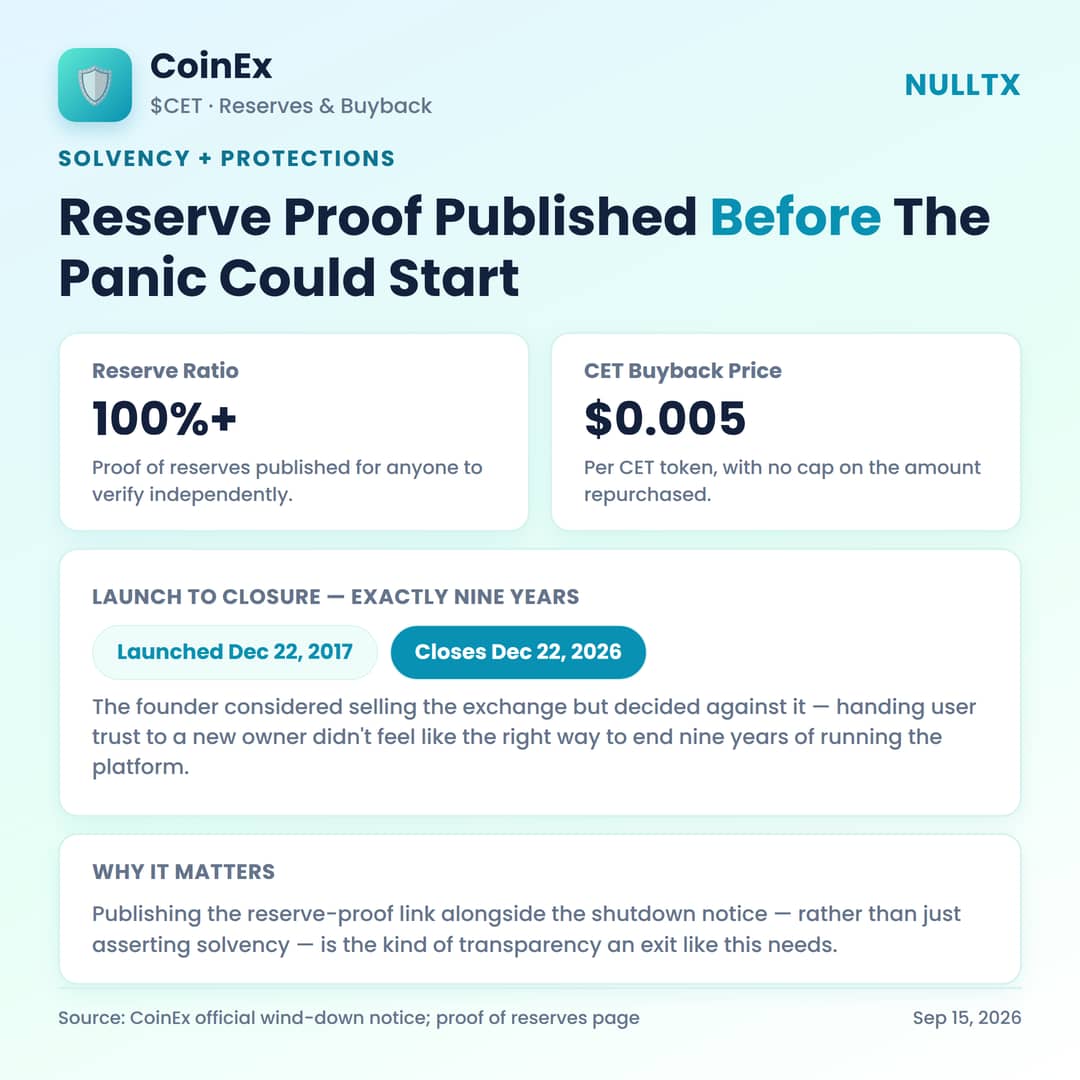
The part of this announcement that actually stuck with me wasn’t the timeline, it was the CEO’s own words. He didn’t hide behind corporate language, he said plainly that CoinEx never became one of the industry’s leading exchanges, and that carrying unlimited risk for limited revenue stopped being a rational choice. What struck me most was his line about considering a sale and deciding against it, because users trusted CoinEx and trusted him personally, and handing that trust to a new owner didn’t feel like the right way to end nine years of running the platform.
I don’t think every founder facing a shutdown would make that same call. Selling a struggling exchange to someone willing to inherit its user base is usually the financially cleaner move, and choosing an orderly wind-down instead, on a date that lines up exactly nine years after the exchange’s December 22, 2017 launch, reads to me like someone who genuinely wanted the ending to match how the business was run.
One detail I think matters more than it might look at first glance is how fast CoinEx’s related businesses moved to separate themselves from the shutdown. ViaBTC, the mining pool under the same ownership, issued its own statement confirming it operates as a fully independent legal entity with separate finances and infrastructure, and that mining deposits, withdrawals, and settlements continue unaffected.
The one actual change users need to make is updating any auto-withdrawal setting pointed at CoinEx, since ViaBTC is discontinuing that specific feature on September 22. CoinEx Wallet and CoinEx Vault issued a similar clarification, confirming both remain fully operational since they run independently of the exchange itself.
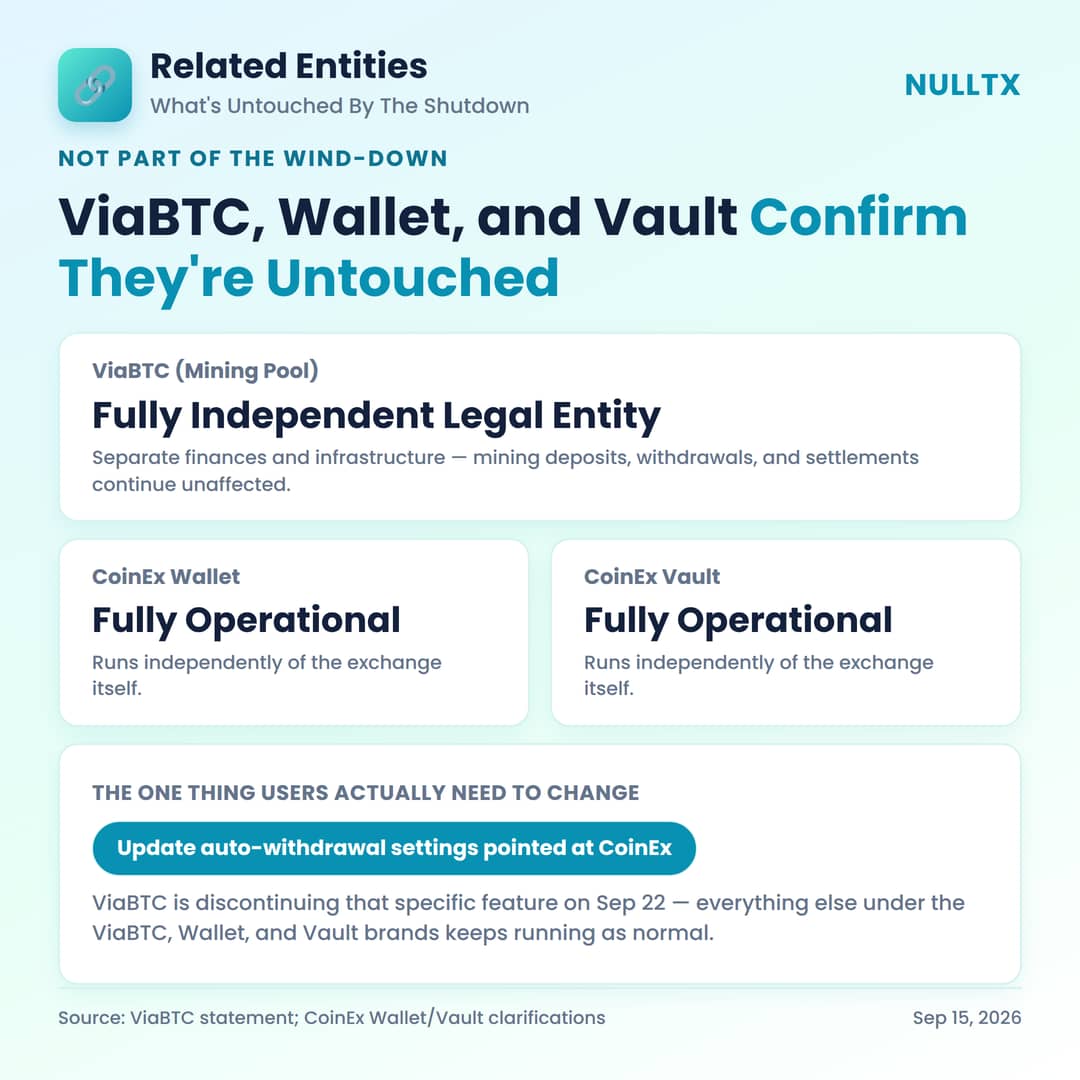
I think that kind of rapid, specific clarification is exactly what prevents unnecessary panic among users of adjacent products who might otherwise assume everything under the same brand is going down together.
Setting CoinEx next to BitMart’s wind-down from earlier this year, the similarities are obvious on the surface, both cited a mix of market downturn, shrinking liquidity, and rising compliance costs, both moved futures into reduce-only mode immediately, both kept withdrawals open through an extended window while shutting off new deposits and registrations first. But the differences are where I think the real story is. BitMart’s shutdown triggered real user pain almost immediately, with on-chain trackers showing withdrawal volumes freezing for hours at a stretch and users publicly complaining about stuck transactions, eventually pushing BitMart to reconsider the shutdown entirely and explore a restructuring plan instead.
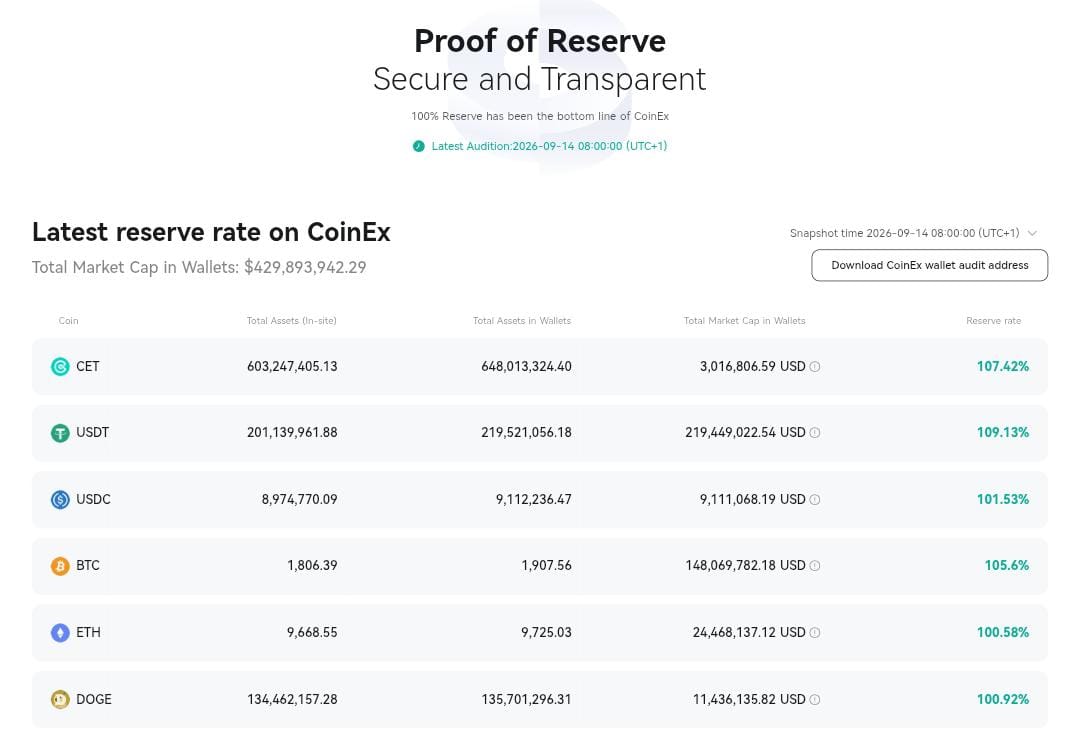
CoinEx’s notice, by contrast, leads with its reserve proof link [https://www.coinex.com/en/reserve-proof](https://www.coinex.com/en/reserve-proof) and a much longer, clearly staged withdrawal runway stretching to December 22 rather than BitMart’s tighter one-month trading cutoff. BitMart’s token, BMX, crashed by more than half within a day of the announcement.
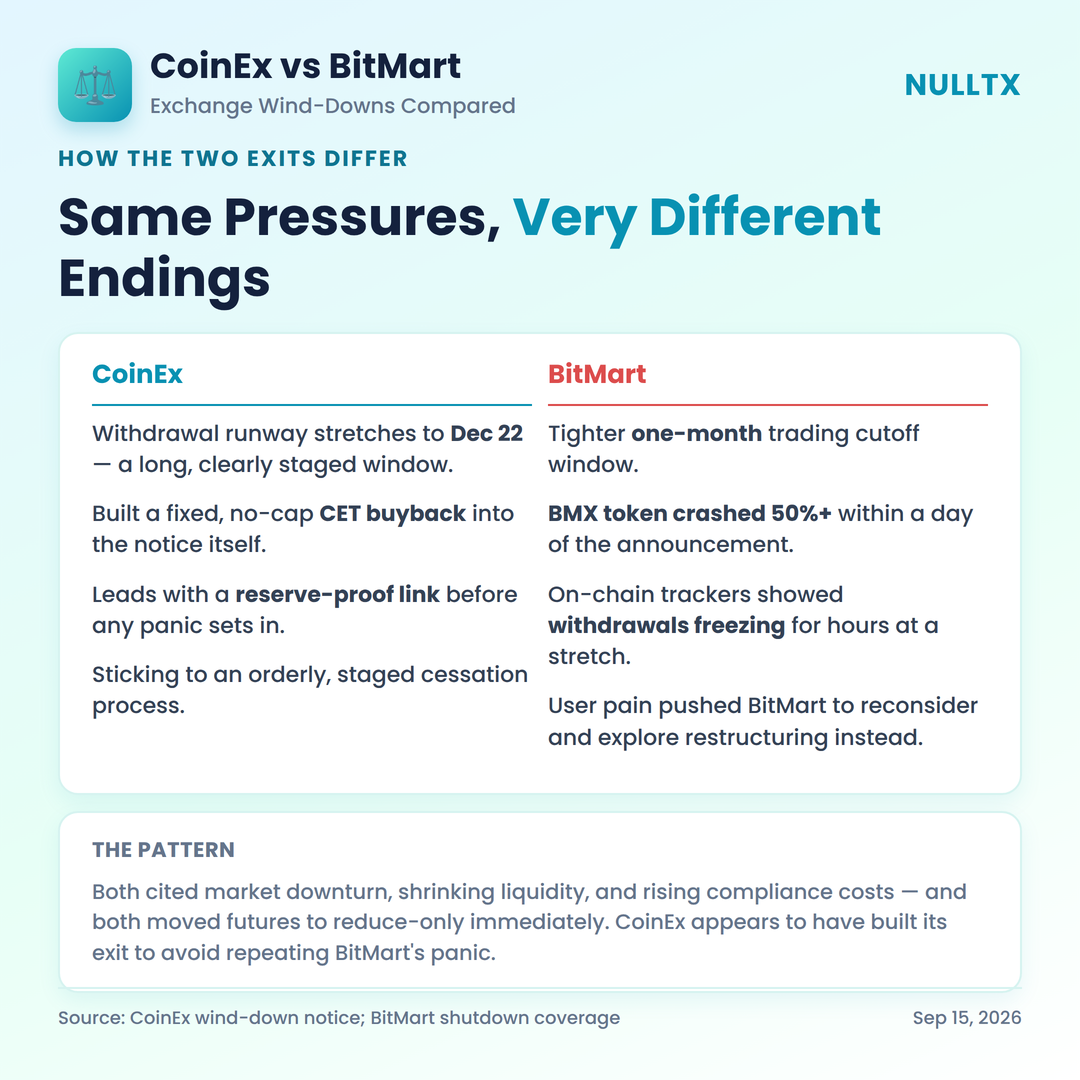
CoinEx built a fixed, no-cap buyback for CET directly into its own notice before that kind of panic could set in. I think CoinEx watched what happened to BitMart and deliberately built its own exit to avoid repeating it.
I don’t think it’s a coincidence that BitMart, BitMEX, and now CoinEx have all closed within a matter of months. Each one points to the same underlying pressure, a market that’s stopped rewarding mid-tier exchanges enough to justify the compliance burden of operating one.
What I find genuinely different about CoinEx’s version of this story is the tone. It didn’t try to spin nine years into a victory lap, and it didn’t quietly disappear the way some platforms do. It named the hard truth, gave users a long and specific runway to get their funds out, and let its founder say goodbye in his own words instead of a legal team’s. Whether that becomes the new template for how exchanges leave the market, or just one founder’s personal choice, I think it’s worth noticing when a shutdown actually tries to end with some dignity instead of leaving users to figure it out on their own.
Disclosure: This is not trading or investment advice. Always do your research before buying any cryptocurrency or investing in any services. Follow us on X @nulltxnews