Synapse SYN doesn’t fit the usual pattern where weekly triple-digit moves in crypto come with an asterisk attached, a wash-traded chart, a token nobody’s ever heard of, or a Discord rumor with no paper trail.
This is a nine-year-old cross-chain protocol whose engineering team has spent the past year quietly building an on-chain options exchange, and the chart just caught up to what that team has been shipping in public, on the record, almost every week.
Look at the shape of the move itself. SYN spent September 12 through 15 pinned flat around $0.080, barely moving, volume thin. Then, starting around September 16, the chart goes essentially vertical, tagging highs near $0.18 within two days and holding there. That’s the kind of break you get when a market that’s been ignoring a steady drip of real news suddenly re-rates all at once, not a single headline spiking and fading. SYN is currently at $0.1868, market cap $44.23 million, up 3.05% on that metric today. Total supply sits at 250.71 million against a 250 million hard cap, with 236.72 million already circulating, so this move is coming from demand, not a fresh unlock hitting the market.
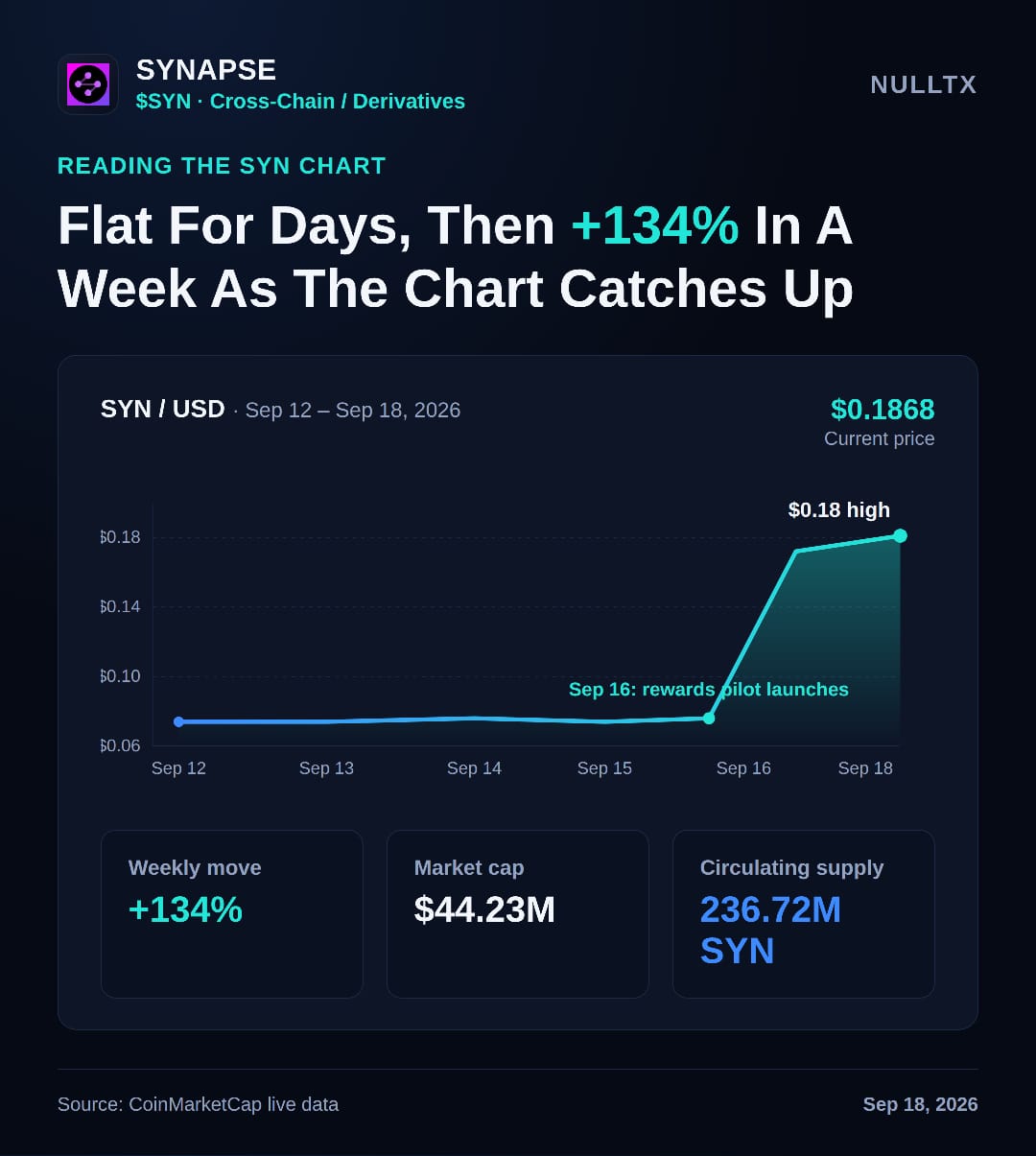
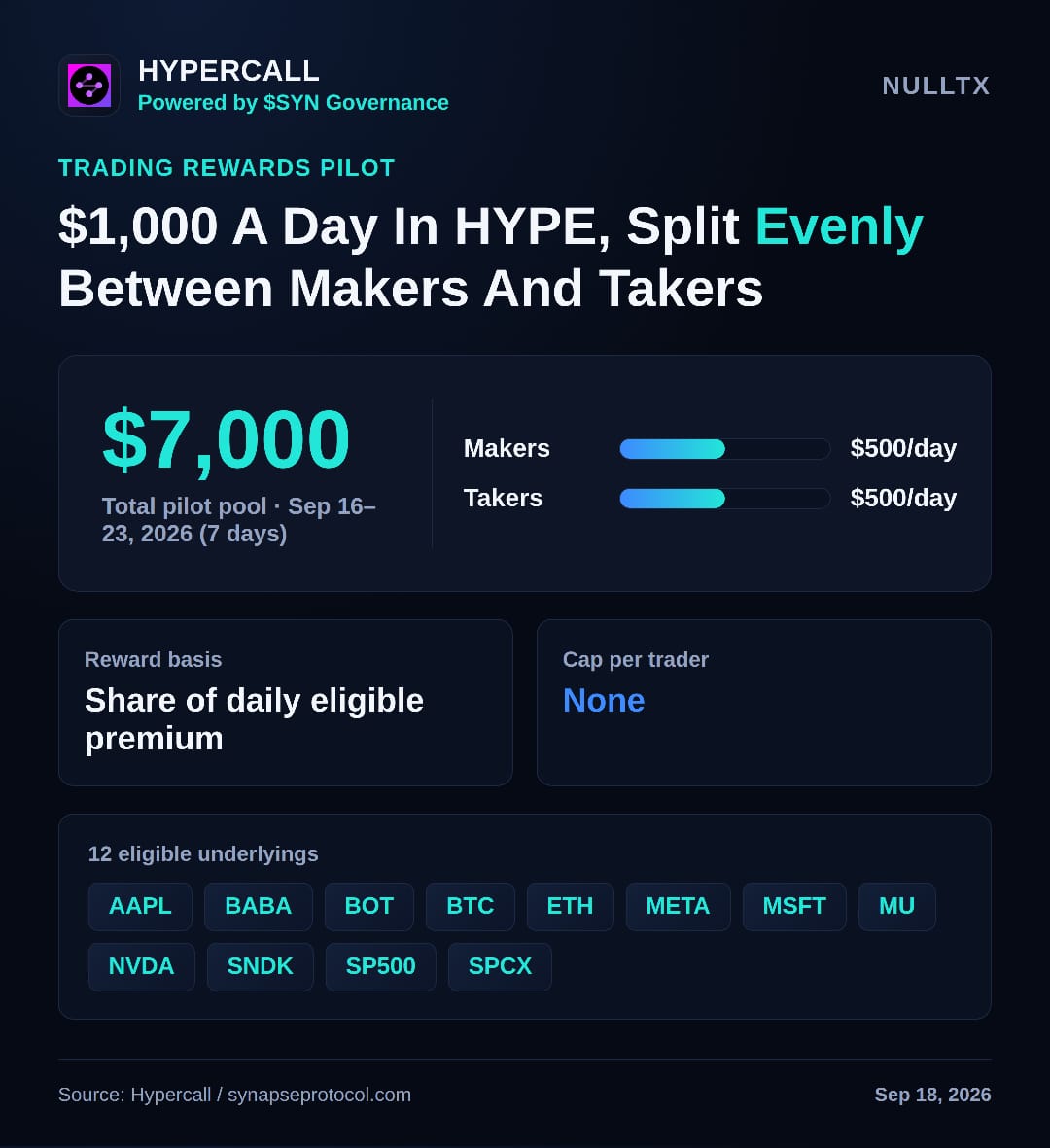
The breakout date isn’t a coincidence. On September 16, Hypercall launched a seven-day trading-rewards pilot, putting $1,000 worth of HYPE a day on the table, split evenly between makers and takers, running through September 23. Your share of each day’s $500 pool tracks your share of that day’s eligible options premium, no cap per trader. Eligible underlyings span AAPL, BABA, BOT, BTC, ETH, META, MSFT, MU, NVDA, SNDK, SP500 and SPCX, which by itself says a lot about how far the product has grown past its original SpaceX-only listing back in June.
The same day, Hypercall also announced it’s integrating Block Scholes volatility-oracle infrastructure, the same derivatives-data provider whose crypto implied-volatility feeds already sit on the Bloomberg Terminal. That’s not a cosmetic partnership. Options need a live read on implied volatility to price correctly, and Block Scholes’ work specifically targets the gap that opens when a tokenized real-world asset keeps trading on-chain after its traditional reference market has closed. It’s the unglamorous plumbing work that doesn’t trend on its own but matters to anyone actually pricing risk on the platform.
Two weeks earlier, on September 3, Hypercall launched Earn, a covered-calls product for xStock holders, backed by a $2,000 Quotrons rewards campaign for early sellers. It’s a firm-quote, physically-settled structure with premium paid upfront, no pooled vault, no oracle dependency.
The team frames it as their first live step toward composable yield on tokenized equities, rolling out while Hyperliquid itself, per a Bloomberg report cited directly in that post, is reportedly in talks with Kraken’s parent company on a US market entry.
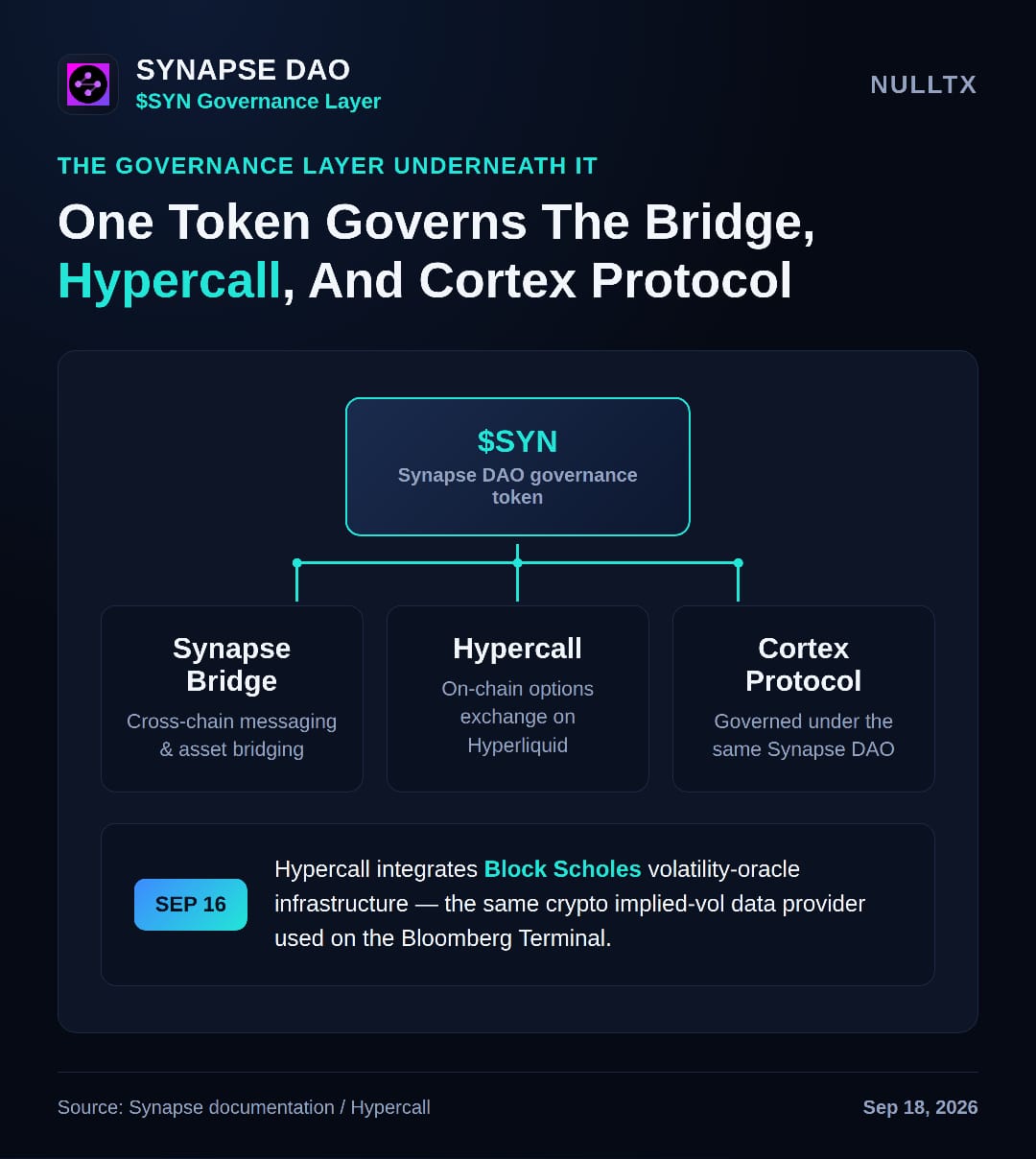
Here’s the piece that separates SYN from a token just riding someone else’s news. Per Synapse’s own documentation, $SYN is the governance token not just for the original cross-chain bridge, but for Hypercall and Cortex Protocol as well, all through the same Synapse DAO. So every product Hypercall ships, the rewards pilot, the Block Scholes integration, the Earn launch, sits under the same governance token that just ripped 134% in a week. That’s a very different setup from a token that’s simply correlated with a hot narrative next door.
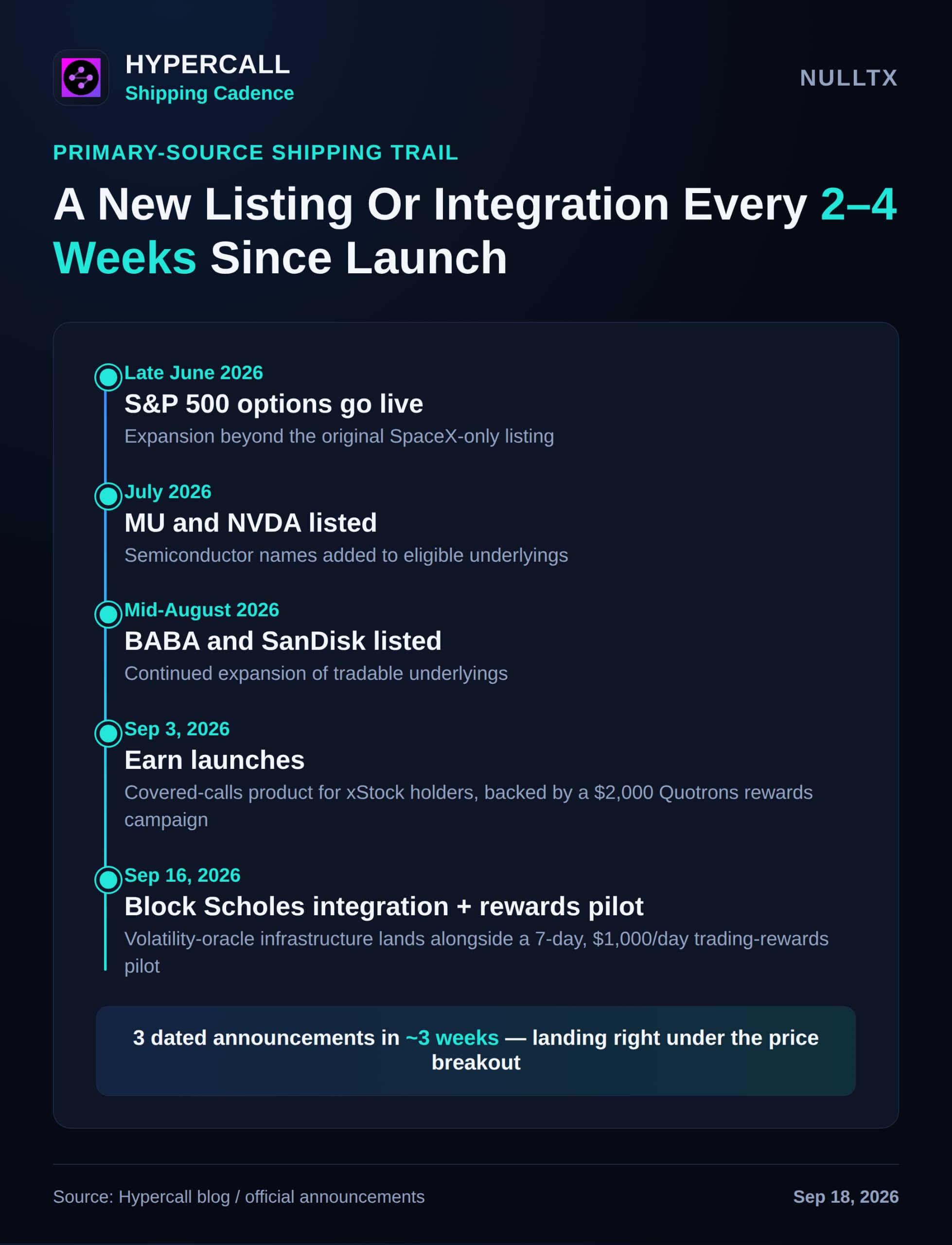
Zoom out further and the shipping cadence holds up. Hypercall’s own blog shows S&P 500 options landing in late June, MU and NVDA in July, BABA and SanDisk in mid-August, then Earn, the Block Scholes integration, and the trading-rewards pilot all inside the first three weeks of September. That’s three dated, primary-source announcements in roughly three weeks, landing right under the price breakout.
I’m not going to pretend a 134% weekly move is something to chase without eyes open, it isn’t. Volume has already cooled by nearly 60% off its peak day, and a 182% volume-to-market-cap ratio on a $44 million cap means moves in either direction from here can be sharp. But the case for SYN right now isn’t built on hope. It’s built on a governance token sitting underneath a derivatives platform that has, by its own dated record, shipped a new listing, product, or integration every two to four weeks since going live, with three of those landing in the same window the chart broke out.
Watch Hypercall’s blog for what ships next, that’s the primary-source trail that tells you whether this is real usage finally getting priced in, or a chart getting ahead of itself.
Figures reflect live CoinMarketCap data as of the morning of September 18, 2026, and will move quickly given current volatility.
Disclosure: This is not trading or investment advice. Always do your research before buying any cryptocurrency or investing in any services. Follow us on X @nulltxnews