
BeInCrypto examined how LBank compares with rival exchanges on trading depth, access to emerging tokens and tokenized products.
Choosing an exchange involves two practical questions: can you trade the asset you want, and how much will the trade cost? LBank’s emphasis on early listings and tokenized products makes both worth examining alongside its established crypto markets.
Our comparisons cover spot markets, where users trade tokens themselves rather than leveraged contracts. An order book lists offers to buy and sell; its midpoint lies halfway between the best buying and selling prices.
We measure displayed depth by adding orders within 2% of that midpoint. More depth can help absorb trades, but a buyer needs available sell orders and a seller needs buy orders.
Our 29 August comparison covered Bitcoin, Ethereum, Solana, XRP, BNB and Dogecoin, each traded against USDT, a stablecoin designed to track the US dollar. We compared LBank with Binance, OKX, Gate, Bitget, MEXC and Bybit.
Across three snapshots, LBank ranked first in five pairs and second in Dogecoin. Its displayed depth exceeded the median, or middle value, of the six rivals on every pair.
Table 1 Major pair comparison
| USDT pair | LBank depth | Strongest rival | Rival depth | Rank |
|---|---|---|---|---|
| BTC | $52.16m | Bitget | $11.79m | 1 of 7 |
| ETH | $25.24m | Bitget | $8.15m | 1 of 7 |
| SOL | $11.10m | Bitget | $10.98m | 1 of 7 |
| XRP | $4.92m | Bitget | $4.36m | 1 of 7 |
| BNB | $11.23m | Bitget | $4.15m | 1 of 7 |
| DOGE | $4.47m | MEXC | $4.51m | 2 of 7 |
Source: Public order books from LBank, Binance, OKX, Gate, Bitget, MEXC and Bybit. Three snapshots, 29 August 2026; first 100 price levels per side; combined depth within 2%. Dollar amounts are approximate USDT values.
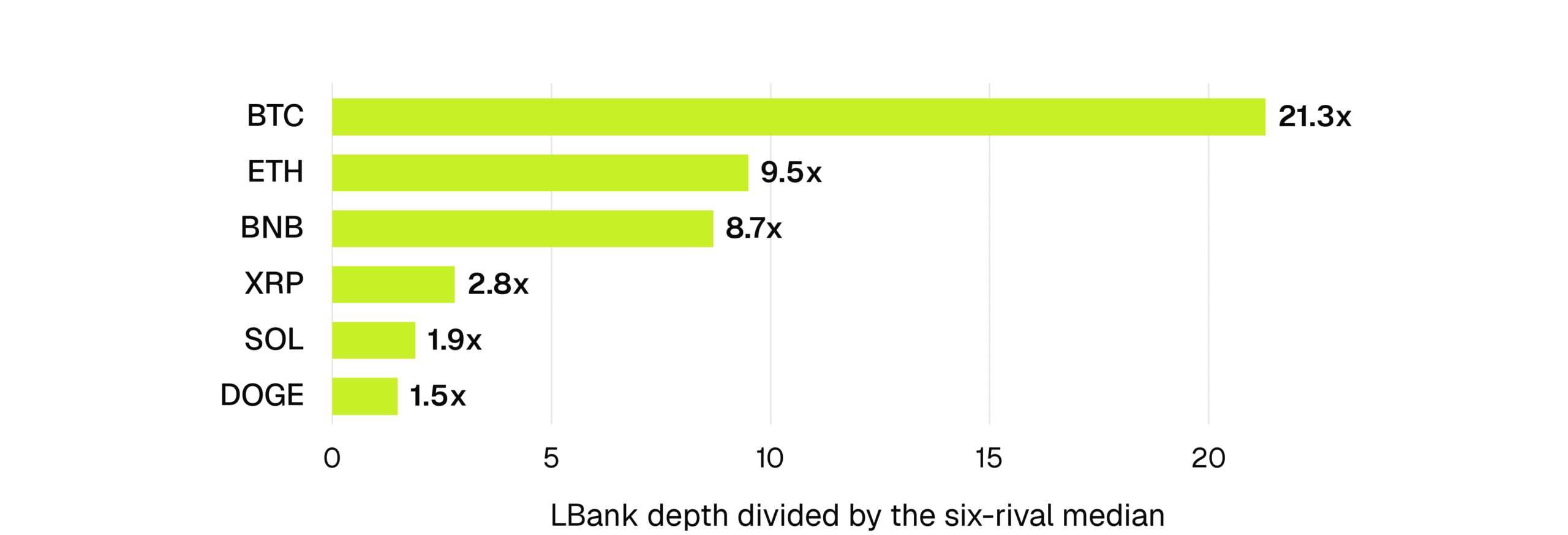
Bitcoin showed the clearest advantage: $52.16 million against Bitget’s $11.79 million, the strongest competing book. Solana was much closer, at $11.10 million against $10.98 million.
The test capped each side at 100 price levels, which can exclude different amounts of depth on different exchanges. Orders can also disappear before a trade executes. These results therefore describe the sampled books, rather than full market capacity or guaranteed execution prices.
| What this means: LBank showed competitive capacity in its core markets, particularly Bitcoin and Ethereum. That gives traders and trading partners a reason to compare its quotes for major assets, while testing the relevant side of the book at their intended order size. |
LBank nominated NIULAI, PONS, Artificial Inu and The Index for a closer look. CoinGecko’s 8 September capture showed large monthly gains in three, while NIULAI fell over the available seven-day window.
Table 2: Price changes in the four nominated tokens
| Asset | 7 days | 30 days |
|---|---|---|
| PONS | +49.47% | +2,226.07% |
| Artificial Inu | +50.12% | +7,921.56% |
| The Index | +23.03% | +212.59% |
| NIULAI | -2.37% | Unavailable |
Source: CoinGecko captures, 8 September 2026: PONS, Artificial Inu, The Index and NIULAI. NIULAI’s 30-day change was unavailable. Selection: LBank, not a representative sample of its listings.
These are changes in token prices, not returns earned by every LBank customer. Entry time, exit price and trading costs determine individual results. Artificial Inu appears as AI on CoinGecko and AI1 on LBank; we matched asset identities rather than relying on symbols alone.
The listing history does support a specific access advantage. LBank scheduled PONS trading for 15 July at 07:00 UTC; Bitget scheduled it for 7 September at 14:00 UTC. LBank’s launch was 54 days and seven hours earlier.
| What this means: LBank offered access to PONS well before that particular rival, giving users an earlier opportunity to trade it. The evidence does not establish a worldwide first listing, typical customer profits or consistently successful token selection. |
The next question is whether traders could transact at the prices they saw. Three direct order-book captures per comparison on 8 September found much less nearby depth for several nominated tokens.
Table 3 Nearby depth in the same smaller tokens
| Asset | LBank depth | Matched rival | Rival depth |
|---|---|---|---|
| NIULAI | $82 | Gate | $17,011 |
| PONS | $288 | Gate | $113,214 |
| Artificial Inu | $5,792 | Gate | $2,660 |
| The Index | $9 | MEXC | $1,194 |
Source: BeInCrypto direct exchange captures, 8 September 2026. Median combined buy and sell depth within 2%; approximate dollars from USDT values. AI1 uses the later matched LBank and Gate capture; Gate names the same token AINVDA.
PONS illustrates the difference between an attractive quote and enough orders behind it. LBank’s spread, the gap between its best buying and selling prices, was only 0.011%, narrower than Gate’s 0.081%. Yet a simulated $1,000 purchase on the captured LBank book paid an average 2.23% above the midpoint, against 0.06% on Gate.
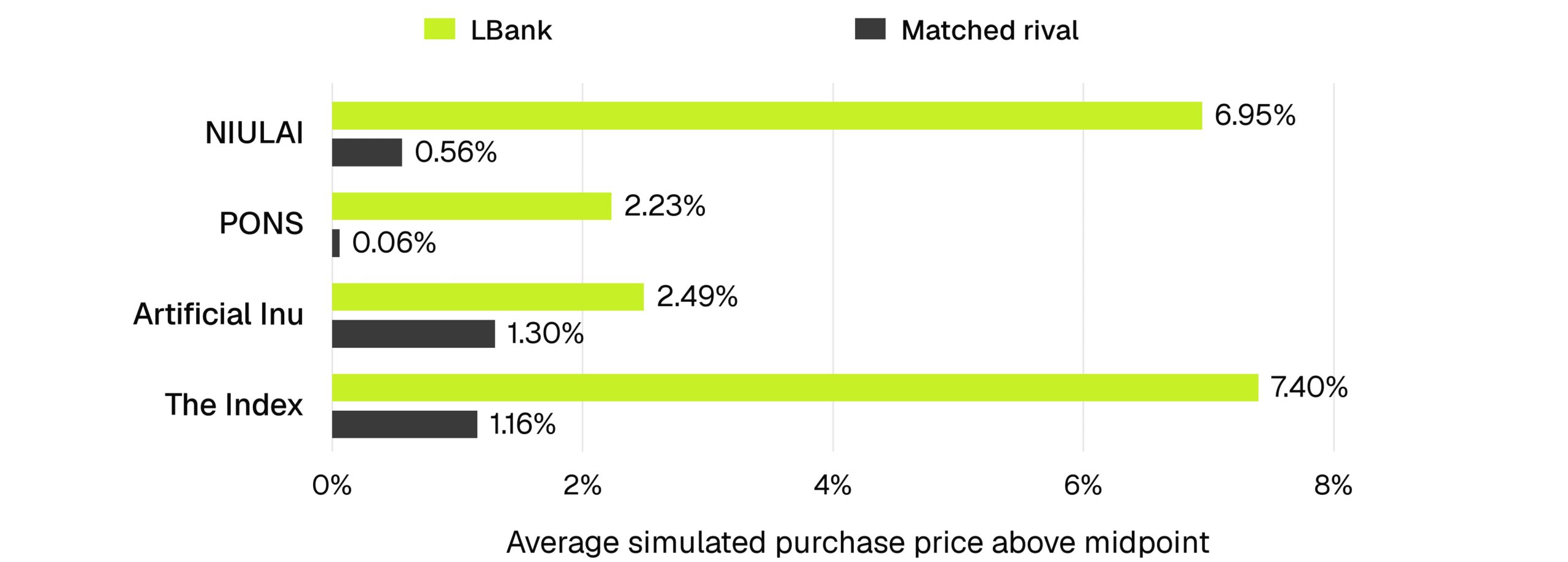
Source: Median simulated buying premium across three captures per comparison. Rivals: Gate for NIULAI, PONS and Artificial Inu; MEXC for The Index. No trades were placed. Calculations use displayed sell orders and exclude fees, delays, cancellations and new orders.
Artificial Inu needs a further distinction. LBank had more combined depth than Gate in the matched capture, but only about $96 consisted of sell orders, against Gate’s $1,396. Most of LBank’s depth was buying interest, offering little help to someone buying the token.
Its combined depth had also risen sharply between capture rounds. That change shows why a single snapshot cannot establish persistent liquidity.
| What this means: Early access did not consistently translate into capacity for larger purchases. The simulations show why retail users need to inspect sell orders before buying; for listing partners, the weakness is the amount and balance of available liquidity, not simply the number of tokens offered. |
LBank offers tokenized products across bStocks, Ondo and xStocks. Our 8 September CoinGecko screen covered 22 selected products across those three families.
Tokenized products provide exposure linked to an underlying asset through a digital token. Two tokens referencing the same company can have different issuers and terms, so we compared the exact product and USDT spot pair across exchanges.
Table 4: Reported activity across the selected tokenized basket
| Product family | Products | 24h volume | Basket share |
|---|---|---|---|
| bStocks | 8 | $14.39m | 63.91% |
| Ondo | 6 | $4.43m | 19.67% |
| xStocks | 8 | $3.70m | 16.42% |
| Total | 22 | $22.51m | 100% |
Source: CoinGecko ticker captures, 8 September 2026; selected LBank basket. Totals use unrounded figures. Share means share of this basket’s reported volume, not global market share. Ticker data and depth fields.
The basket covered eight reference names: Apple, Amazon, Circle, Nvidia, Robinhood, Tesla, SK Hynix and SpaceX. Including SK Hynix and SpaceX-linked products takes the comparison beyond ordinary US-listed shares. This is a selected product sample, not a measure of the whole US stock market.
xStocks represented just 16.42% of the basket’s $22.51 million in reported daily trading. The broader total reflects added product coverage, not evidence of a sudden increase in activity.
We also checked six overlapping xStocks pairs against completed one-minute trading records over nearly aligned 24-hour windows. CoinGecko showed $2.61 million; the reconstruction gave $2.64 million, 1.08% higher. Valuing the reconstructed quantities at CoinGecko’s latest prices narrowed the gap to 0.07%, suggesting pricing explains most of the difference.
Both calculations ultimately use exchange-reported activity. Agreement supports consistency between the two methods, but does not independently audit the trades.
| What this means: bStocks contributed almost two-thirds of this sample’s reported activity, so an xStocks-only view would miss much of the trading covered here. Traders and partners should assess each product’s liquidity and terms separately. |
LBank led nine of the 22 exact-product depth comparisons. Its two largest leads over the strongest available rivals were HOODON and HOODX, two different products linked to Robinhood shares.
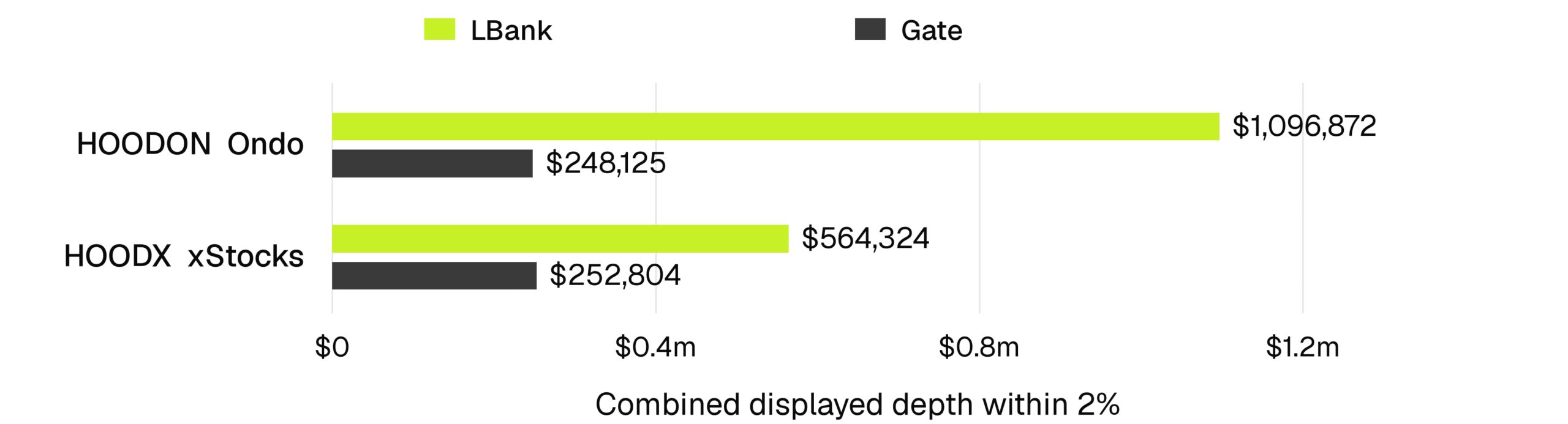
Source: CoinGecko, 8 September 2026. Combined upward and downward 2% depth; Gate was the strongest valid matched rival in both cases. Four valid venues, including LBank, returned for each product.
HOODON held $1,096,872 on LBank against Gate’s $248,125, a 4.42-fold difference. HOODX held $564,324 against $252,804, or 2.23 times as much. Both reference Robinhood, so these are two product strengths tied to one company.
Table 5: Other product comparisons show where the result changes
| Product | Family | LBank depth | Strongest rival | Rival depth |
|---|---|---|---|---|
| HOODB | bStocks | $613,791 | Binance | $499,816 |
| TSLAB | bStocks | $548,588 | Binance | $927,889 |
| NVDAX | xStocks | $881,259 | Gate | $597,711 |
| NVDAON | Ondo | $312,474 | MEXC | $885,850 |
Source: Selected examples from the 22-product CoinGecko capture, 8 September 2026. Each row compares the same token against USDT. Product sources: HOODB, TSLAB, NVDAX, NVDAON.
Results also varied across issuers. LBank led 9 of the 22 tokenized-product depth comparisons in the September 8 snapshot: four of eight bStocks products, four of seven xStocks products and one of seven Ondo products.
The table below lists every product where LBank led. Each comparison matches the same token and USDT trading pair against the strongest qualifying rival. Depth measures the combined value of buy and sell orders within 2% of the market midpoint.
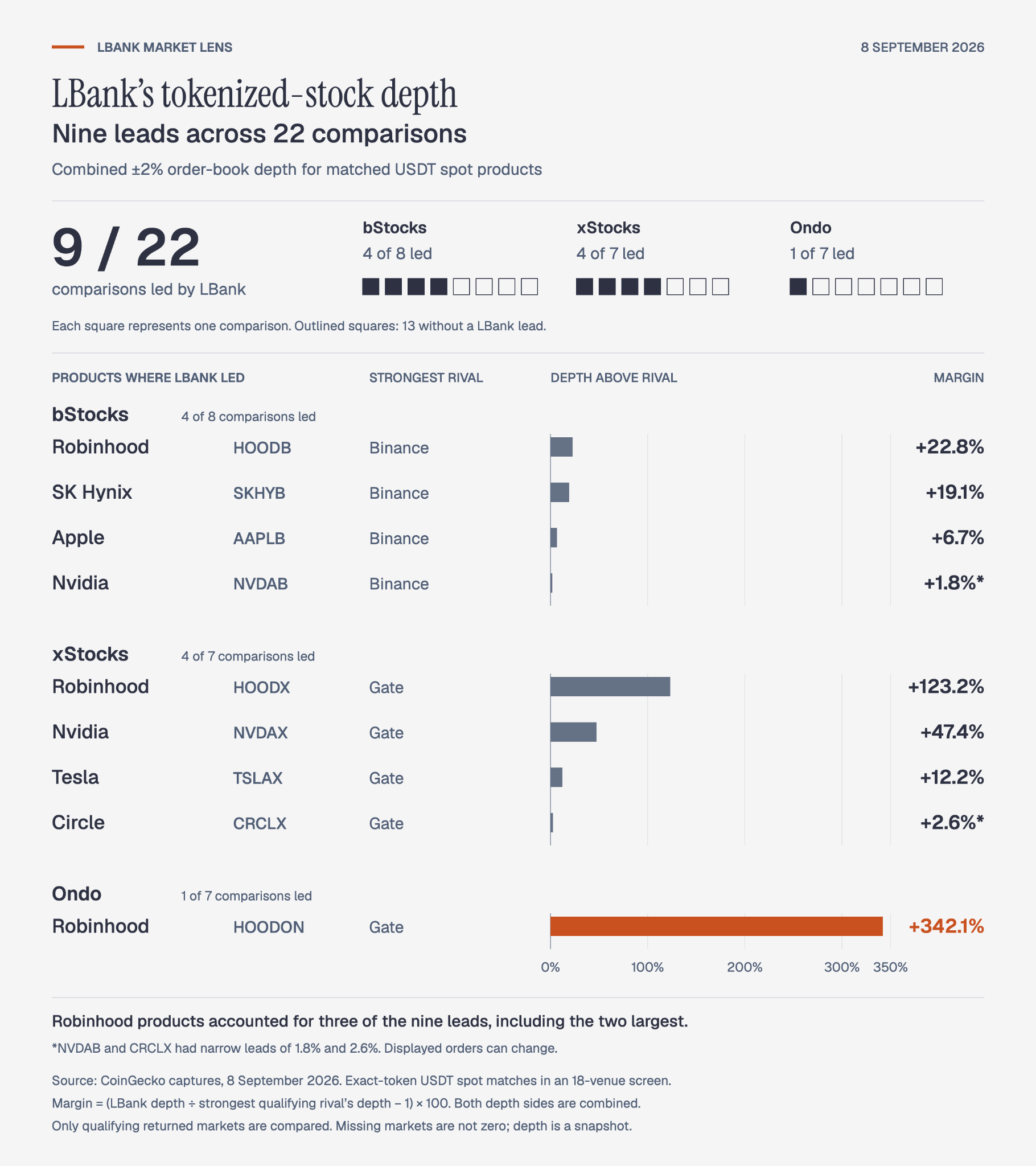
Robinhood stood out across all three product families, accounting for three of LBank’s nine leads. HOODON held 4.42 times Gate’s displayed depth, while HOODX held 2.23 times as much—the two largest percentage advantages in the sample. HOODB also exceeded Binance’s depth by 22.8%.
The other leads ranged from 1.8% for Nvidia’s bStocks product to 47.4% for Nvidia’s xStocks product. The narrow advantages in NVDAB and CRCLX could reverse with relatively small changes in displayed orders.
These rankings cover valid returned matches in an 18-exchange screen. Missing markets were not counted as zero, and the number of qualifying rivals differed by product.
| What this means: LBank’s strongest result was the consistency of its Robinhood lead across three separate tokenized products. Its other wins give traders and partners a wider set of markets to consider. These books showed more combined buying and selling interest near the market price than their strongest qualifying rivals, although actual execution still depends on order size, the side of the book and whether those orders remain available. |
LBank supplied evidence of security controls and external partnerships that deserves consideration alongside trading performance. The sources establish different things, from a certificate’s stated scope to announced testing arrangements.
Table 6: What the security evidence supports
| Evidence | Documented scope | Limit of the evidence |
|---|---|---|
| ISO/IEC 27001:2022 | LBK EXCHANGE FZE; platform, infrastructure, applications and AWS security management. Stated validity 13 Feb 2026 to 12 Feb 2029, subject to periodic audits. | Names Prescient Security LLC as issuer. Issuer confirmation remained incomplete in this review. |
| Elliptic | Provider confirms transaction and wallet screening and fund tracing. | Partnership announcement; no measured control outcomes. |
| CertiK | LBank announces simulated attack testing and rewards for finding vulnerabilities, 10 Aug 2026. | Announcement does not establish completed tests or fixes. |
Source: Certificate supplied by LBank and reviewed 1 September 2026; Elliptic announcement; LBank CertiK announcement. Elliptic’s page is dated 12 March 2025.
LBank also told BeInCrypto that SlowMist joined its security initiative. This review did not independently confirm that participation or its scope.
Access depends on jurisdiction as well as technical controls. Historical notices from Japan’s FSA on 14 June 2024, Spain’s CNMV on 9 September 2024 and India’s FIU on 1 October 2025 addressed registration or compliance. Those records alone do not determine today’s legal status.
| What this means: The documentation gives users and partners specific controls to investigate. It does not measure how reliably every control operates, guarantee protection from breaches or replace checking the legal entity and permissions relevant to a user’s country. |
Table 7: Research scope and dates
| Test | Capture date | Basis |
|---|---|---|
| Major pairs | 29 Aug 2026 | Seven exchanges; three snapshots; first 100 levels per side. |
| Nominated tokens | 8 Sep 2026 | CoinGecko prices; listing notices; three direct books per comparison. |
| Tokenized products | 8 Sep 2026 | 22 products; 18-venue screen; exact USDT spot matches; stale or anomalous rows excluded. |
| Volume check | 8 Sep 2026 | Six xStocks pairs; 1,440 completed one-minute records per pair; nearly aligned windows. |
The observations describe two dated research windows, not live rankings or a controlled before-and-after comparison. Reported turnover is not independently audited. The nominated tokens and selected tokenized basket cannot establish exchange-wide market share or typical investment returns.
Public wallet trackers cover different address sets, and no complete current reserve package was supplied in the reviewed material. This study therefore cannot establish whether assets cover everything owed to customers; that does not demonstrate a shortfall. Verification requires dated assets and liabilities, a way for customers to check inclusion, and a defined independent review.
What this means: The findings support comparisons of specific markets and documented arrangements. They cannot establish the exchange’s overall financial condition or guarantee what a future trade will cost.
Table 8: Where the evidence is strongest
| Use case | Finding | Condition |
|---|---|---|
| Major crypto trades | Led five of six sampled books | Depth must persist until execution. |
| New token access | PONS available earlier than Bitget | Large gains did not ensure deep sell books. |
| Tokenized products | Led nine of 22 comparisons | Choose the exact issuer and pair. |
LBank’s strongest evidence concerns its major crypto markets and selected tokenized products. The sampled Bitcoin and Ethereum books compared favourably with large rivals, and the Robinhood-linked products showed substantial depth advantages. Its earlier PONS listing adds a separate benefit for traders seeking new assets.
The smaller-token tests qualify that case. Access to a rising asset can coexist with a thin sell book, making a larger purchase more expensive than the headline quote suggests. LBank has demonstrated reasons to consider individual markets; this research does not establish consistent leadership across its full catalogue.
For a retail trader, the practical conclusion is to compare the exact token, the relevant side of its book and the intended order size before choosing a venue. For partners, the strongest next test is whether LBank sustains the observed depth and delivers comparable execution over time.
The post LBank Market Depth: How It Compares With Six Major Crypto Exchanges appeared first on BeInCrypto.



It’s BloFin’s third anniversary, and to celebrate, the exchange has launched a month-long campaign offering traders a share of a prize pool totaling an extraordinary
In a crypto landscape still dominated by fragmented liquidity, opaque matching engines, and bridges that introduce risk and complexity, a new platform has emerged with
There is a particular frustration familiar to anyone holding stablecoins. The balance sits in the app. It is dollar-denominated, it is liquid, and it is
TL;DR US spot Ethereum ETFs recorded $270.0 million of net inflows for the September 21 session. BlackRock’s ETHA led the day with $110.0 million, while