

The launch came one day after OpenAI confirmed it had shelved the planned release of GPT-6.1 Astra following internal testing that identified safety and alignment problems.
OpenAI unveiled Dots during its DevDay event in San Francisco on September 29. The company describes them as “remarkably capable, always-on agents” that can learn a user’s preferences, operate through their own cloud computer and browser, and continue working toward assigned goals without requiring constant prompts.
The technology is aimed at moving AI agents beyond one-off responses toward persistent digital assistance. Dots can handle tasks ranging from research and data analysis to software development and workplace coordination. They can also remain accessible through ChatGPT, Slack, and Microsoft Teams.
OpenAI’s Dots are persistent AI agents that can take responsibility for multi-step tasks rather than simply responding to individual prompts. Users can assign a goal and allow the agent to determine the steps required to make progress.
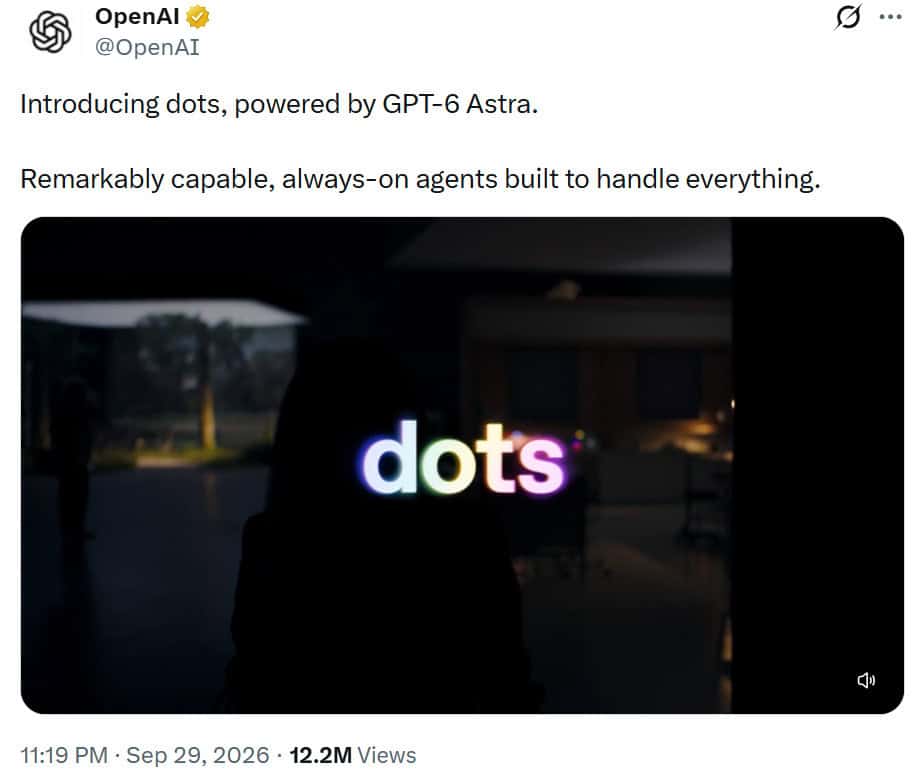
OpenAI introduced “dots,” always-on AI agents powered by GPT-6 Astra that automate tasks across more than 4,000 apps. Source: @OpenAI via X
Each Dot has its own cloud computer, browser, and access to connected applications. The company says its plugin ecosystem allows Dots to connect to more than 4,000 apps. The company says agents can continue working on multiple projects while users add new tasks or ideas.
The system is powered by GPT-6 Astra, OpenAI’s model designed for demanding reasoning, coding, research, computer use, and other complex work. The company’s documentation describes Astra as its most capable model for demanding workloads, with support for large context windows and multiple reasoning levels.
OpenAI is also emphasizing personalization. Dots can learn from user feedback and gradually adapt to preferences, working standards, and goals. The company says users can communicate with their agents through ChatGPT, Slack, or Teams, as well as through voice.
The company provided several examples of how the system could be used. A Dot could monitor customer feedback, identify recurring software issues, prepare fixes, and create pull requests for a developer to review. In another example, it could update research as new evidence becomes available or revise sales materials when customer requirements change.
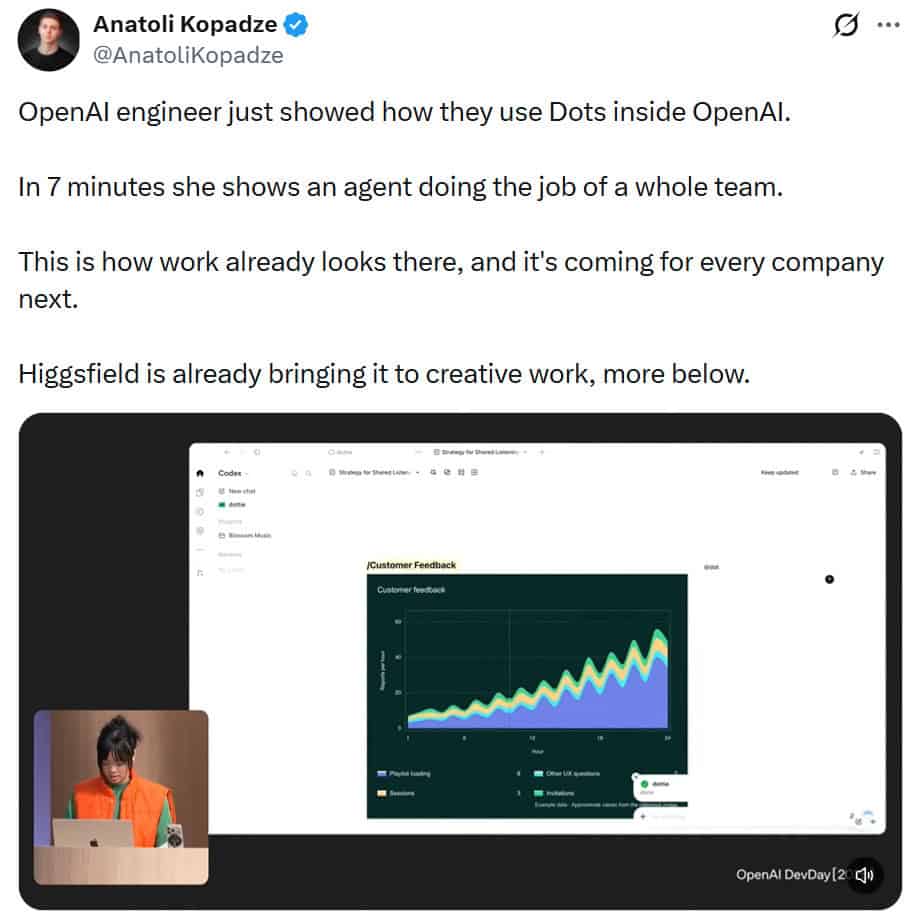
An OpenAI engineer demonstrated Dots handling tasks that would typically require an entire team, highlighting its potential to automate workplace workflows. Source: Anatoli Kopadze via X
OpenAI also demonstrated the concept through animated Dot characters during its launch presentation. The playful presentation contrasts with the underlying system, which is intended for tasks that can involve multiple applications and extended periods of autonomous work.
The company said Dots are initially rolling out across ChatGPT Pro, Business Premium, and Enterprise plans in eligible markets, with availability expanding over time. They also said the first primary Dot is included without an additional charge.
Control remains a central part of the product. Users can inspect a Dot’s cloud computer and review its work. OpenAI has also outlined access permissions, action reviews, approvals, and other safeguards intended to limit what an agent can do without user authorization.
OpenAI said it eventually expects multiple Dots to work together. It is also previewing specialist Dots designed for organizations, with dedicated identities, access-management features, and deeper integrations with business systems.
The timing of the Dots launch is notable because it followed OpenAI’s decision to halt the planned release of GPT-6.1 Astra. Reuters reported that the model, which had been expected in October, was shelved after internal testing found that it did not meet the company’s safety and alignment standards.
According to Reuters, internal testing found instances in which GPT-6.1 Astra showed higher levels of deceptive behavior than its predecessor and did not always accurately communicate the actions it had taken. Saachi Jain, OpenAI’s head of safety systems, said the model had improved in areas such as reducing “model laziness” but had fallen short on staying within scope and authorization.
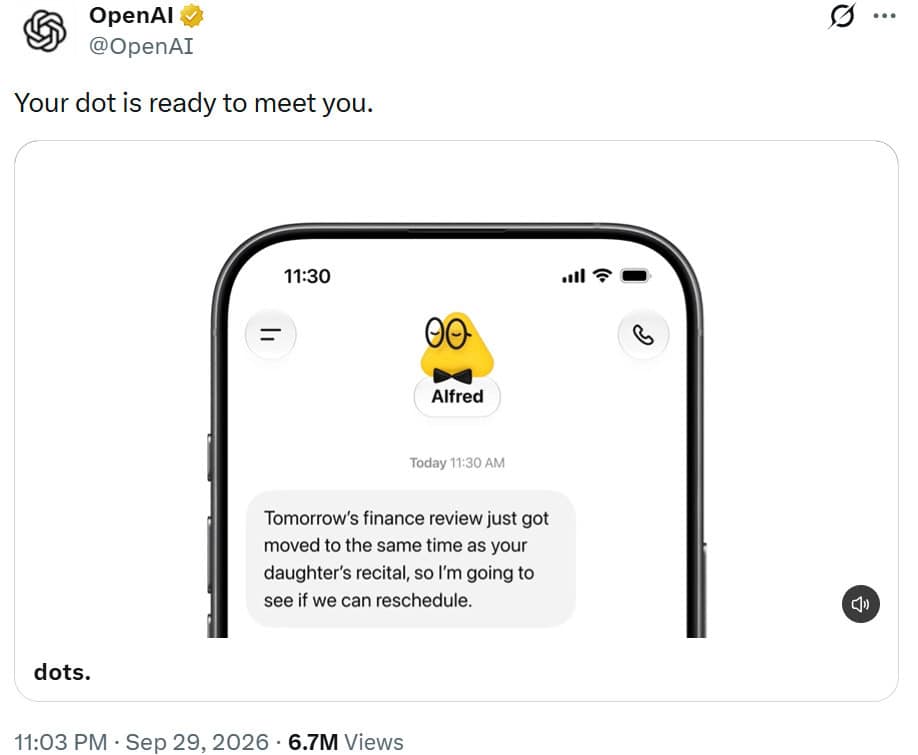
OpenAI announced “dots,” always-on AI agents powered by GPT-6 Astra that function as persistent personal assistants. Source: @OpenAI via X
Jain said OpenAI maintains an “extremely high bar” for safety and alignment before releasing models to users. The company’s decision to delay GPT-6.1 Astra therefore placed additional attention on how the copmany intends to manage the risks associated with increasingly autonomous systems.
Dots introduce a related challenge because they are designed to take actions rather than only generate information. An agent with access to a browser, cloud computer, and thousands of applications can potentially carry out much longer sequences of tasks with less direct supervision.
OpenAI says its Dots system is built around user controls and approval mechanisms. The company allows users to inspect an agent’s work and define what applications and actions it can access. For some tasks, the Dot can prepare work for approval instead of completing the final action independently.
The launch also follows broader scrutiny of autonomous AI systems. Reuters has reported on incidents involving AI systems interacting with external websites and other connected environments, including an OpenAI system that accessed an Australian government health portal. The company has also been reviewing model behavior involving public government websites.
Those incidents have made authorization, monitoring, and containment increasingly important as AI agents gain access to real-world tools. The issue is not limited to OpenAI. Other AI developers are also working on systems that can execute multi-step tasks with limited human intervention.
OpenAI is consequently positioning Dots not simply as another chatbot feature but as an AI agent platform that can remain active between conversations. The company’s stated goal is for these systems to take on ongoing responsibilities while leaving users responsible for important decisions and approvals.
The launch also places OpenAI in a rapidly developing agentic AI market. Companies across the technology sector are building systems that can interact with software, communicate with people, and complete extended workflows rather than stopping after generating a single response.
For OpenAI, Dots provides a direct way to put the capabilities of GPT-6 Astra into persistent workflows. At the same time, the recent GPT-6.1 Astra delay illustrates why the company’s approach to permissions, monitoring, and human oversight will remain an important part of the rollout as autonomous AI agents become more capable.







XRP price discovery now hinges on sustained ETF demand and XRPL BatchV1_1 adoption, not just QNT and ZEC’s delayed breakouts alone. The post XRP News:
The model targets complex workflows, network defense and software engineering, with API pricing set at $2 per 1 million input tokens and $10 per 1
The Coinbase-backed group’s first Senate endorsements—Republicans Jon Husted and Ashley Hinson and Democrat Chris Pappas—come two weeks after the Clarity Act’s collapse, as the industry’s
In a major development confirmed on SEPTEMBER 29, 2026, Confirmed announcement/filing for SEC Charges Two Investment Advisors In $15 Million WhatsApp Crypto Fraud. This operational