
The US services prices gauge reached a four-year high in September even as growth slowed, a combination that could keep leveraged Bitcoin positions exposed to restrictive financing conditions. The October 5 survey pairs softer activity with more widespread reports of rising input costs.
The Institute for Supply Management’s services report, issued on its October 5 release date, put the prices index at 74.0, up from 72.6 in August. That was its highest reading since July 2022, when it reached 74.5.
The headline services PMI eased to 54.9 from 55.4, while business activity dropped to 56.5 from 61.7. Both remained above the 50 expansion threshold. Employment moved the other way, rising from 47.8 to 50.1 and returning to slight expansion after two months of contraction.
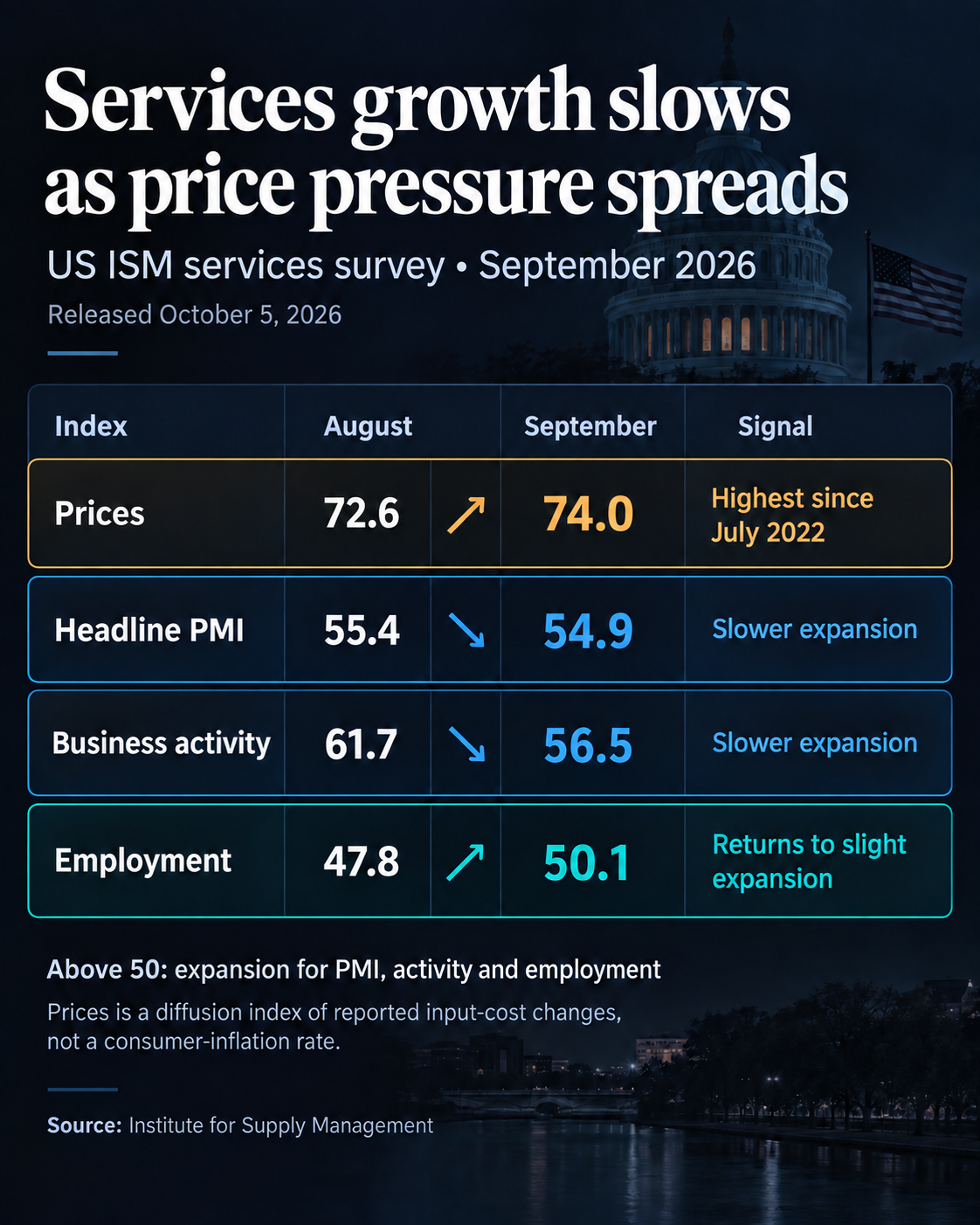
Growth therefore lost momentum while reported input-cost increases became more widespread. ISM’s prices gauge is a diffusion index describing the direction and breadth of monthly input-cost changes across survey respondents. Its 74.0 reading provides no estimate of the size of price increases and cannot be read as a consumer-inflation rate.
Fed Vice Chair Philip Jefferson said on October 1 that inflation risks tilted upward. He also described September’s quarter-point increase in the federal funds target range to 3.75%-4.00% and said future adjustments should depend on the data, outlook and balance of risks.
His remarks preceded the services release. The survey adds cost-pressure evidence to a policy debate already underway. Slower expansion gives investors one part of the picture; rising input-cost pressure keeps the prospect of rate relief uncertain.
For leveraged Bitcoin exposure, the concern is how that uncertainty affects financing and willingness to take risk. If persistent costs make rate relief less likely and investors become more cautious, financing-sensitive positions could face pressure. Leverage would magnify a trader’s losses from an adverse price move: the CFTC explains that margined virtual-currency futures traders can be forced to replenish collateral or close positions when markets move against them.
The Fed’s policy rate and perpetual-futures funding operate differently. Coinbase’s documentation describes funding as payments between long and short positions that help align perpetual prices with spot prices. Bitcoin perpetual funding needs its own market observation; it cannot be inferred from the federal funds target.
Historical evidence also cautions against treating the price connection as automatic. A February 2023 New York Fed study using intraday data found Bitcoin largely disconnected from monetary and macroeconomic news in its sample.
Bitcoin traded near $85,580 on CryptoSlate’s October 6 page, down 0.04% over 24 hours. That rolling change cannot identify a reaction to the ISM release.
The funding-risk case would strengthen if adverse policy or yield repricing coincided with weaker leveraged demand. Easing cost pressure, stable rate expectations or stronger buying without leverage would weaken it. Slower services expansion alone offers little assurance of relief for leveraged Bitcoin positions; the effect on their financing still needs evidence from markets.
The post US services price gauge hits a four-year high, clouding Bitcoin’s rate-relief outlook appeared first on CryptoSlate.






パイト・ネットワークは10月8日にニューヨークで重要なイベント”Prediction Markets Conference”を開催する予定である.ウォール街が予測市場にますます注意を払っているため,この会議は,この分野における重要な洞察と発展を展示するポジションにある.機関ビジネス開発の責任者,マイク・ジェームズは,金融市場が予測モデルにどのように関わるのかという潜在的な変化を指摘し,成長する機関的な関心について議論する. Pyth ネットワークのツイート どう なり まし た か パイスネットワークが主催するニューヨークで開催される予想市場会議は,機関投資家の間で話題を醸し出しつつあります.このイベントでは,主要金融機関がなぜ予測市場に焦点を当てているのかについての議論が行われます.仮想通貨の景色が進化するにつれて,これらの動態を理解することは,市場の発展の次の段階をナビゲートしたいトレーダーにとって重要です. 主要 な 教訓 パイト・ネットワークは10月8日にニューヨークでPrediction Markets Conferenceを開催する. マイク・ジェームズは予測市場に対する機関的な関心について発表する.このイベントは,暗号と伝統的な金融との間のギャップを埋めることを目的としている.参加者は予測市場に関するウォール街の戦略について洞察を得ることができる.これらの市場の未来とその主流金融への統合をめぐる重要な議論が期待されている. 数字 に よる と 現在,より広範な暗号市場は混合信号を反映しており,Pyth Networkの重要な価格動向は報告されていない.しかし,来年開催されるカンファレンスを取り巻く予想は感情の変化を示唆している.機関的なプレーヤーは予測市場に焦点を当てているようで,金融景観のこの革新的なセグメントに対する関心が高まっていることを示唆している.そのような進展が進むにつれて,トレーダーはこれらの議論が市場の動向にどのように影響するかに目を向けなければならない. パイスネットワークは,予測市場領域内で活動し,金融意思決定に不可欠なデータサービスを提供している.この組織は,代替取引戦略を求める機関投資家の間で牽引力を獲得している予測市場の正確性とアクセシビリティを向上させることを目指している.この会議は,この新興傾向の最前線に立っているため,パイスネットワークにとって重要な瞬間を象徴している.
CEO Jed Meyer described a patent-pending custody model that gives members individual ownership of Bitcoin held in a multisignature vault.

The exploit highlights vulnerabilities in decentralized governance, urging tighter controls to prevent concentrated voting power from undermining security. The post Onyx DAO treasury moves 620M

Conduit Technology has sued Tether after the stablecoin issuer froze $2.76 million in the company’s USDT and allegedly kept it locked for more than a