

The decision completes a regulatory process that began with conditional approval in December 2025. The new charter is expected to strengthen federal oversight of RLUSD reserve management and expand Ripple’s capacity to provide digital asset custody services to institutional clients.
Garlinghouse announced the development ahead of Ripple Swell, highlighting the company’s strategy of bringing blockchain-based financial services into established regulatory frameworks. He said the approval gives the company a federally supervised platform to support RLUSD and offer digital asset custody to enterprises.
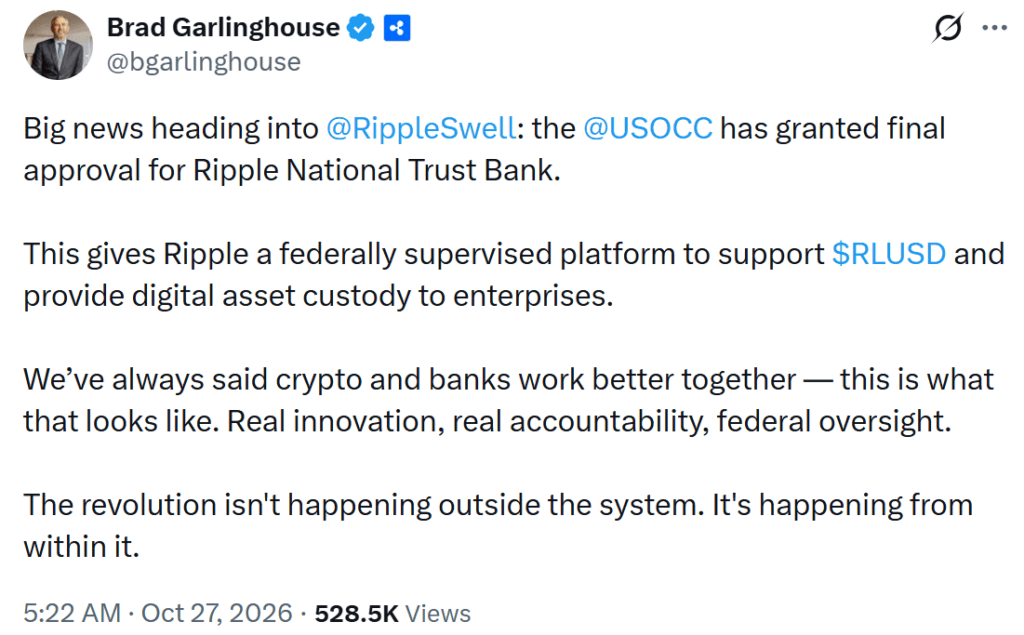
Ripple CEO Brad Garlinghouse announced final OCC approval for Ripple National Trust Bank, enabling federally supervised RLUSD reserves and digital asset custody. Source: Brad Garlinghouse via X
“For years, we’ve said crypto and banks work better together. Final approval for Ripple National Trust Bank is what that looks like in practice,” Garlinghouse said in a company announcement.
He added that the company had spent more than a decade building regulated financial infrastructure for institutional use. According to the CEO, the National Trust Bank charter provides a stronger foundation for the company’s stablecoin, payments, custody, and capital markets operations.
Garlinghouse also framed the decision as evidence that financial innovation can develop within the existing regulatory system. “The revolution isn’t happening outside the system. It’s happening from within it,” he said in his social media announcement.
The final approval follows the OCC’s December 12, 2025, conditional approval of the company’s application to establish the national trust bank. That initial decision required the proposed institution to satisfy additional regulatory and operational conditions before receiving authorization to commence business.
Ripple National Trust Bank is expected to perform several functions related to RLUSD, the company’s U.S. dollar-backed stablecoin. Its approved activities include managing the stablecoin’s segregated reserves, acting as a collateral trustee for the benefit of RLUSD holders, and providing fiduciary digital asset custody services.
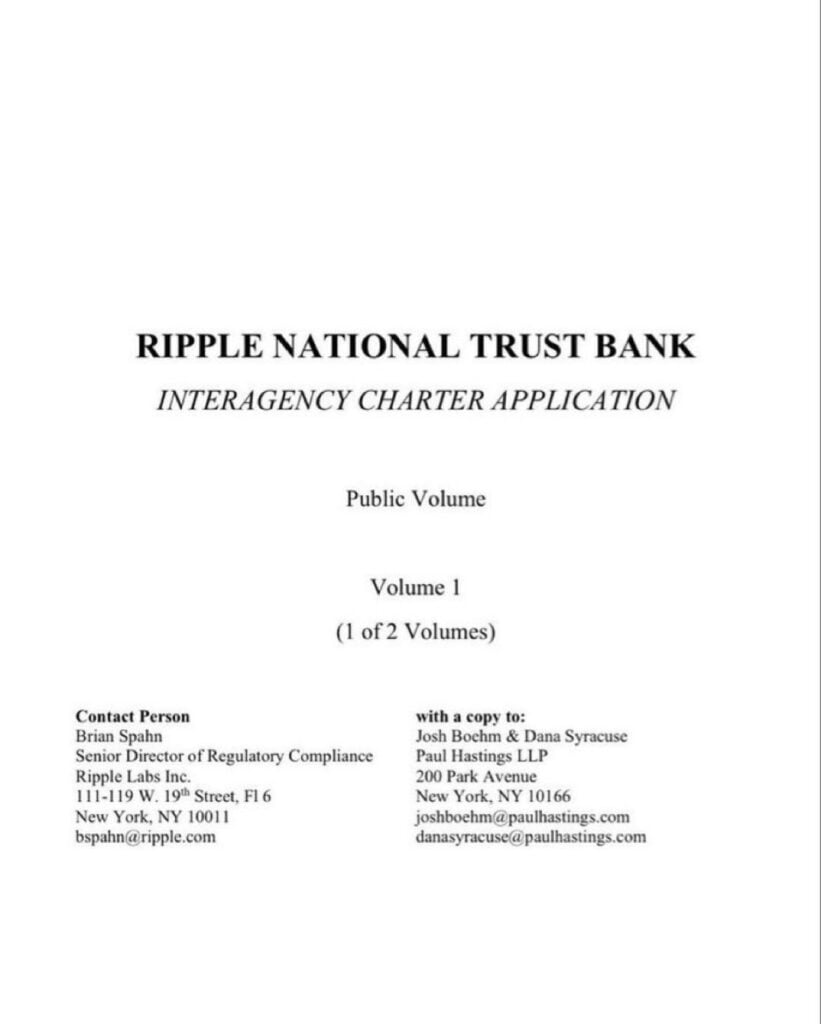
The official cover page of Ripple National Trust Bank’s interagency charter application. Source: @cryptorover via X
The distinction between reserve management and stablecoin issuance is important. RLUSD will continue to be issued by Standard Custody & Trust Company, a limited-purpose trust company regulated by the New York State Department of Financial Services (NYDFS).
The new national trust bank adds a federal supervisory layer through the OCC. This expands the regulatory framework surrounding Ripple’s stablecoin operations while preserving the existing role of its state-regulated issuer.
Ripple has also established reserve reporting practices intended to provide transparency into RLUSD’s backing. The company publishes monthly reports based on independent third-party attestations covering the stablecoin’s circulating supply and reserve assets.
Its transparency dashboard listed approximately $2.38 billion in circulating RLUSD and $2.53 billion in reserve funds as of October 22, 2026. The company’s October 26 announcement described the stablecoin’s market capitalization as approximately $2.5 billion.
The additional oversight does not turn Ripple National Trust Bank into a conventional retail bank. A national trust bank operates under a more limited framework focused on fiduciary and custody activities, rather than ordinary consumer deposit-taking and lending.
Beyond RLUSD, the charter could expand Ripple’s capacity to serve enterprises that need regulated infrastructure for holding and managing digital assets. Banks, investment firms, payment providers, and corporate treasuries may require custody arrangements that fit their compliance, governance, and asset-control requirements.
Once the new bank begins operations, its approved fiduciary custody services will give Ripple another federally supervised offering for institutional customers. These services could complement the company’s existing payments and prime brokerage operations, although the approval itself does not establish new client partnerships or guarantee additional demand.
BNY serves as the primary reserve custodian for RLUSD, according to the company’s announcement. The role of Ripple National Trust Bank in managing segregated reserves would therefore operate within an existing custody arrangement rather than imply that all reserve assets will immediately move to the new institution.
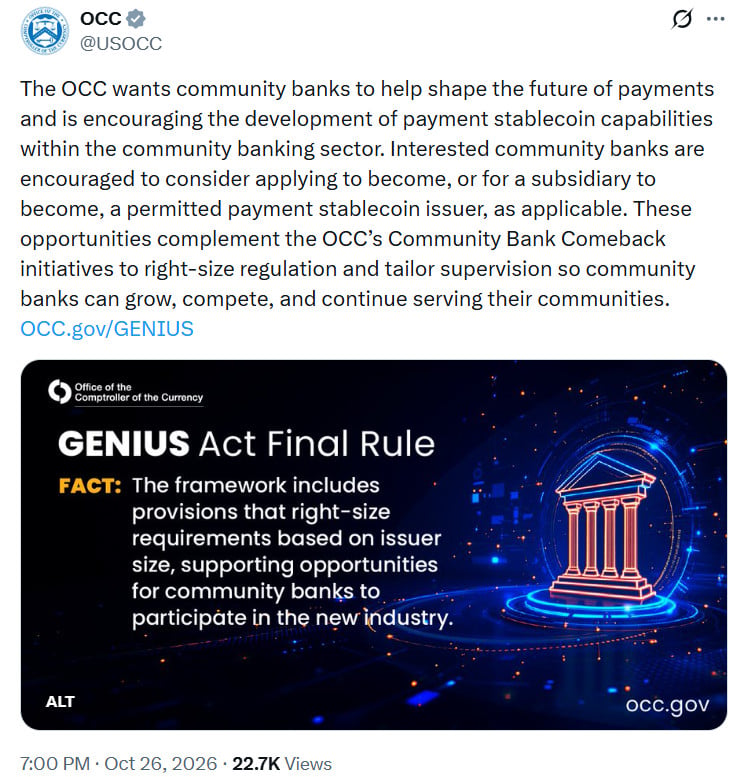
The OCC encourages community banks to apply directly or via subsidiaries to become permitted payment stablecoin issuers under the GENIUS Act to help shape digital payments. Source: OCC via X
The approval also comes amid broader efforts to establish clearer rules for digital assets in the United States. The GENIUS Act, signed into law in July 2025, established a federal framework for payment stablecoins. The development of regulated trust banks represents another part of the evolving relationship between traditional financial institutions and digital asset companies.
Ripple said it would continue working with the OCC, NYDFS, and other regulators as the new institution moves toward operations. The practical impact will depend on how the bank implements its approved activities and how institutional customers adopt its services.
The final charter approval gives Ripple a clearer federal regulatory foundation for its stablecoin and custody businesses. However, its long-term significance will be measured by the bank’s operational readiness, compliance standards, and ability to meet institutional demand within the boundaries of its authorization.