
Key Takeaways:
Bitcoin’s whitepaper was created on October 31st, 2008, marking 18 years in digital asset history. The initial allotment of nine pages of documents to send the funds without any process of money brokering has now become a worldwide network of trillions of dollars’ worth.

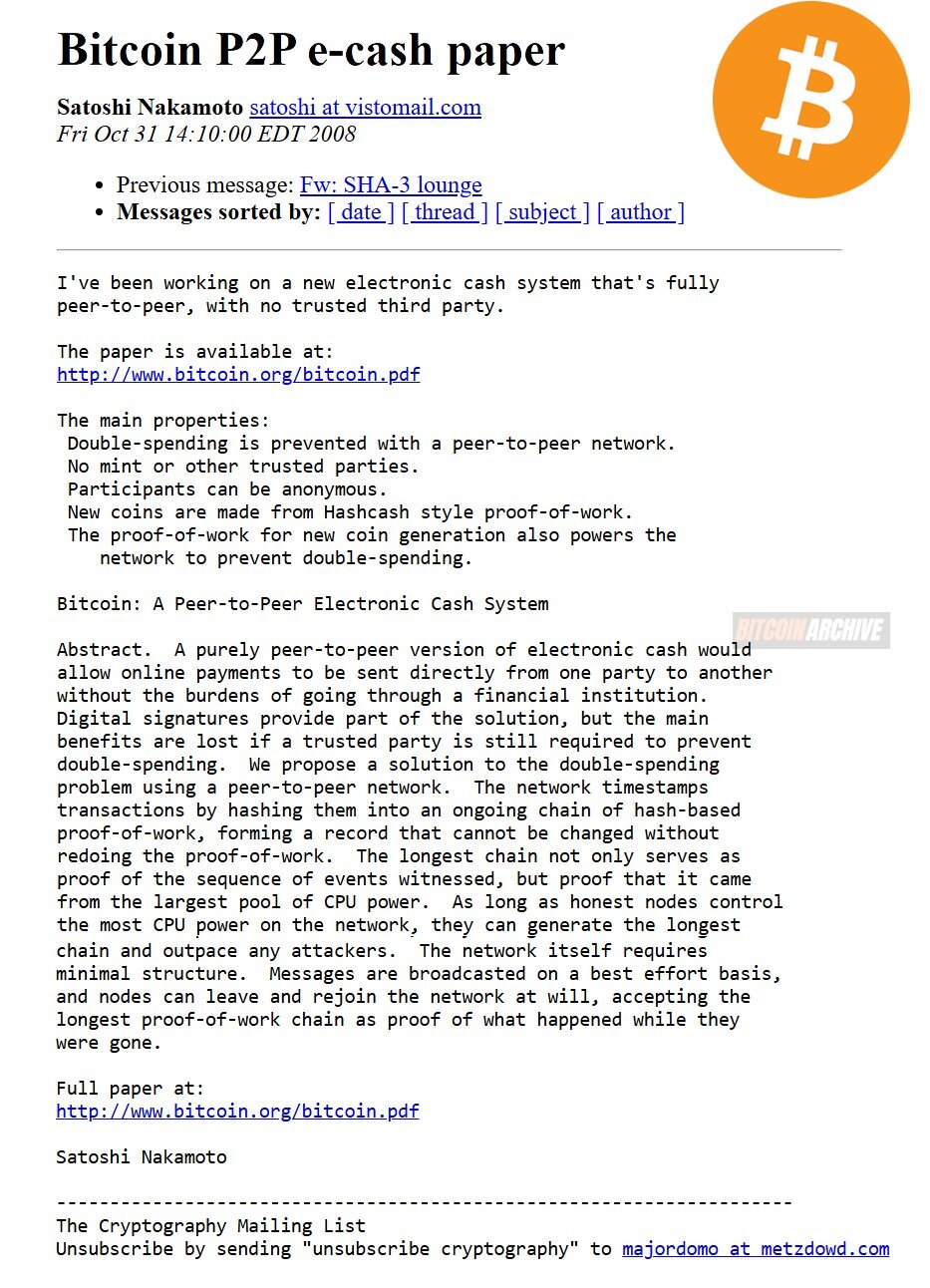
On October 31, 2008, an individual or group using the name Satoshi Nakamoto published Bitcoin: A Peer-to-Peer Electronic Cash System on a cryptography mailing list.
One major problem with online payments was that too often, financial institutions had to confirm the transfers of funds and avoid double spending. Satoshi envisioned a new peer-to-peer system that did not require central control to function: When people make an exchange, the transaction is verified using cryptographic proof, with a shared and publicly visible record containing the transactions.
This design was a distributed ledger plus proof-of-work. The miners confirm transactions, create new blocks, and miners are rewarded with transactions whenever the network follows the longest chain with largest proof-of-work.
On January 3, 2009, the Bitcoin network came into operation by mining the first block. This protocol later comes to be associated with a maximum supply of 21 million BTC and the assets are issued at a predictable time frame.
Read More: Michael Saylor Teases More Bitcoin After Strategy’s $69.45B Reserve Hits 848,250 BTC

The network has since expanded well beyond the realm of cryptography, where the paper first appeared. U.S. spot Bitcoin ETFs launched in January 2024, providing another channel for traditional investors to buy Bitcoin without owning cryptocurrency wallets.
Public companies are also including Bitcoin on their balance sheets. Some other examples include strategy being the largest publicly listed corporate holder and the U.S. government creating a Strategic Bitcoin Reserve in March 2025 using seized Bitcoins.
This represents a significant shift from Bitcoin’s early years, when every Bitcoin was dominated by technology enthusiasts and early adopters.
Bitcoin Archive recently marked the occasion on X with a message celebrating 18 years of Bitcoin and thanking Satoshi Nakamoto. Another aspect of the network’s creation was also touched on in the post, the historic moment.
18 years of Bitcoin.
Thank you, Satoshi — what an incredible journey. https://t.co/DhYNB3SZ9y
— Bitcoin Archive (@BitcoinArchive) October 31, 2026
However, Bitcoin’s original concept has stayed true to its nature, allowing users to make transactions on a public network without a bank or payment company approving it.
Satoshi’s identity remains unknown, and the white paper’s publication began a project that would eventually influence thousands of other digital assets and blockchain networks.
Read More: Coinbase Pro Returns With Deribit, Unlocking $30B in Bitcoin Options Liquidity
The post Bitcoin Whitepaper Turns 18: How Satoshi’s 9-Page Vision Reshaped Global Finance appeared first on CryptoNinjas.






Binance has announced that it has successfully replenished 90% of the assets stolen in a recent security incident. The CEO, Richard Teng, confirmed the exchange’s
DTCC has chosen Canton to facilitate blockchain-based tokenization, a significant move involving major financial players like Nasdaq, CME, and Visa. This collaboration underscores Wall Street’s
Ethereum is currently experiencing significant challenges as ETF investors withdraw from the market. According to a recent tweet from @glassnode, US spot Ethereum ETFs have

Could Ripple-linked XRP be sitting on the brink of a massive supply squeeze? Fresh on-chain data has revealed a striking development: XRP reserves on Binance