
Bitcoin’s march past six figures in 2026 has vindicated a handful of macro analysts who staked their reputations on a bold call years ago. Among them, hedge fund veteran James Lavish stands out for connecting the dots between Trump-era fiscal policy, Federal Reserve capitulation, and Bitcoin’s trajectory toward a new all-time high. His thesis isn’t built on chart patterns or crypto-Twitter hopium: it’s grounded in decades of institutional finance experience and a clear-eyed reading of sovereign debt dynamics. Whether you’re a long-term holder or still skeptical, understanding the logic behind Lavish’s prediction offers a useful lens on where both monetary policy and digital assets are heading through the rest of this cycle.
James Lavish spent three decades managing money across traditional markets: equities, fixed income, derivatives, and macro strategies. He’s not a crypto-native influencer who discovered Bitcoin in a Discord server. His career includes portfolio management at institutional firms where capital preservation and risk-adjusted returns were the only metrics that mattered. That background gives his Bitcoin thesis a different flavor than most. When Lavish argues that Trump’s policies will send Bitcoin to an all-time high, he’s applying the same frameworks he used to trade sovereign debt crises and central bank interventions throughout the 1990s and 2000s.
Lavish co-founded the Bitcoin Opportunity Fund after concluding that traditional hedging instruments, including gold and Treasury Inflation-Protected Securities, were insufficient to protect wealth against the scale of monetary expansion he saw coming. His newsletter, The Informationist, breaks down complex macro topics for a broad audience, but the underlying analysis is institutional-grade. The fund’s thesis centers on Bitcoin as a monetary network with a fixed supply schedule, not a speculative tech bet. That distinction matters because it frames Bitcoin as a response to fiscal reality rather than a bet on adoption curves alone.
Lavish has repeatedly argued that Trump’s return to the White House would accelerate the conditions necessary for Bitcoin to reach new highs. The mechanism is straightforward: political pressure on the Federal Reserve to keep rates low, maintain liquidity, and avoid triggering a recession during a presidency focused on economic growth narratives. Trump’s public criticism of Fed Chair Jerome Powell, combined with the appointment of more dovish board members, has effectively narrowed the Fed’s independence. Lavish sees this as a structural shift, not a temporary blip. A politically captured central bank defaults to printing, and printing is Bitcoin’s best friend.
The second Trump factor is the administration’s sensitivity to consumer sentiment indicators like gas prices and grocery costs. Keeping these low often requires fiscal interventions, subsidies, or strategic petroleum reserve releases that carry their own inflationary consequences down the line. Lavish points out that this creates a feedback loop: suppress visible inflation now, expand the balance sheet later to cover the cost, and watch real purchasing power erode. Equity markets have remained elevated partly because of this dynamic, but Lavish warns that the risk premium is mispriced. Bitcoin, with no earnings to disappoint and no balance sheet to impair, benefits from the same liquidity while sidestepping equity-specific risks.
One of Lavish’s most cited frameworks is the “Four Doors” model for resolving unsustainable sovereign debt. A government facing a debt-to-GDP ratio above 120% has four options: austerity, higher taxes, default, or currency debasement. Austerity is politically impossible in a democracy addicted to entitlement spending. Tax hikes sufficient to close a $2 trillion annual deficit would crush economic activity. Outright default on Treasury obligations would collapse the global financial system. That leaves one door: inflate the debt away by expanding the money supply and allowing real interest rates to go negative. Lavish argues the U.S. walked through that door years ago and is now sprinting down the hallway.
With the U.S. national debt surpassing $37 trillion in early 2026 and annual interest payments exceeding $1.2 trillion, the math is unforgiving. Lavish frames Bitcoin as digital gold: a scarce, portable, divisible asset that cannot be debased by any government. His macro outlook on digital gold positions Bitcoin not as a replacement for the dollar but as an insurance policy against the dollar’s inevitable loss of purchasing power. The fixed supply of 21 million coins stands in stark contrast to a monetary base that has roughly tripled since 2019. For Lavish, this isn’t ideology: it’s arithmetic.
Lavish draws a direct parallel between current conditions and the 2020-2021 liquidity explosion that sent Bitcoin from $5,000 to $69,000. The Fed began cutting rates in late 2024 and has continued a measured easing path into 2026, partly in response to softening labor data and partly under political pressure. Lavish expects this trajectory to steepen, especially if equity volatility picks up heading into midterm positioning. He notes that every major Bitcoin rally has coincided with periods of expanding global liquidity, measured by M2 money supply growth across the Fed, ECB, BOJ, and PBOC. That composite metric has been trending upward since Q3 2025.
Perhaps the most provocative element of Lavish’s thesis involves the growing conversation around Bitcoin as a strategic reserve asset under the Trump administration. Executive orders in early 2025 directed federal agencies to study digital asset reserves, and the creation of a working group on strategic Bitcoin holdings signaled a policy shift that would have been unthinkable four years earlier. Lavish sees this as validation of Bitcoin’s monetary properties at the sovereign level. If even a fraction of U.S. reserves were allocated to Bitcoin, the supply shock would be enormous given the asset’s fixed issuance schedule and the roughly 70% of supply that hasn’t moved in over a year.
On-chain data supports Lavish’s macro thesis with hard numbers. Bitcoin’s hash rate hit record highs in Q1 2026, indicating that miners are investing heavily in infrastructure despite the April 2024 halving reducing block rewards to 3.125 BTC. Illiquid supply, meaning coins held in wallets that have shown no spending history, has climbed to over 15 million BTC. That leaves fewer than 6 million coins in any kind of active circulation, and a significant portion of those sit on exchanges where institutional custody solutions are locking them up for long-term holding. The supply side of the equation is tighter than it has ever been.
The MVRV Z-Score, which compares Bitcoin’s market cap to its realized cap, sat in the mid-cycle range as of early 2026: elevated above the accumulation zone but well below the euphoric peaks that preceded the 2017 and 2021 tops. HODL wave data tells a similar story. Long-term holder cohorts (1-year-plus) continue to grow, while short-term speculative activity remains muted compared to previous cycle peaks. Lavish interprets this as evidence that the market hasn’t yet entered the distribution phase where veteran holders sell into retail mania. The implication: there’s room to run before this cycle exhausts itself.
Bitcoin trading above $100,000 has shifted the psychological landscape for both retail and institutional participants. The six-figure mark, once a meme, now functions as a support level that multiple Wall Street research desks have anchored their models around. Consensus price targets from firms like ARK Invest, Standard Chartered, and Bernstein cluster between $150,000 and $250,000 for this cycle. Lavish’s own range aligns with the higher end, contingent on continued liquidity expansion and no catastrophic geopolitical disruption. The spot Bitcoin ETFs approved in 2024 continue to absorb daily supply at a rate that dwarfs new issuance, creating a structural bid that didn’t exist in previous cycles.
No thesis is without risk, and Lavish acknowledges several. A sudden geopolitical escalation, particularly involving Taiwan or the Middle East, could trigger a risk-off cascade that temporarily crushes all assets, Bitcoin included. Regulatory surprises remain possible: while the U.S. has moved toward a clearer framework, executive action can reverse course quickly. The EU’s MiCA regulations, fully enforced since mid-2025, have created compliance costs that some smaller exchanges struggle to absorb. Timing is the hardest variable. Lavish’s macro setup could take six months or two years to fully play out, and leverage in the system means short-term drawdowns of 30% or more are entirely normal even within a bull market. Investors who size positions based on conviction rather than leverage tend to survive these shakeouts.
The core of Lavish’s argument is simple and hard to refute on the fundamentals: sovereign debt is too large to repay in real terms, debasement is the only politically viable path, and Bitcoin is the only major asset with a supply schedule immune to political interference. Whether Trump’s specific policies accelerate the timeline by months or years is debatable, but the direction of travel is not. For anyone building a long-term portfolio in 2026, understanding this macro framework is more useful than obsessing over any single price target. The signal from on-chain data, institutional flows, and fiscal arithmetic all point the same way. Position accordingly, manage risk honestly, and let the math do the work.
The post James Lavish Says Trump Will Send Bitcoin to ATH appeared first on Coinfomania.








Bitcoin Pizza Day turns dark as BTC and ETH battle USD weakness, ETF outflows grow, while Harvard and Cuban dumped holdings. $BTC $ETH The post
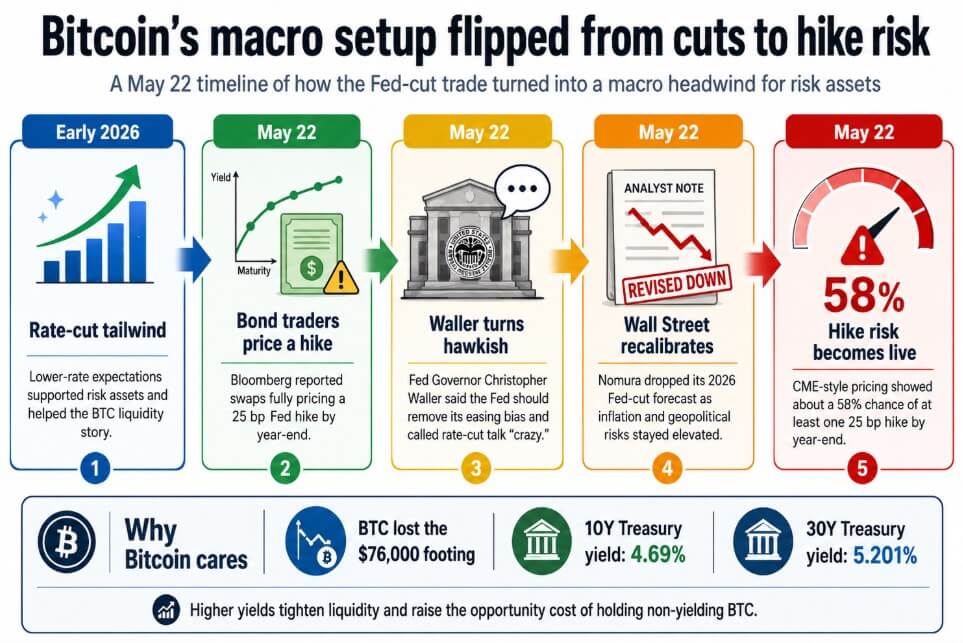
Bloomberg reported on May 22 that bond traders are fully pricing in a Fed interest rate hike by year-end, with interest rate swaps implying the
The use of advanced missiles in Ukraine highlights escalating military tactics, potentially influencing global market stability and investor behavior. The post Russia claims successful strikes
Infinit (IN) surged nearly 10% on Sunday ET as trading activity spiked sharply, pushing the token to the top of Upbit’s investor sentiment rankings and

Blockchain Bodega is here and you know the vibes. We’re at the intersection of hip-hop culture and web3, exploring this new digital frontier. Who better to guide you through these uncharted lanes than Ock Chain – The Bitcoin Boss and the Consensus Corner Boys?
Ock Chain doesn’t just cook up random details about cryptocurrency; he lives it. Ock’s been deep in the game since Bitcoin was just a baby.
And let’s not forget about the Consensus Corner Boys. They’re our skilled crew of blockchain enthusiasts. They’re here to educate, entertain, and enlighten.
Welcome to Blockchain Bodega!
Copyright © 2023 Blockchain Bodega. All rights reserved.