


AI-enabled microbusinesses could provide a major boost for stablecoin transaction volumes as the global gig and freelance payment market grows, according to Australian crypto exchange Swyftx.
In a second-quarter industry report, Swyftx estimated the global gig and freelance payments market could reach $2.1 trillion by 2033, with AI-native workers accounting for $775 billion. Swyftx’s base-case model projected that $262 billion of the AI-native cohort’s payment volume could be settled in stablecoins, based on an assumed adoption rate of roughly 33%.
“We see the vibe-coding and AI economy as a significant potential tailwind for stablecoin use,” Pav Hundal, lead market analyst at Swyftx, told Cointelegraph.
“Adoption doesn’t happen just because the technology exists. It happens when the economics are compelling, and the rules are clear. For stablecoins, both of those conditions are now falling into place.”
Stablecoins, which have doubled in market cap over the past two years and hit a record $1.79 trillion in volume in June, have been a clear indicator of payment utility demand.
Swyftx said that the very smallest firms, those with fewer than five employees, are now among the fastest-moving in AI adoption, and the shift from larger company adoption has produced a new class of solo entrepreneurs.
These solo workers operate across borders, invoice frequently and settle in amounts that the conventional banking system and payment infrastructure were not optimized to handle, it said. They number between six and 10 million globally today but are projected to grow to 17 million over the next decade.
“A lot of these solo founders are going to be sensitive to remittance and transaction fees. It’s a potentially chunky market for stablecoins,” Hundal said.
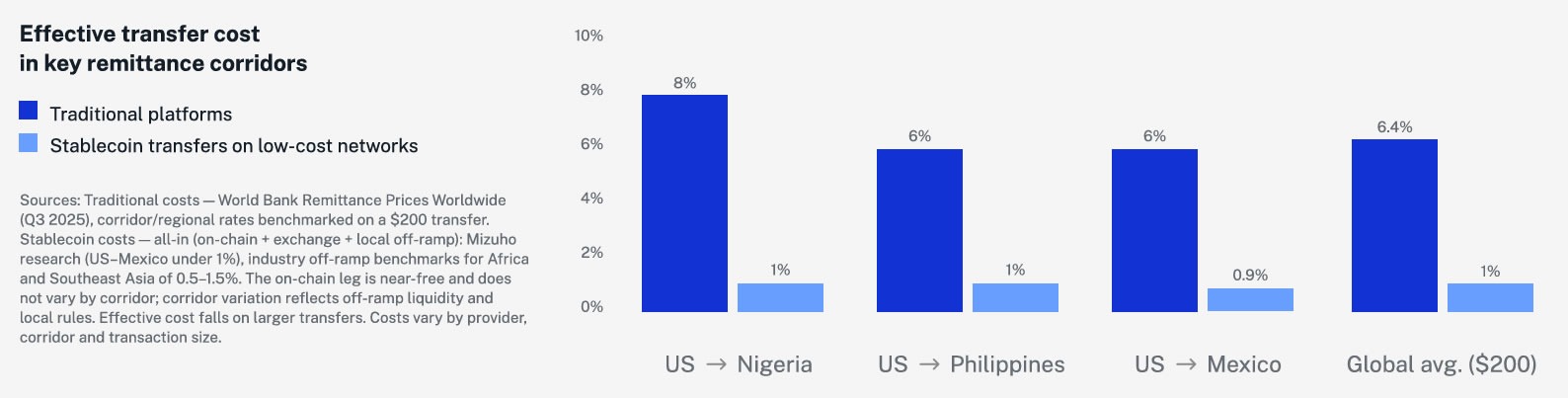
Using stablecoins can save thousands of dollars in annual transfer fees. Source: Swyftx
Swyftx added that if its projections played out, “the institutional settlement layer beneath this — over-the-counter liquidity, custody and yield services for the platforms routing these payments — could capture a significant new revenue stream.”
Related: Stablecoin transaction volume hits record $1.79T in June
This theoretical revenue stream could be as much as $1.3 billion by 2033, assuming total transaction, liquidity and custody costs of 0.5%, it added.
Traditional cross-border rails charge high fees, have multiday settlement windows and exclude users in more than 50 countries.
Stablecoin transfers using Ethereum layer-2 networks can cut those fees by 80% to 90%, saving the average freelancer about 86% per year in transfer fees, Swyftx said in an example.
The agentic AI payment narrative could be another big driver of stablecoin volume, as AI agents cannot get bank accounts, so they will likely use crypto assets for payments.
Features: Robinhood L2 sparks ETH optimism, Saylor ‘muddies waters.’ Hodler’s Digest






The escalating US-Iran conflict in the Strait of Hormuz threatens global maritime stability and could further strain international relations. The post Iran warns ships at
Rising tensions in the Strait of Hormuz could disrupt global shipping routes, heightening geopolitical instability and economic uncertainty. The post Iran warns ships at risk
After a brutal June, Bitcoin (BTC) has started July on a stronger note, climbing about 7% from $58,000 to $64,000 in less than two weeks.
U.S. pressure on Oman complicates Iran’s strategic ambitions, reducing prospects for U.S.-Iran diplomacy and impacting market confidence. The post Iran-Oman Strait of Hormuz talks hindered