






The S&P 500 rose 0.86%, while the Dow Jones Industrial Average advanced 0.78% during the session.
KuCoin has highlighted the rapid rise of the digital credit market, estimating its value at $16 billion. This emerging market could pose a significant challenge
Bankless founder David Hoffman also called a daily close above $87,400 “extremely bullish.”
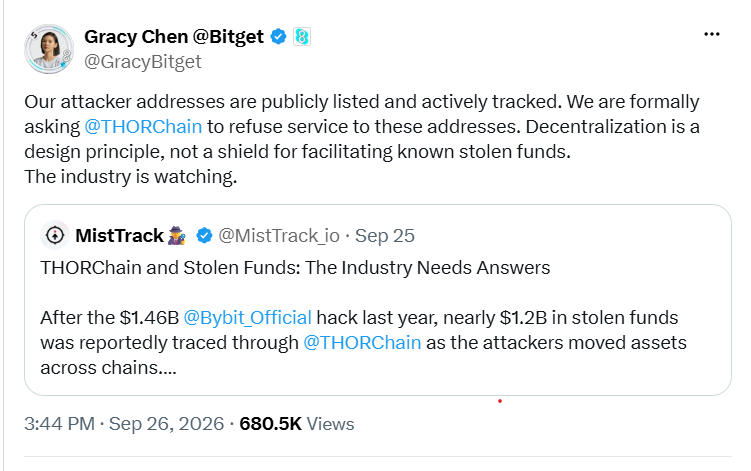
After Bitget got hacked on Sept. 24, $387.5 million of stolen funds quickly began moving across chains, with some headed to decentralized cross chain swaps platform THORChain.Chief executive Gracy Chen publicly appealed to the platform to refuse service to attacker-linked addresses. “The industry is watching,” she said.Yet THORChain refused. And that refusal has kicked off a furious debate between those who believe protocols have a moral obligation to block stolen funds, and those hold the cypherpunk ideals of decentralized, permissionless technology sacrosanct. Having previously watched on as the Bybit hackers funneled $1.2 billion through the protocol, it’s pretty clear which side of the argument THORChain is on. Developer Boone Wheeler tells Magazine:“A truly permissionless protocol can do nothing when it encounters known stolen funds — it is blind to their provenance. If THORChain were able to block specific stolen funds, it would not be permissionless.”Where does permissionlessness end? Critics argue that THORChain wasn’t quite so idealistic when validators voted to halt the chain in May after an automated system triggered when an attacker exploited a vulnerability and drained over $10 million from one of its vaults. Bitget CEO argues THORChain should refuse services. Source: Gracy ChenNEAR Intents, which is a cross-chain transaction competitor of THORChain, took the opposite approach and intervened to block hack-linked funds. Its automated security layer SHIELD identified more than $50 million in attempted flows linked to the Bitget incident and stopped $503,000 during execution. It said $166,000 passed through. Related: THORChain under fire over Bitget, ETH evolves beyond blockchain: Hodler’s DigestNEAR also waived its share of Bitget’s recovery bounty. General manager Alex Shevchenko tells Magazine, “NEAR Protocol is permissionless: anyone can build on it, transact on it, and become a validator…“No one needs permission to hold or transfer assets or deploy contracts on NEAR Protocol. However, that does not mean every application built on NEAR must process every request.”NEAR Intents has since come under heavy fire for intervening, with critics arguing it demonstrates it is not permissionless or decentralized. This may expose it to claims it should exercise that control more broadly. However, because SHIELD is an automated system, crypto lawyer Yuriy Brisov believes it could still fall within the protections afforded to decentralized protocols. “There is no compliance team, people who sit there and control the operation manually. This is a smart solution, and that’s what we recommend to all the DeFi companies.”Source: Omid MalekanPermissionless does not necessarily mean neutral Biget’s Chen tells Magazine that while she understands different protocols have “different architectures, governance models and technical capabilities,” there is an important distinction between permissionless infrastructure and “facilitating the movement of known stolen funds.”She points to NEAR Intents’ actions and says, “We appreciate that response and will follow the appropriate legal and recovery process for those assets.”Bitget wants to understand “what is technically and governance-wise possible when stolen assets are identified,” Chen says, and whether the industry can find workable approaches together:“Permissionless infrastructure does not necessarily mean there can be no mechanisms for detecting and responding to known illicit flows.” Complicating THORChain’s argument, it has shown it can intervene in an emergency if it chooses to. THORChain’s post-mortem of the May exploit said the protocol automatically halts activity when its solvency checks detect an insolvency event, and node operators can then use broader emergency controls to pause trading, signing and other network activity. Related: SlowMist traces Bitget hack activity to Aug. 31 zero-day exploitWheeler says there is “firm consensus” among THORChain’s nodes around the ideal of being permissionless, and that “halts are only used when there is an active issue or problem with the protocol.” Moreover, he says there is “no functionality to screen individual addresses or transactions.” This is a design choice, as the system was “intentionally designed to be truly permissionless.”THORChain halted its chain in May over a security incident. Source: THORChainNEAR Intents provides a contrasting modelWhile THORChain is located at the shadowy super-coder end of the spectrum, the NEAR team occupies the middle ground. NEAR has a new ETF from Bitwise and has a different philosophy and approach.Shevchenko says NEAR Intents was designed to enable open participation but has its own financial integrity measures, and SHIELD is built to “automatically apply targeted controls to supported flows.”In this incident, he says SHIELD used public onchain data and signals from an internal anti-money laundering (AML) database and third-party intelligence providers, such as those listed in the NEAR Intents risk and compliance docs. “SHIELD not only protects NEAR Intents but the whole cross-chain ecosystem it serves,” Shevchenko says: “Every major hack drains capital and activity from the onchain economy, so screening for stolen funds and restricting money laundering helps protect the integrity of the wider blockchain economy.”In fact, the AI-based SHIELD identified the suspicious behavior behind Thursday’s $3.8 million Omni deposit/withdrawal interaction exploit, and halted activity. Chen says when stolen funds can be reliably identified, ecosystem participants “should cooperate where technically and legally possible.” That could mean tracing and information sharing, declining transactions, freezing assets where the infrastructure allows it, or “supporting recovery through the appropriate legal and law enforcement processes.”The cost of drawing the line Joël Valenzuela, a libertarian, cypherpunk and head of business and development for Dash, argues that permissionless means exactly that.“Permissionless protocols, quite frankly, should not draw the line anywhere when stolen funds are identified, because being able to do so at all makes them permissioned.”He says that, as “painful” as it is to watch stolen funds freely moved, the ability to step in and prevent this “opens up Pandora’s Box” and “lets all manner of censorship of innocents eventually happen.” Instead, centralized exchanges should harden security protocols, he says: “High-level exchanges custodying billions of dollars need to take their security much more seriously. Ultimately, DEXs are the way forward.”Max Shannon, senior research associate at Bitwise Europe, says that protocols still in their formative years, like THORChain and NEAR, still have to earn trust and that refusing to launder hack proceeds is a “sound stance.” He believes THORChain’s actions will likely result in more money laundering flows shifting from NEAR Intents to THORChain.Valenzuela argues we must hold the line on permissionlessness. Source: Joël Valenzuela“Credible neutrality at all costs,” Shannon says, is a “cypherpunk ideal” that a small faction of crypto users and builders still champion.“They rarely ask why it is valuable, when it is valuable, or what it costs,” he says. “This is the core difference between NEAR Intents and THORChain.”Magazine: Altseason is coming — and traders are more discerning this timeCointelegraph publishes long-form journalism, analysis and narrative reporting produced by Cointelegraph’s in-house editorial team with subject-matter expertise. All articles are edited and reviewed by Cointelegraph editors in line with our editorial standards. Some articles contain affiliate links, from which Cointelegraph may earn a commission. These relationships do not influence which products we review or our editorial conclusions. Content published in here does not constitute financial, legal or investment advice. Readers should conduct their own research and consult qualified professionals where appropriate. Cointelegraph maintains full editorial independence.