

Bitcoin (BTC) could face further losses ahead of the November 3 U.S. midterm elections before recovering in 2027, as analysts compare it to previous election cycles.
In a Tuesday post on X, CryptoQuant analyst Satoureireal cited data from blockchain analysis firm Alphractal showing that Bitcoin suffered significant corrections around the 2018 and 2022 midterms before recovering the following year. BTC bottomed in late 2018 before rebounding in 2019, while the 2022 bear market gave way to a recovery in 2023.
With the next midterms approaching, Satoureireal questioned whether the same pattern could emerge in 2026, potentially setting the stage for a recovery in 2027.
In a September 13 post, the analyst also highlighted recurring volatility around U.S. midterms, noting that Bitcoin has sometimes rallied before an election and sold off afterward, while declines have emerged later in other cycles.
“During the previous two midterm election cycles in 2018 and 2022, Bitcoin experienced significant corrections before forming a bottom and entering a recovery phase in the following year,” Satoureireal stated.
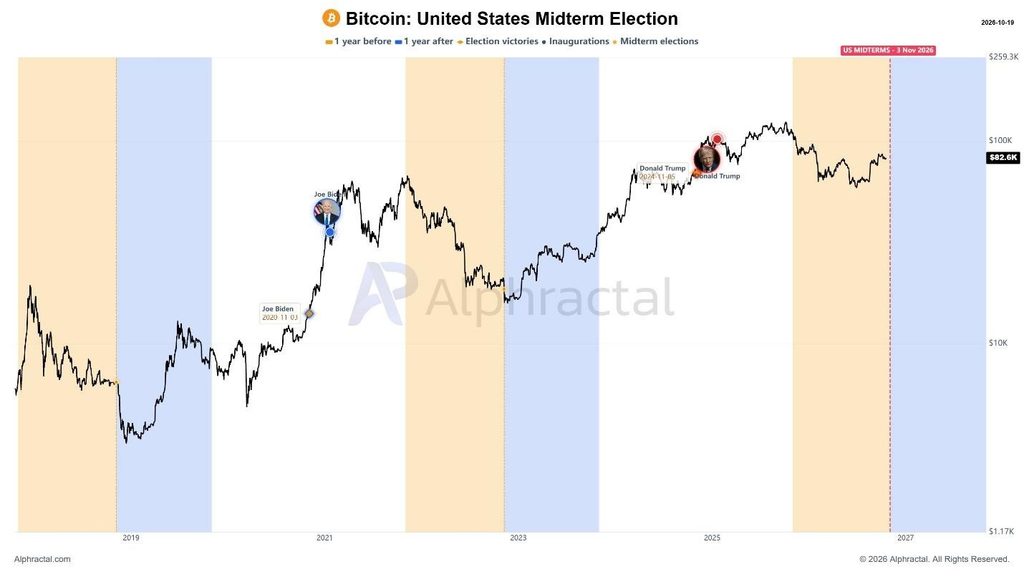
Notably, this distinction matters because the historical relationship does not prove that elections cause Bitcoin sell-offs. Market liquidity, monetary policy, investor positioning, and broader economic conditions can also influence price movements.
Elsewhere, Technical analyst Frank Cappelleri has also identified similarities between Bitcoin’s current chart and the price structure that preceded its previous major recovery.
Speaking to CNBC recently, the CappThesis founder compared Bitcoin’s roughly 54% decline during the current cycle with the nearly 70% drawdown recorded between 2022 and 2023.
“This also looks like a bullish pattern to me,” Cappelleri said, pointing to how the earlier decline eventually gave way to a strong recovery as market momentum returned.
However, he stopped short of predicting another rally as large as Bitcoin’s previous advance, which approached 400%.
“I’m not calling for that, but I am calling for a very similar foundation to be leveraged and potentially get back to new highs again,” he said.
His analysis suggests Bitcoin could establish a base for another advance, potentially reaching new highs in early 2027.
That said, not all historical comparisons support an immediate bullish outlook.
Recently, popular analyst Ali Charts highlighted Bitcoin’s declines following the previous four U.S. midterm elections.
According to his analysis, Bitcoin fell 72% after the 2010 midterms, 65% after the 2014 elections, 52% after the 2018 vote and 27% following the 2022 midterms.
In a thread on X, the analyst identified $73,000 as a level to watch if the historical pattern repeats.

Meanwhile, on-chain data point to changes in investor behavior that could influence Bitcoin’s next move.
Glassnode reported that profit-taking by short-term Bitcoin holders has eased after contributing to selling pressure in recent weeks.
The analytics firm said the share of exchange inflows from short-term holders sitting on profits reached a one-year high before returning to its average level over the past year.
Santiment also reported that wallets holding between 10 and 10,000 BTC accumulated approximately 88,987 BTC in one month from September 19. Their combined holdings exceeded 13.69 million BTC, the highest level since April, according to the analytics firm.
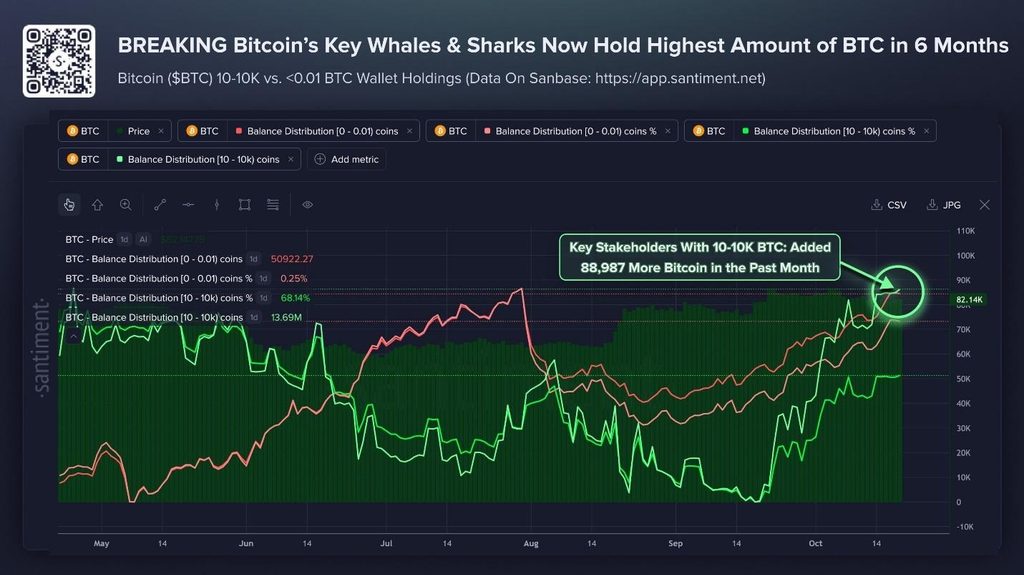
The firm noted that continued accumulation could support market confidence despite price volatility.
“Bitcoin still drives much of crypto’s direction, so persistent accumulation from its largest influential holders can support not only BTC, but confidence across the market.” The firm noted.
At press time, Bitcoin was trading at $80,341, up 1.02% in the past 24 hours.






Daily active addresses fell 2.2% to 615,200 in the report covering the week through Oct. 25.
Trading volumes for TOMO spiked significantly as the price surged 16.41% in just 30 minutes, reaching $0.003708. This dramatic move reflects growing investor interest amid

Teradyne’s AI-driven revenue surge highlights both growth potential and concentration risk, while robotics profitability hints at diversification. The post Teradyne posts $1.306 billion Q3 revenue
A video post dated Oct. 27 presented Bitcoin as a possible option in the debasement trade but offered no evidence of a shift in investment