
The US derivatives regulator is exploring a market for futures tied to AI computing power just as Bitcoin miners pour hundreds of millions of dollars into data centers, but the contracts may leave their biggest risks untouched.
On Aug. 19, the Commodity Futures Trading Commission (CFTC) opened a consultation on compute derivatives, seeking feedback on the size and liquidity of underlying markets, manipulation risks, customer protections and perpetual futures tied to computing capacity.
CFTC Chairman Michael Selig said a robust derivatives market for compute would be important to US competitiveness in artificial intelligence, describing the consultation as an initial step toward establishing rules for the emerging market.
Exchanges are already preparing products. CME Group plans to launch H100 Rental Index Futures and B200 Rental Index Futures on Oct. 5, pending regulatory review. The cash-settled contracts would track Silicon Data benchmarks for hourly rental prices of specific Nvidia GPUs. Intercontinental Exchange is separately developing futures linked to GPU compute indexes.
A futures market could give cloud operators a way to protect revenue against falling GPU rental rates, while companies buying compute could hedge rising costs. It could also establish a forward price curve for an industry where capacity is increasingly treated like a commodity.
Multicoin Capital co-founder Tushar Jain, a member of the CFTC’s Innovation Advisory Committee, has urged regulators to provide an innovation exemption or safe harbor for emerging markets including compute derivatives, allowing new products to develop within a regulated framework.
The push comes as Bitcoin miners increasingly turn their power infrastructure toward AI in search of higher and more predictable returns than mining alone.
HIVE Digital Technologies recently signed a five-year AI cloud agreement worth about $350 million, but expects to spend roughly $185 million deploying 2,016 Nvidia Blackwell Ultra GPUs before the contract reaches its projected $70 million annualized revenue run rate.
Riot Platforms has taken the transition further into data-center infrastructure, arranging access to as much as $573 million of debt financing for a 191 critical IT megawatt project at its Rockdale site.
Those commitments make miners obvious potential users of compute derivatives. However, they also show why futures may hedge only a fraction of what investors worry about.
VanEck’s Matthew Sigel argues that miners are increasingly being valued around the capital required for their AI projects rather than Bitcoin alone.
Bitcoin’s correlation with mining stocks has fallen to an all-time low, according to Sigel, as investors price in the prospect that miners will need to issue shares to fund the equity portion of new data-center developments.
Using an assumed financing mix of 80% debt and 20% equity, Sigel estimates Riot would need about $475 million of equity for its visible Rockdale AI pipeline. CleanSpark could require roughly $385 million for Sandersville, while Hut 8 could need about $774 million for Beacon Point Phase 2.
Those figures are estimates based on Sigel’s financing assumptions, rather than guidance from the companies. But they illustrate a risk that GPU futures cannot offset.
A miner can hedge a decline in compute rental prices and still face higher interest costs, construction overruns, equipment delays, or shareholder dilution because it cannot finance the project.
Sigel argues Bitcoin could itself change that equation.
At higher Bitcoin prices, miners generate more cash from existing operations while the value of coins available for sale or collateral also rises. That can increase their ability to fund AI development without issuing common stock.
CleanSpark has already demonstrated part of that strategy. The company has said the anticipated equity portion of Sandersville is fully funded, while Sigel noted it had been buying back shares even as investors were pricing in dilution.
The proposed futures also face a more basic mismatch with some miner projects.
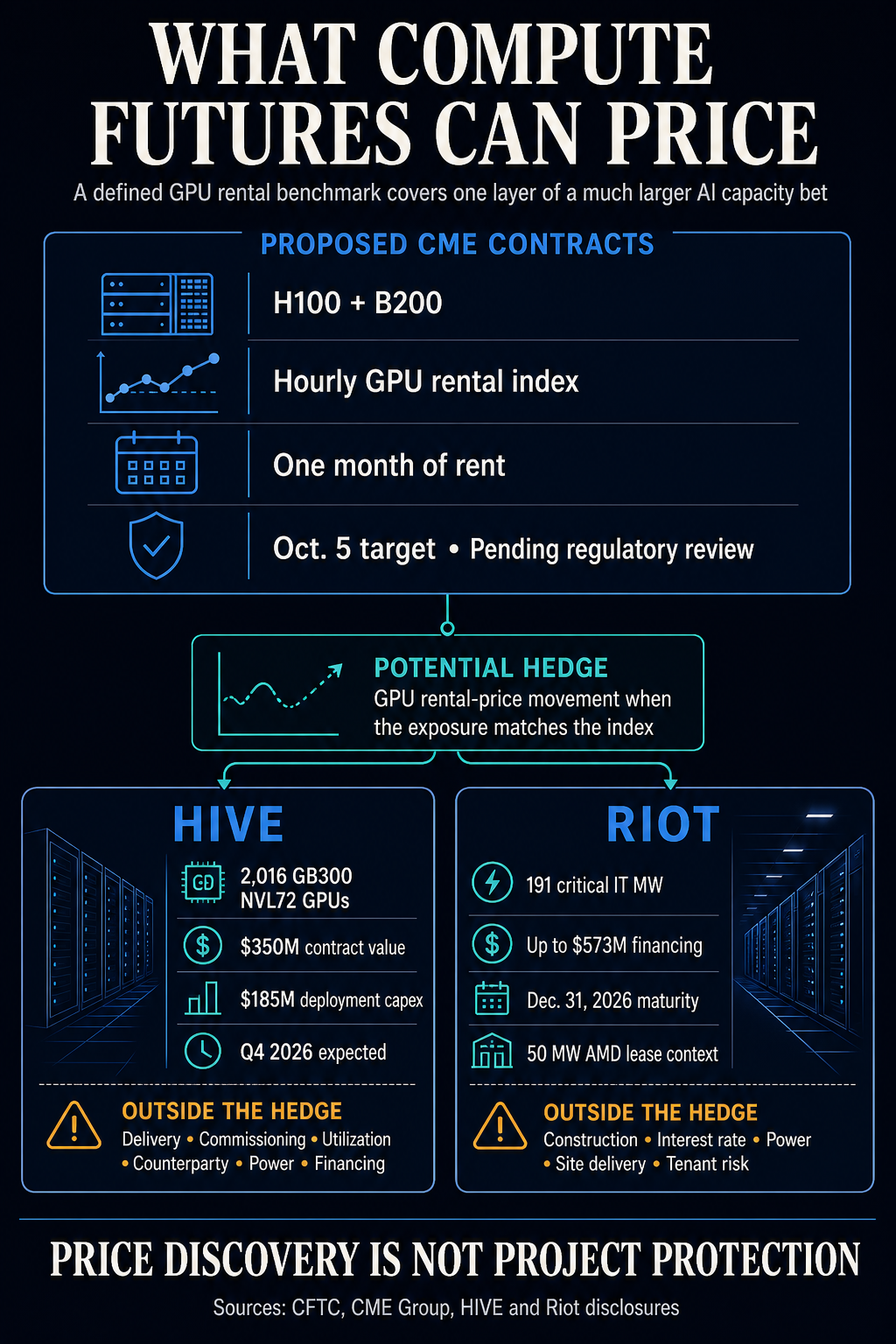
HIVE is deploying GB300 NVL72 systems, while CME’s initial contracts reference H100 and B200 rental rates. The prices may move together, but differences between chip generations, regions and contract structures create basis risk.
Riot’s exposure is further removed. Its Rockdale economics depend on construction, power, financing and long-term data-center leases measured in megawatts rather than floating sales of H100 or B200 GPU hours.
Compute futures could still give miners and lenders a useful benchmark for valuing capacity and negotiating future contracts. For operators selling uncontracted GPU hours, they could eventually become a direct hedge.
But Bitcoin miners are entering AI through capital-intensive projects where compute price is only one variable.
The new futures may help them hedge what their GPUs can earn. They cannot hedge what it costs to get those GPUs online without diluting shareholders.
The post Bitcoin miners are getting a new AI hedge, but it may protect them from the wrong risk appeared first on CryptoSlate.






September brings two regulatory decisions on opposite sides of the Atlantic. Microsoft Copilot AI predicts they set the tone for the rest of the year,
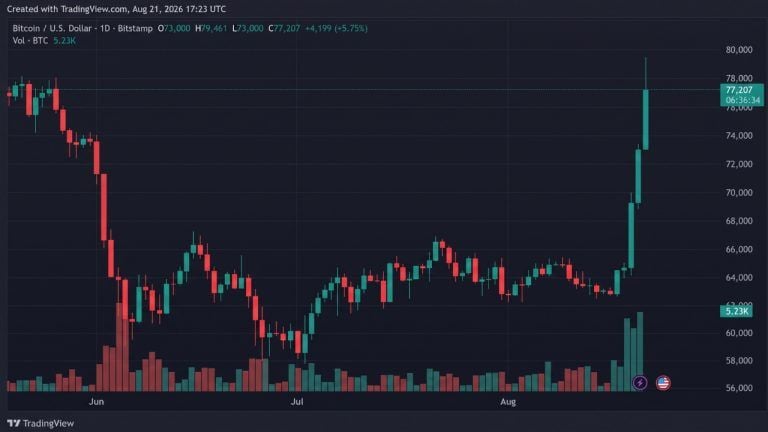
Bitcoin held above $77,000 after touching a multi‑month high near $79,500, positioning the asset for its strongest week of August. Bitcoin Consolidates Near $77,000 After

This significant fine underscores the growing regulatory scrutiny on automated decision-making, emphasizing the need for human oversight in tech-driven industries. The post Dutch regulator fines
The rapid growth of USDG on Robinhood Chain highlights the increasing appeal of high-yield stablecoins, potentially reshaping financial ecosystems. The post Paxos-issued USDG adds $94M