



That second question, what to do with crypto wealth once you’ve decided not to keep all of it in crypto, has produced a quiet pattern across this cycle. A growing share of realized profits are not flowing into other tokens, equities, or property. They are flowing into operating businesses. Service businesses, in particular.
The on-chain data has been clear for several months. Long-term holder distribution accelerated through the back half of 2025, with on-chain analysts tracking sustained net selling from wallets that had been dormant for years. The retrace from October’s all-time high to current levels, a roughly 35 percent drawdown, has tested newer holders far more than it has the cohort that bought below $40,000 and is still comfortably in profit.
For that cohort, the practical question is no longer “how high does this go.” It is “what fraction of this should remain in BTC, and where does the rest go.” Cash sitting in a savings account loses to inflation. Equities are a competing risk asset. Real estate is illiquid and yield-suppressed in most major markets. The remaining option, and the one a non-trivial number of crypto holders are now choosing, is buying into or building a working business.
The case for rotating crypto profits into a small business is not complicated. Bitcoin gains, by themselves, do not produce cash flow. A business does. For a holder not interested in being permanently leveraged to BTC’s price for the rest of their working life, the ability to earn an operating income uncorrelated with crypto markets has obvious appeal — particularly during periods like the current one, where BTC has been range-bound between $75,000 and $80,000 with weak conviction in either direction for weeks.
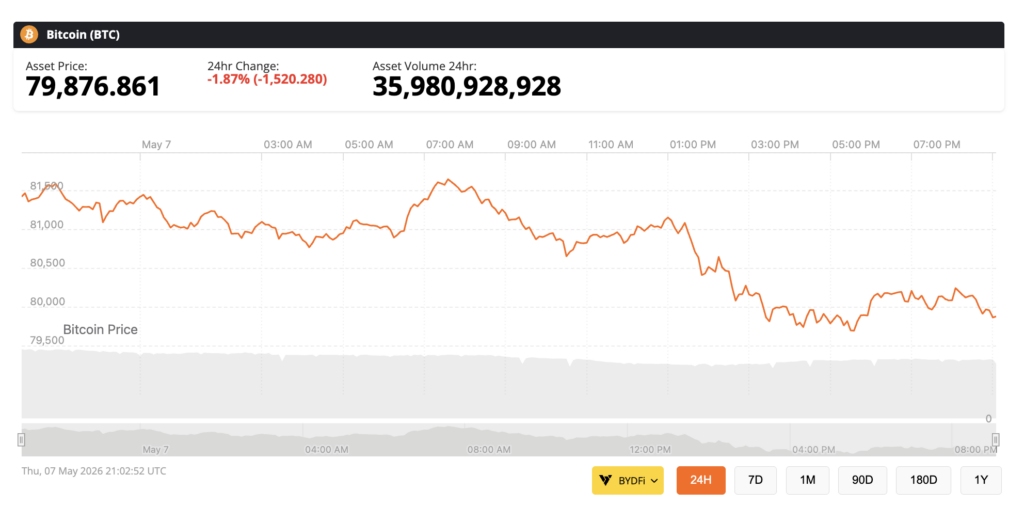
Bitcoin remains at, with the future direction uncertain, source: BNC
The trend is reinforced by a more straightforward pressure: tax. In most jurisdictions, realizing crypto gains and deploying the proceeds into productive business assets is treated very differently from realizing them and parking the cash. Holders working through significant disposals are often doing so with one eye on what the next deployment looks like, and a working business is one of the more tax-efficient destinations available.
It is worth distinguishing this from the corporate treasury strategy that defines the public-markets end of crypto. Strategy’s continued accumulation of BTC, even with the company currently underwater on recent purchases relative to its $75,537 average cost basis, is a leveraged bet that price recovers and exceeds that level. The individual holder rotating into a small business is doing something close to the opposite: reducing exposure to BTC’s price by exchanging it for an asset whose value is anchored to operating cash flow rather than spot quotation.
A predictable pattern has emerged across the sectors absorbing crypto profits. Service businesses, hospitality, fitness, wellness, beauty, food and beverage, have taken a meaningful share. The reasons are partly practical and partly demographic.
Practically, service businesses have lower capital requirements than asset-heavy alternatives like manufacturing or property development. A holder with $200,000 to $500,000 in realized crypto gains can buy into or build a service business comfortably within that range, where the same capital deployed into commercial property would be a fraction of a single deal. Service businesses also generate cash from week one of operation, which compares favorably to assets that produce returns only on exit.
Demographically, the holder cohort with significant 2023–2025 cycle gains skews toward people in their late twenties to mid-forties, the same demographic that disproportionately starts service businesses generally. Beauty, wellness, and fitness sit at the center of that overlap. They are popular categories for first-time business owners, they have established operational templates, and they are domains where the new owner can be hands-on if they want to be, or hire operationally if they don’t.
What changes most for a former passive holder making this transition is the shape of the risk being taken. On-chain risk, for someone who has done this for several years, is reasonably well understood: custody discipline, security hygiene, position sizing, exposure to a single asset class. The risks of operating a service business are different in almost every respect.
A salon, a wellness studio, or any client-facing service business carries a permanent surface area of operational risk that does not exist when the only asset is a wallet. Clients are physically present on the premises. Treatments involve chemicals, heat, sharp tools, and equipment that can fail. Employees handle products that produce reactions in a small but non-zero proportion of users. A single incident, a slip, a chemical burn, a dispute over the outcome of a service, can produce legal costs and lost revenue that, for a small business, are existentially significant.
The discipline that protected a long-term Bitcoin position translates surprisingly well. The same instinct that says “do not be forced to sell at the wrong price” is the instinct that, on the operating side, says “do not be forced to close because of a single incident.” The implementation looks different, but the principle is identical: identify the events that could remove you from the market, and put a floor under them before they happen.
For service-business owners, that floor is operational insurance. The right policy is the operating equivalent of the long-term cost basis a holder protects on-chain — not a return-generating asset, but a structural position that prevents one bad outcome from compounding into something worse.
For anyone deploying crypto profits into a salon, beauty studio, or independent stylist business specifically, the relevant cover is hair and beauty insurance. The category exists because beauty businesses face a distinct risk profile that generic small-business policies do not address well. General liability covers client injuries on the premises. Professional liability, sometimes called errors and omissions cover, responds to claims arising from the service itself, from chemical reactions to dissatisfaction with a result. Property cover protects tools, products, and equipment that can run into tens of thousands of dollars even for a single-operator business. Business interruption protection replaces lost income if a covered event takes the operator off the floor.
For a former BTC holder who has spent years thinking about cost basis, drawdown tolerance, and the cost of being forced into a sale at the wrong moment, hair and beauty insurance is the same conversation in a different domain. It costs something to maintain. Most of the time, that cost looks like dead weight. The one time it matters, it is the difference between absorbing a shock and watching the business that the cycle paid for disappear over a single bad week.
The pattern is likely to continue for the rest of this cycle and well into the next. Long-term holders who took profits between $90,000 and $126,000 are still working out what to do with the cash. Holders watching current levels are deciding whether the next leg up is worth waiting for or whether the prudent move is to take some chips off the table now. Some fraction of both groups will end up running a business they did not previously imagine themselves operating.
The discipline that built the position on-chain is the same discipline that protects the position off-chain. The asset class changes; the question of what protects you when the unexpected happens does not.
This is a sponsored article. Opinions expressed are solely those of the sponsor and readers should conduct their own due diligence before taking any action based on information presented in this article.






The leading prediction market closed its Series F funding round, led by Coatue, to reach institutions, which are Kalshi’s next target audience. The move comes
Solv Protocol will move its tokenized Bitcoin infrastructure to Chainlink, following Kelp DAO’s lead after it blamed LayerZero for a hack.
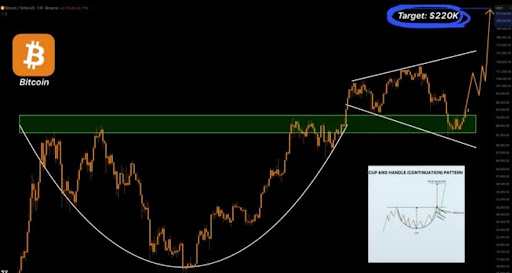
A crypto analyst has identified a multi-year Cup and Handle pattern on the Bitcoin (BTC) chart that he says has gone largely unnoticed by the
World Liberty co-founder Zach Witkoff also said Thursday that the crypto firm is “in the final stages” of receiving bank charter approval from the Trump