






Chainlink is experiencing a surge in community engagement and strategic upgrades, positioning itself as a key player in digital finance. Recent developments include discussions around
Days after its disputed Navier-Stokes claim, OpenAI says it’s made “substantial progress” on another Millennium Prize math problem—and won’t say which one yet.
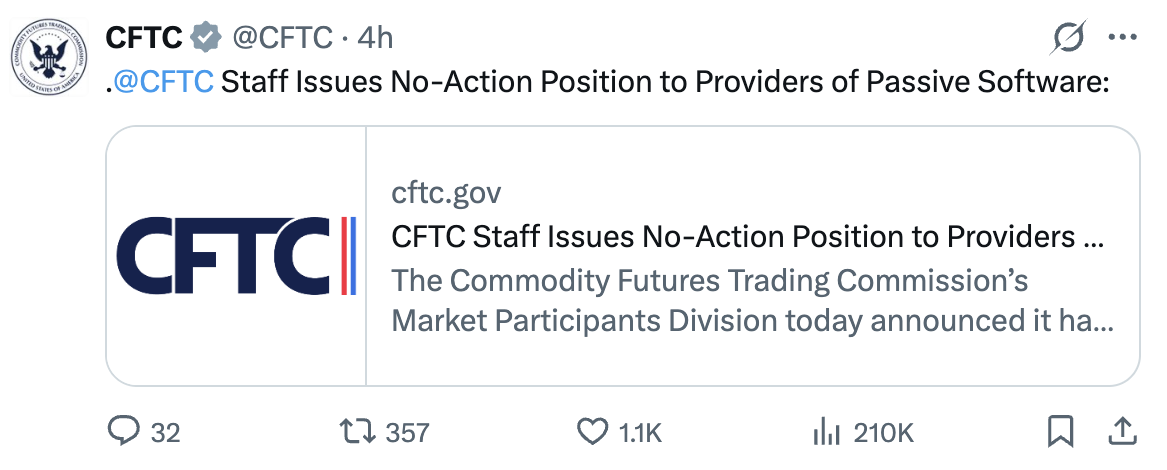
The Commodity Futures Trading Commission (CFTC) has expanded regulatory relief for “passive software” providers that connect users to regulated derivatives firms and exchanges.In a no-action position issued Thursday, the agency’s Market Participants Division said it would not recommend enforcement against qualifying providers or their personnel for failing to register as introducing brokers or associated persons when facilitating trading with CFTC-registered firms and exchanges.The position could make it easier for crypto wallets and other apps to offer access to regulated derivatives, including perpetual contracts and prediction markets, without becoming CFTC-regulated introducing brokers themselves.Source: CFTCTo qualify, providers must meet conditions limiting their role in transactions, including restrictions on exercising discretion over users’ orders.The action extends a similar position granted to Phantom Technologies in March for its self-custodial crypto wallet software. The earlier letter allowed Phantom, subject to certain conditions, to provide and market software connecting users with registered futures brokers and exchanges without registering as an introducing broker.Phantom and the Hyperliquid Policy Center also pushed for broader protections in July, asking the CFTC to shield non-custodial wallet providers from introducing broker requirements and clarify how existing rules apply to blockchain developers and regulated derivatives firms using onchain infrastructure.Related: Bernstein expects ‘aggressive’ rulemaking from SEC, CFTC, following CLARITY Act failureRegulators move quickly after CLARITY Act setbackThe move from the US regulator comes two days after the CLARITY Act failed to advance in the Senate, with a cloture motion receiving 49 votes, short of the 60 needed to proceed to debate.Following the vote, CFTC Chair Michael Selig and Securities and Exchange Commission Chair Paul Atkins signaled Wednesday that their agencies would continue moving forward on crypto regulation under their existing authority.“The CFTC is locked in and ready to ship its rules for the new frontier of finance,” Selig said in a post on X, while Atkins said the SEC would act “with or without legislation” to provide regulatory certainty for digital assets.Source: Paul AtkinsOn Thursday, the agencies began following through. Alongside the CFTC’s no-action position, the SEC approved a temporary exemption allowing qualifying platforms to facilitate limited onchain trading of tokenized US stocks through permissioned automated market makers and liquidity pools.Magazine: Is there any chance left to save the CLARITY Act?
Traders scanning the order books got a surprise when COTI surged 10.31% in just one hour. The cryptocurrency jumped from $0.02086 to $0.02301, marking a