
China’s securities regulator is shutting down mainland operations of major online brokers Tiger Brokers, Futu Holdings, and Longbridge over a two-year wind-down. These are online brokerage platforms based in Hong Kong and overseas that let users trade US, Hong Kong, and other global stocks from their phones.
Mainland Chinese investors flocked to them because they offered cheap, easy access to foreign markets like US equities. Now, some of that frozen capital could flow into crypto channels like USDT and OTC desks.
The cases name Tiger Brokers (NZ) Limited, Futu Securities International (Hong Kong) Limited, and Longbridge Securities (Hong Kong) Limited.
Each entity allegedly handled trading orders, public fund sales, and futures brokerage for mainland customers without a Chinese license.
According to the CSRC, the firms violated the Securities Law, the Securities Investment Fund Law, and the Futures and Derivatives Law.
The agency plans to seize all illegal gains from the domestic and overseas units involved in the business.
“In accordance with relevant regulations, the CSRC intends to confiscate all illegal gains of Tiger Brokers (NZ) Limited, Futu Securities International (Hong Kong) Limited, and Changqiao Securities International (Hong Kong) Limited, both domestically and internationally, and impose severe penalties according to law,” local media reported.
Existing mainland users will only be allowed to sell positions and withdraw funds during the two-year wind-down. New deposits and new buy orders are blocked immediately.
After the cleanup window, the platforms must shut their China-facing websites, apps, and servers.
Legal overseas routes such as the Qualified Domestic Institutional Investor (QDII) program and the Hong Kong Stock Connect stay open.
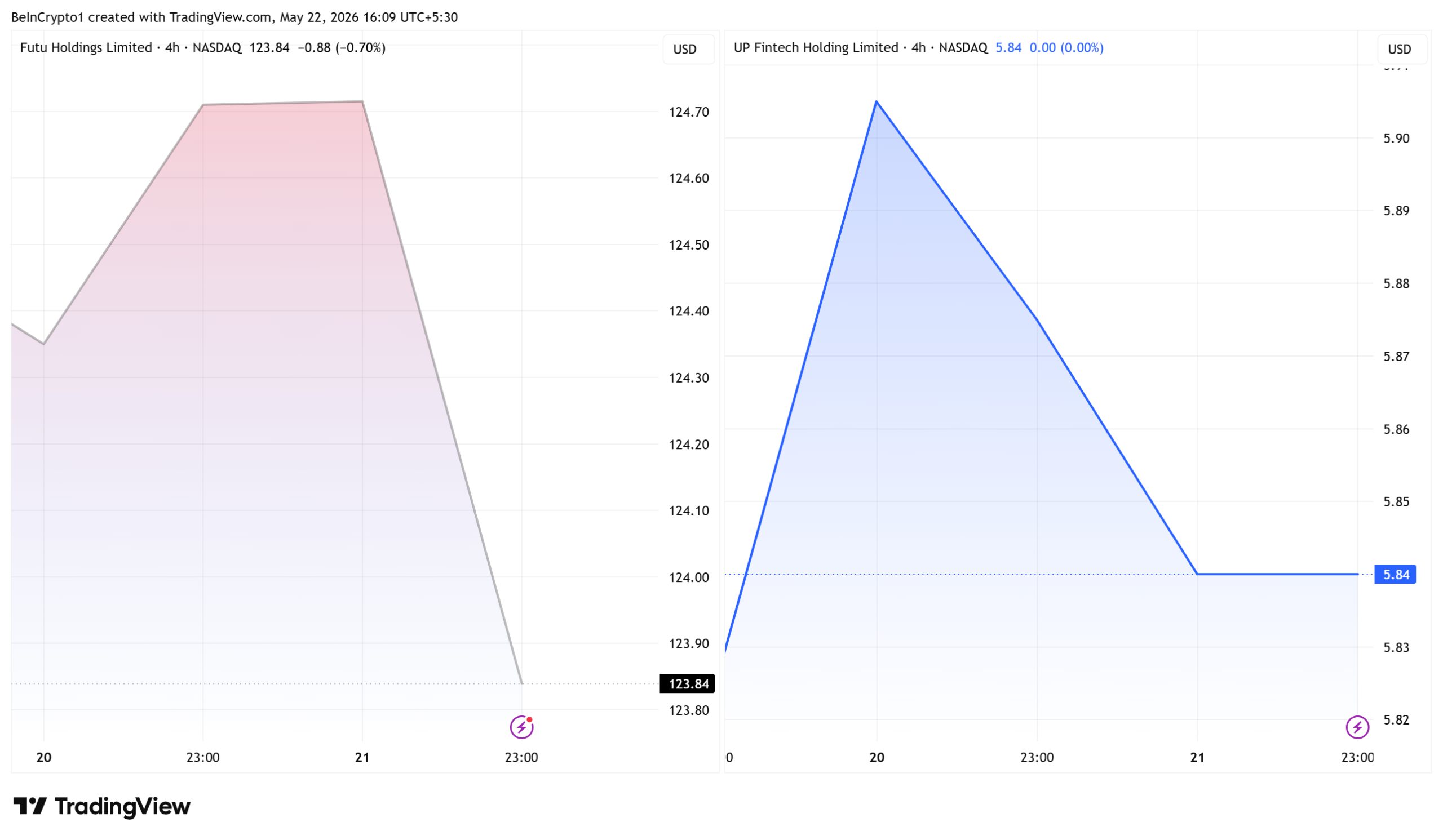
The FUTU and TIGR stocks dipped on the news and were trading for $123.84 and $5.84, respectively, as of this writing.
China’s $50,000 annual foreign exchange quota leaves most retail investors with little legal room to move money offshore.
Tiger and Futu filled that gap for years through grey-market onboarding. Their mainland clients have driven a large share of trading revenue at both firms.
With those accounts frozen, demand could rotate toward over-the-counter (OTC) desks and peer-to-peer (P2P) exchanges.
These channels form the main route for Chinese traders bypassing restrictions, often running through offshore platforms accessed via VPN.
Tether’s USDT remains the dominant on-ramp. Underground brokers have routinely sold USDT at premium prices against the yuan during past capital flight episodes.
A similar premium could return if Tiger and Futu’s mainland clients shift to crypto.
The wider stablecoin dollar dominance trend shows how quickly USD-pegged tokens can fill gaps left by TradFi. Industry estimates put the number of Chinese crypto users at over 20 million despite the 2021 ban.
The QDII program, Cross-border Wealth Management Connect, and the Hong Kong Stock Connect remain open.
However, those routes carry strict quotas, higher fees, and limited product menus. None of them match the speed or breadth of US stock access Tiger and Futu offered.
“Bitcoin as a Limitless Haven: Unlike traditional investments, Bitcoin has no QDII/QFII limits…Chinese fund houses face overseas investment quotas under the QDII program… quotas are quickly reached daily, leading to premiums… quotas are maxed out, halting some mutual funds… tired of the restrictions…,” analyst Kyle Chasse stated.
Crypto is also far from a safe substitute. Beijing has spent 2026 widening its position against private digital assets.
The People’s Bank of China (PBOC) and the CSRC expanded China’s sweeping crypto ban in February. The notice now covers stablecoins and tokenization activity.
The same February policy, which marked China’s stablecoin enforcement push, targets foreign issuers that offer services to Chinese residents.
Any large rotation into USDT or on-chain US equity products would likely draw similar scrutiny.
The brokers have the right to a hearing before final penalties are issued. Beijing’s two-year deadline gives regulators time to monitor where displaced capital lands.
The post China’s Offshore Trading Crackdown Could Unleash a New Wave of Crypto Capital Flight appeared first on BeInCrypto.





A single block trade on Deribit just sold 1.5 million $XRP call and put contracts at the $1.40 strike, collecting $224,500 in premium and effectively

Increased scrutiny of prediction markets may lead to stricter regulations, impacting how these platforms operate and their user base. The post House Oversight chair seeks
The incident highlights the critical dependency on oracle networks in DeFi, underscoring the need for redundancy and robust risk management. The post Fulcrom Finance enters
The attack on Barakah highlights vulnerabilities in energy infrastructure, potentially escalating regional tensions and impacting global markets. The post UAE condemns drone attack on Barakah