
Nobody asked for a chatbot in their spreadsheet. Nobody asked for one in their group chat either. Somewhere along the way, “AI-powered” stopped meaning useful and started meaning unavoidable.
I noticed the exact moment it tipped over into annoyance. I was editing a document, mid-sentence, and a little sparkle icon lit up asking if I wanted help rewriting what I’d already written perfectly well. I hadn’t clicked anything. I hadn’t asked for anything. It just showed up, like a coworker leaning over your shoulder uninvited, confident you needed the assist.
That’s the whole problem in one image. The tech industry decided that inserting AI everywhere was the same thing as improving the product, and for a while, the sheer novelty covered for how badly that assumption held up. It doesn’t anymore.
I used to think my irritation was just me getting cranky about software, the same reflex that makes me grumble every time an app reshuffles its settings menu for no reason. Then I looked at the actual numbers, and it turns out the fatigue is not a me problem. It’s the mainstream reaction.
Only 19% of users in 2026 say they feel excited about AI, a collapse from 50% just two years earlier. That’s not a dip, that’s a technology falling out of favor with the very people it was marketed to win over.
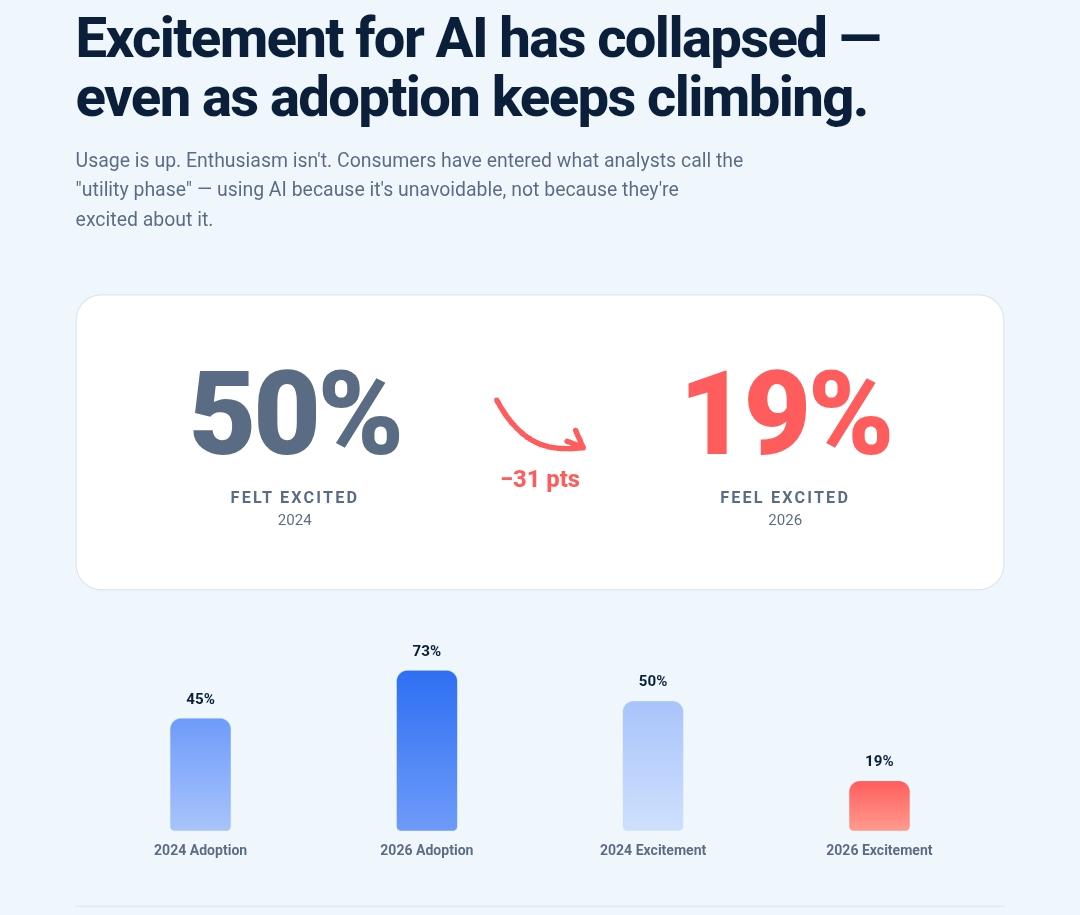
Adoption climbed to 73% according to Prophet’s 2026 consumer research, even as enthusiasm fell another 7 points, and that gap between “I use this constantly” and “I’m glad it’s here” is exactly what analysts mean when they talk about AI entering its utility phase. People aren’t falling in love with the technology anymore. They’re just tolerating it because avoiding it has become close to impossible.
A Quinnipiac survey from March 2026 makes the mood even clearer: 80% of US adults say they’re concerned about AI, against only 35% who say they’re excited, a ratio that should terrify anyone still building product roadmaps around “just add a chatbot.”
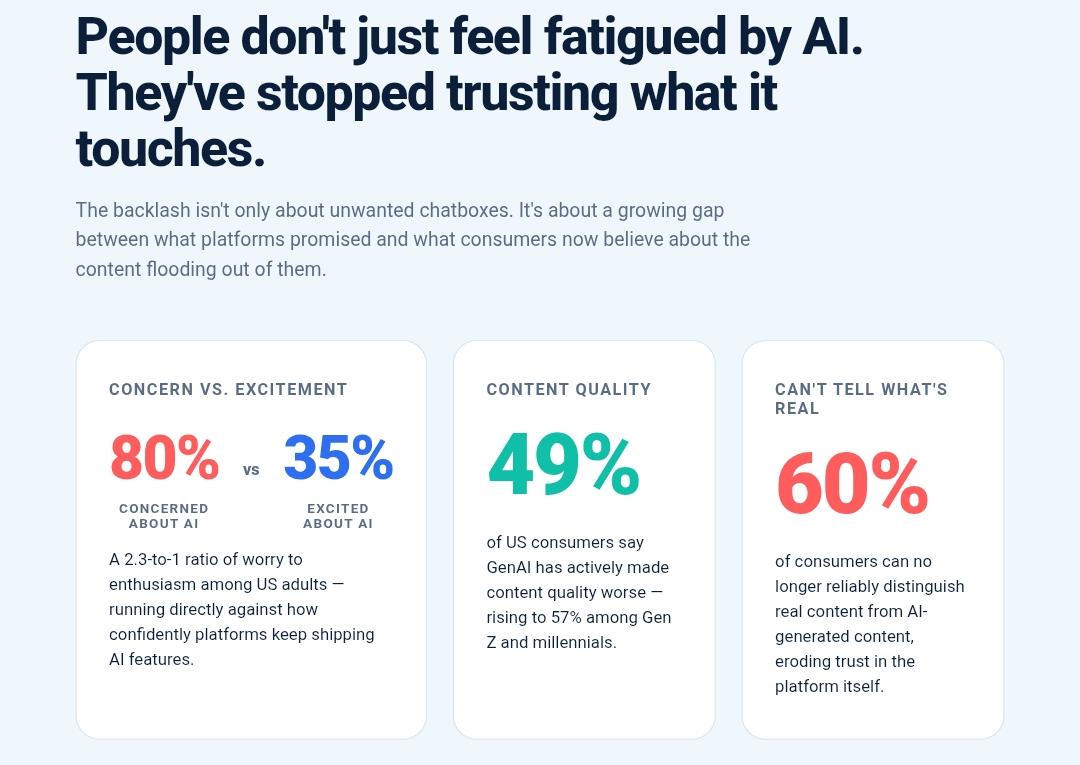
It’s not only the interruptions. It’s what’s flooding out of these tools once they’re switched on. 49% of US consumers, and 57% of Gen Z and millennials specifically, believe AI has actively made content quality worse. That’s the generation platforms are supposedly building all this for, telling researchers the output is degrading, not improving. And nearly 60% of people now say they can’t reliably tell real content from AI-generated content anymore, which quietly erodes trust in everything a platform shows you, whether AI touched it or not.
Signal check: three things fueling the backlash
This is where the frustration turns into something closer to contempt. Meta has no full toggle to disable Meta AI on WhatsApp or Instagram at all, the only options are archiving chats and muting notifications, which isn’t really “off,” it’s just “quieter.” Microsoft’s Copilot keeps resurfacing inside Word and Excel even after you uninstall the standalone app, because it was wired into each program separately rather than as one removable piece. And Google has never given publishers a way to opt content out of AI Overviews while staying in normal search results, it’s citation or nothing, which mirrors exactly what regular searchers run into on the results page: no clean switch, just workarounds.
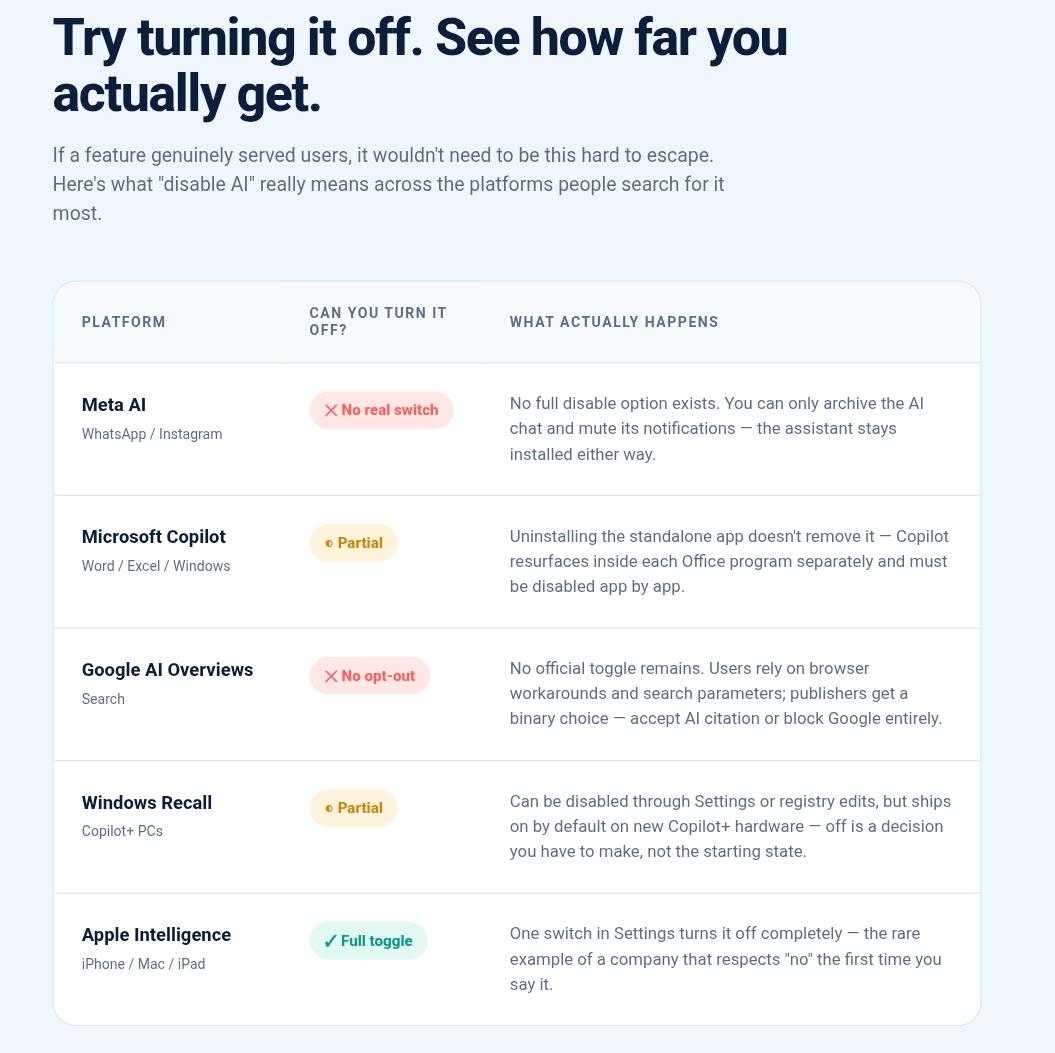
That buried, broken, or missing off switch is the confession. If these features actually earned their place, companies wouldn’t need to make quitting them this hard.
I’m not asking anyone to strip AI out of software. I’m asking for it to behave like a tool instead of a tenant that’s moved in uninvited. Let it wait until I call for it. Let it disappear completely when I say no. That’s not a compromise, that’s just decent design, the standard we used to expect by default instead of begging for as a favor.
Right now, the industry is optimizing for “did we ship the AI feature” instead of “does this actually help anyone.” The fatigue numbers are the invoice for that choice, and it’s arriving faster than anyone building these roadmaps seems willing to admit.
Disclosure: This is not trading or investment advice. Always do your research before buying any cryptocurrency or investing in any services. Follow us on X @nulltxnews








Peter Brandt is eyeing a BTC-to-gold rotation as Bitcoin drops 28% YTD. Here’s what the charts say about key support, the $50K bear case, and
Dogecoin active addresses hit nearly 50,000 as analyst Ali Martinez flags a buy signal. DOGE trades at $0.077 — here’s what the key levels and
FIFA’s decision sets a precedent that could undermine tournament fairness, raising questions about the influence of political pressure in sports. The post FIFA clears US
Services will integrate into “Sberbank Online” and “SberInvestments” once the “On Digital Currency and Digital Rights” bill takes effect in September.