

The latest market movements highlight growing uncertainty across traditional and digital assets. While election expectations influenced trading, concerns over artificial intelligence spending, corporate earnings, and declining crypto liquidity also contributed to the unsettled market environment.
The Nasdaq 100 and S&P 500 faced renewed selling pressure as investors assessed the potential consequences of a change in congressional control. On November 2, the S&P 500 erased an early gain of approximately 1.1% and finished the session down 0.5% at 7,541.40. The Nasdaq Composite dropped 1.1% to 25,164.32, while the Dow Jones Industrial Average advanced 0.4%.
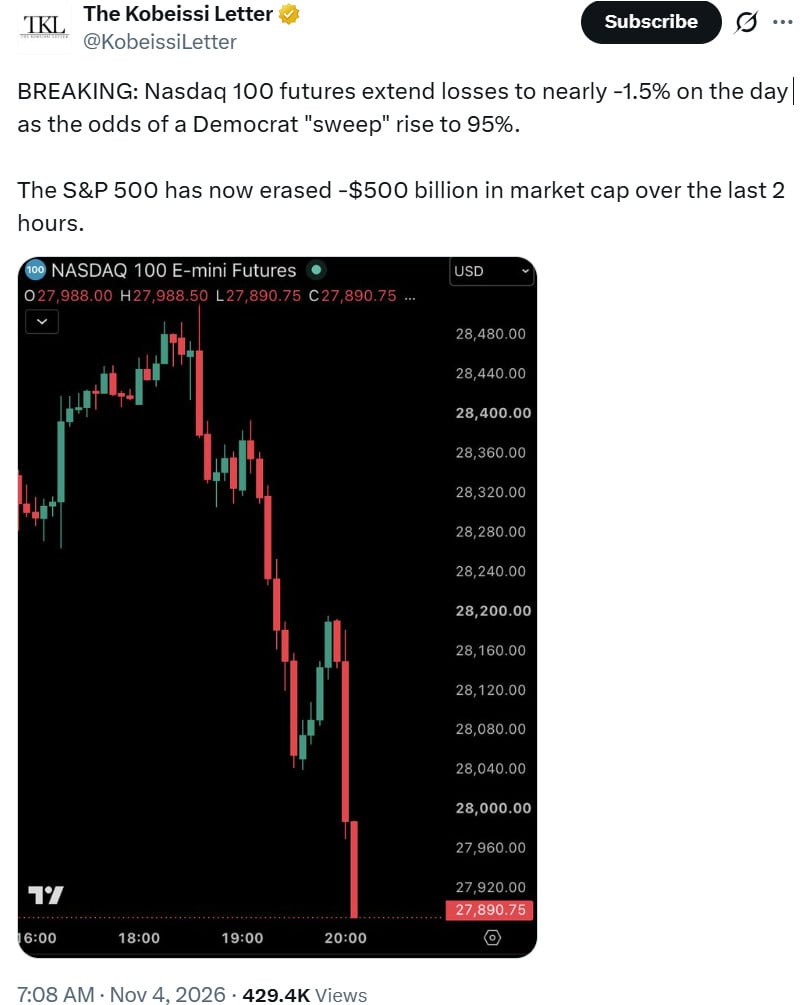
Nasdaq 100 futures dropped nearly 1.5% as rising Democratic election odds fueled concerns over potential policy changes ahead of the 2026 US midterms. Source: @KobeissiLetter via X
Technology shares remained under pressure following the previous week’s decline. Nvidia reversed its early gains and finished lower, weighing on the broader market despite gains across many other Wall Street stocks. The Nasdaq 100 had also entered correction territory, falling approximately 10% from its October peak, reflecting sustained weakness in semiconductor and technology companies.
Political expectations added another source of uncertainty ahead of November 3 voting. Prediction markets increasingly favored Democratic gains in Congress, raising questions about potential changes to corporate regulation, government spending and oversight of the technology industry. Kalshi’s November 2 figures placed Democratic candidates at a 94% probability of winning the House and a 74% probability of gaining control of the Senate. These were separate market-implied probabilities rather than a 95% certainty of a Democratic sweep.
The market reaction became more pronounced as early election results arrived. On November 4, Reuters reported that S&P 500 futures had fallen 0.8%, while Nasdaq futures declined 1.8% during early Asian trading. Treasury yields also moved lower, with the 10-year yield declining six basis points to 4.906%. Investors were responding to early Democratic Senate victories, although the final balance of power remained uncertain.
The political uncertainty arrived during an already difficult period for technology stocks. Investors had been questioning whether the enormous capital commitments made by major technology companies to artificial intelligence infrastructure would generate sufficient financial returns.

Alphabet’s Q3 earnings heightened investor concerns that rising AI infrastructure spending could pressure profitability and disrupt traditional revenue streams. Source: Bloomberg via X
Alphabet’s third-quarter results added to those concerns. The Google parent reported revenue of $127.6 billion, below the $128.2 billion analysts had expected. Its free cash flow turned negative by approximately $9.1 billion as the company increased spending on artificial intelligence and cloud infrastructure. Although Google Cloud revenue more than doubled, weaker advertising performance and higher investment requirements weighed on investor sentiment.
Amazon faced similar scrutiny after reporting a trailing 12-month free cash flow deficit of $42.4 billion through the September quarter. Its capital expenditure reached $77.26 billion, approximately $20 billion above analyst expectations. The company also projected capital spending of $220 billion for 2026, with CEO Andy Jassy indicating that investment would increase further next year.
The financial pressure was not caused by weak cloud demand alone. Amazon Web Services revenue increased 39% to $46 billion in the third quarter, demonstrating continued demand for cloud computing. However, investors focused on the cost of expanding infrastructure and the time required for those investments to generate cash returns.
Aptus Capital Advisors portfolio manager Dave Wagner highlighted the concern, saying, “Operations generated plenty of cash but their capex just absolutely swallowed it.”
These earnings developments created a difficult backdrop for technology shares before election results began arriving. The possibility of tighter AI regulation under a Democratic-controlled Congress added another consideration for investors already reassessing valuations and infrastructure spending.
The weakness in technology stocks also affected the Crypto Market as investors reduced exposure to risk-sensitive assets. Bitcoin fell approximately 2% to below $77,000 during Asian trading on November 3, erasing its previous session’s recovery. The decline coincided with renewed selling across U.S. semiconductor shares and growing caution ahead of the midterm vote.
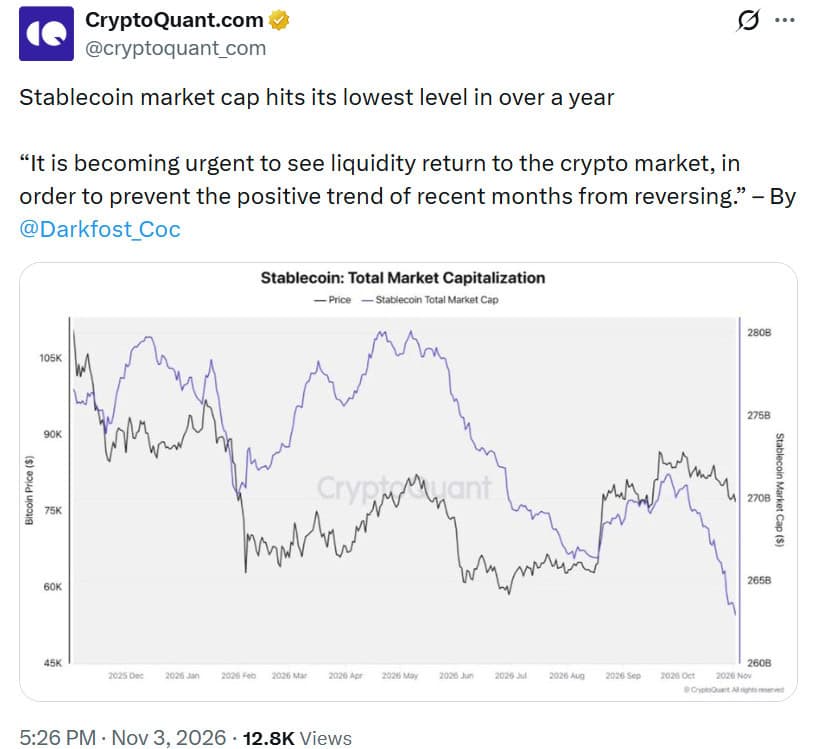
Stablecoin market capitalization fell to its lowest level in over a year by early November 2026, signaling declining liquidity across cryptocurrency markets. Source: CryptoQuant via X
Several large cryptocurrencies recorded additional losses. Zcash declined nearly 10% to approximately $1,140, while Hyperliquid’s HYPE token fell 5% to around $84. Solana dropped 3% to approximately $92, and BNB slipped below $700. Ethereum and Dogecoin also lost around 2%, while XRP remained comparatively stable near $1.25.
Selling pressure returned as early election results started influencing market expectations. The Wall Street Journal reported that Bitcoin traded around $76,800 after falling more than 1% in less than two hours on November 3. Ethereum and other digital assets followed a similar pattern as traders responded to early indications of Democratic gains.
However, political uncertainty is not the only concern facing digital assets. CryptoQuant reported that the total stablecoin market capitalization had declined to approximately $263 billion, its lowest level in more than a year. The figure represented a $17 billion decrease from roughly $280 billion in April, equivalent to a decline of about 6% over six months.
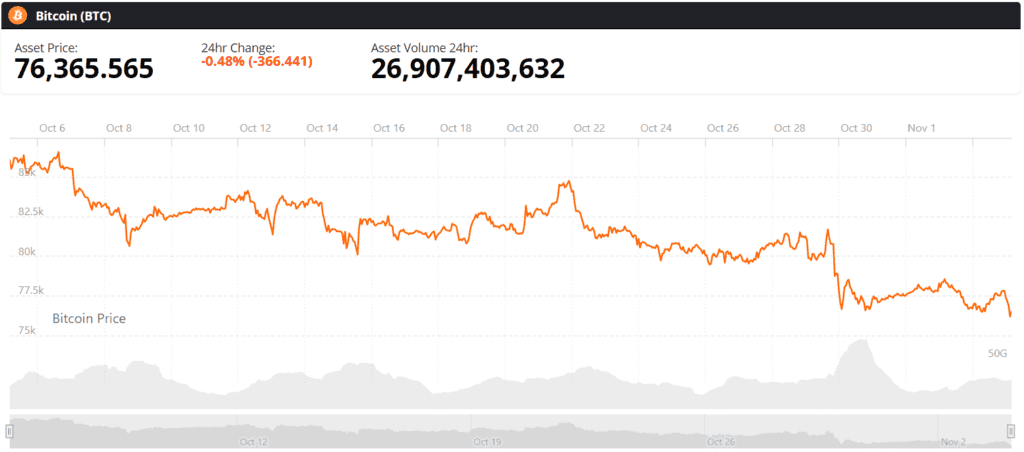
Bitcoin (BTC) price chart. Source: Brave New Coin
The contraction has raised concerns about the availability of fresh liquidity across cryptocurrency markets. Stablecoins serve as an important source of trading capital, allowing investors to move between digital assets and dollar-denominated holdings without leaving the crypto ecosystem. A prolonged decline in their combined capitalization can therefore indicate weaker demand for deploying capital into digital assets.
CryptoQuant analyst Darkfost also highlighted the trend, stating that “it is becoming urgent to see liquidity return to the crypto market” to prevent recent positive market developments from reversing.
The data suggests that Bitcoin’s performance depends on more than movements in U.S. equity markets. Institutional demand, investor confidence, stablecoin supply, and broader financial conditions remain important factors in determining whether digital assets can maintain their recovery.
Market movements across different asset classes have not followed a consistent pattern throughout the election period. Some trading sessions have shown simultaneous weakness in equities and cryptocurrencies, while precious metals have moved in the opposite direction.
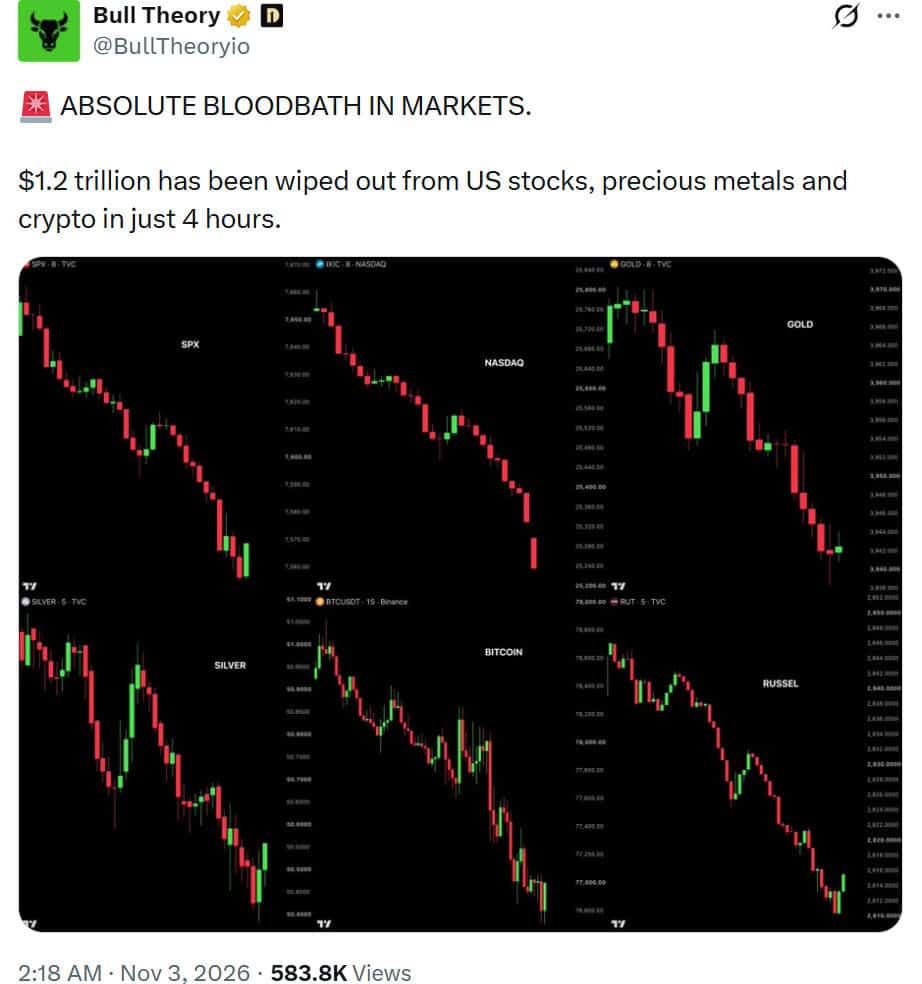
Gold and silver fell alongside risk assets ahead of the US midterms, as margin calls and forced deleveraging outweighed their traditional safe-haven appeal amid the October tech sell-off. Source: @BullTheoryio via X
For example, gold and silver recovered on November 2 after substantial losses during the previous session. Kitco reported that spot gold traded around $3,945.80 per ounce, up approximately 1.84%, while silver reached $50.80, gaining around 3.67% during U.S. trading. Gold also recorded a 2.1% gain in Reuters’ November 2 market report.
This performance complicates claims that equities, precious metals, and cryptocurrencies experienced an identical sell-off throughout November 2. Different trading windows, market conditions, and investor positioning can produce sharply different movements even when assets respond to the same economic developments.
Precious metals can also experience selling pressure during periods of forced liquidation, when investors raise cash to meet margin requirements or reduce overall portfolio exposure. However, the November 2 recovery in gold and silver indicates that the relationship between traditional safe-haven assets and risk markets was not uniform during this period.
The outcome of the US midterm elections could influence investor expectations across several sectors, particularly technology, artificial intelligence, healthcare, banking, and cryptocurrency. A Democratic victory in both chambers could increase congressional scrutiny of technology companies and potentially introduce additional regulatory challenges for AI infrastructure developers.
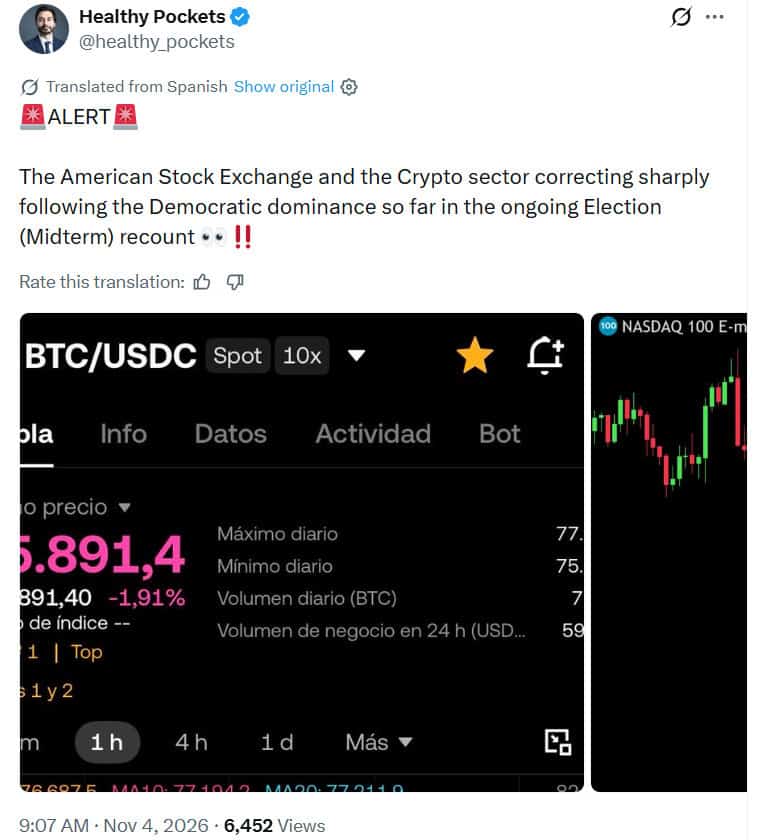
An analyst warned of further declines in US stocks and cryptocurrencies, linking selling pressure to early Democratic leads in the 2026 midterm election results. Source: @healthy_pockets via X
Cryptocurrency businesses could also face greater political scrutiny. Reuters previously reported that Democratic control of one or both chambers would give the party greater scope to investigate the Trump administration’s connections with the crypto and prediction-market industries. However, the extent to which congressional changes would affect existing regulatory policy remains uncertain.
Fiscal policy is another consideration. A divided Congress could complicate negotiations over government spending and the federal debt ceiling, while a Democratic-controlled Congress could limit some of the administration’s legislative priorities. These possibilities may influence expectations for government borrowing, Treasury yields, and the U.S. dollar.
Market participants are also focused on how election results compare with expectations rather than simply which party wins. Chris Weston, head of research at Pepperstone, said, “For traders, the distinction between a narrow Democratic majority and a commanding victory is critical.”
This distinction could determine whether the initial futures decline develops into sustained selling or fades as investors adjust their positions. A result broadly anticipated by prediction markets may produce a relatively limited reaction, while an unexpected outcome could trigger additional volatility.
For Bitcoin and the wider crypto market, the coming sessions will also test whether declining stablecoin capitalization can stabilize and whether institutional demand can offset broader risk aversion. Changes in technology-sector valuations and U.S. financial conditions may continue to influence digital asset prices.
The recent market movements therefore reflect several overlapping pressures rather than a single political catalyst. The Nasdaq 100, S&P 500, and Bitcoin are responding to election uncertainty, but corporate investment decisions, earnings performance, and available market liquidity remain equally relevant to the next phase of price action.