

The sell-off followed disappointing advertising revenue, slower Google Search growth, and rising concerns over the cost of its AI expansion. Despite strong Google Cloud performance, investors questioned whether Alphabet’s growing infrastructure investments could generate sufficient returns.
Alphabet reported third-quarter revenue of $127.6 billion, representing a 25% increase from $102.3 billion a year earlier. However, the result missed analysts’ expectations of approximately $128.2 billion, according to LSEG data.
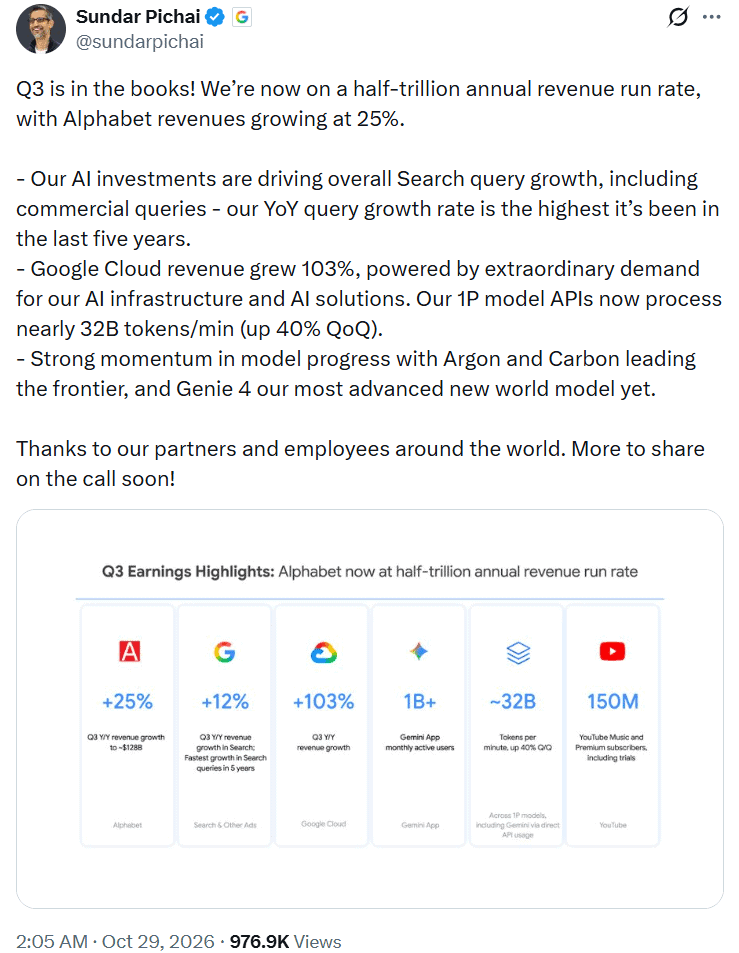
Sundar Pichai reported Alphabet’s Q3 2026 revenue rose 25% year-over-year to $127.6 billion, driven by AI-led growth across its businesses. Source: Sundar Pichai via X
Google advertising revenue reached $82.01 billion, falling about $1.4 billion short of market estimates. Within that segment, Google Search and other advertising revenue increased 12% to $63.35 billion, compared with 17% growth in the previous quarter. YouTube advertising revenue also increased 9% to $11.2 billion.
The slowdown has drawn attention to Google’s expanding use of AI-powered search features. Chief Business Officer Philipp Schindler indicated that increased adoption of AI Mode contributed to the deceleration in search advertising growth. The conversational interface encourages longer interactions, but those queries currently generate less advertising revenue per use than traditional search.
Foreign-exchange movements also affected the quarterly comparison. However, investors remain concerned about how Google’s transition toward AI-generated search experiences could affect its established advertising model.
The issue was highlighted by Dave Wagner, portfolio manager at Aptus Capital Advisors. He said, “In a market worried about AI cannibalizing the franchise, investors need to see search accelerating, not decelerating.”
His comments reflect a central concern surrounding Alphabet’s AI strategy: maintaining search engagement while ensuring that new AI experiences continue to generate advertising revenue.
Alphabet’s increasing AI investment was another source of investor concern. The company recorded $51.4 billion in capital expenditure during the third quarter, with most of the spending directed toward technical infrastructure supporting AI development and cloud services.
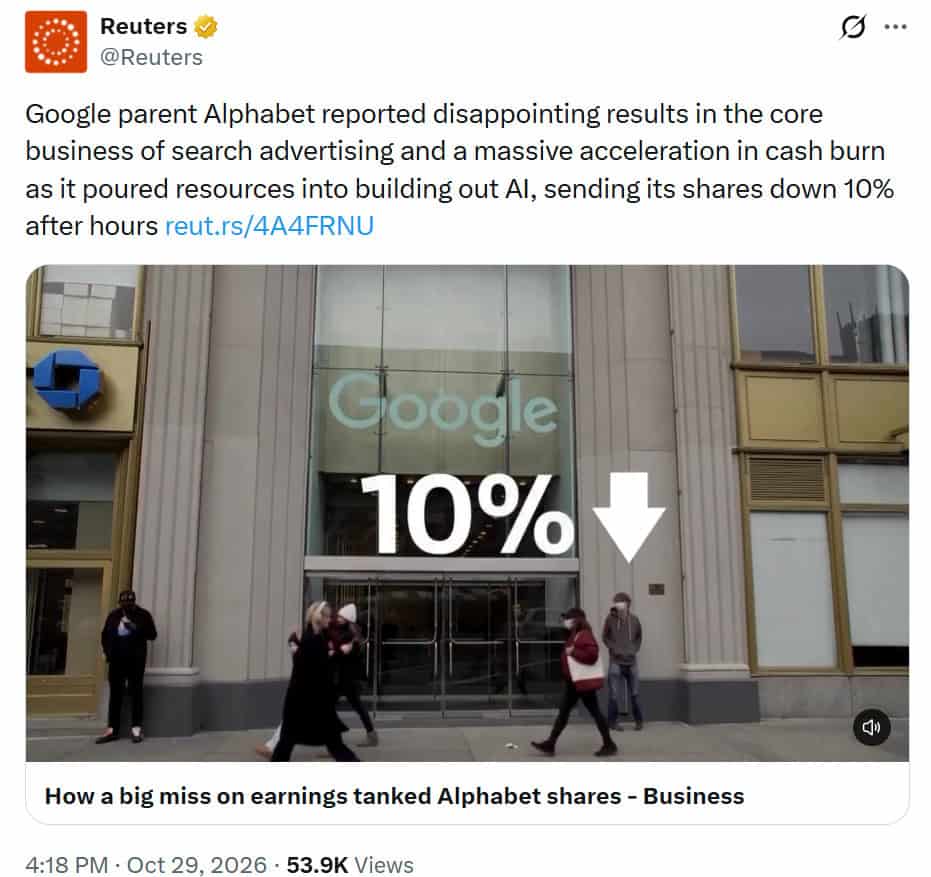
Alphabet reported its first negative free cash flow in 22 years, reaching $9.07 billion as aggressive AI infrastructure investments drove heavy spending on data centers and cloud capacity. Source: Reuters via X
The investment contributed to negative free cash flow of approximately $9.07 billion, compared with a $5.9 billion deficit in the previous quarter. It marked the second consecutive quarter of negative free cash flow and a significant change for a company that had historically generated substantial cash from its operations.
Alphabet’s management said the deficit reflected the cost of expanding technical infrastructure, alongside inventory accumulation for Tensor Processing Unit (TPU) systems and a $5.2 billion cash payment related to a European Commission fine.
The spending also coincided with a decline in reported earnings. Alphabet’s net income available to common shareholders fell 25% year over year to $26.17 billion. Diluted earnings per share came in at $2.12, while the company’s adjusted EPS was reported at $2.67, below the $3.02 analyst estimate.
An unrealized investment loss also affected the results. Alphabet reported negative $8.2 billion in other income and expenses, primarily because of a decline in the value of its SpaceX investment. The non-cash accounting loss reduced reported earnings but was separate from the company’s infrastructure expenditure.
Chief Financial Officer Anat Ashkenazi maintained Alphabet’s 2026 capital expenditure forecast of $195 billion to $205 billion. However, she told analysts that spending would increase significantly in 2027, without providing a specific figure.
This outlook has raised questions about how quickly the company’s AI investments can translate into additional earnings and sustainable cash generation.
Despite the pressure on advertising, Google Cloud delivered one of Alphabet’s strongest quarterly performances. Revenue increased 103% year over year to $30.71 billion, supported by demand for AI infrastructure, enterprise services, and computing capacity.
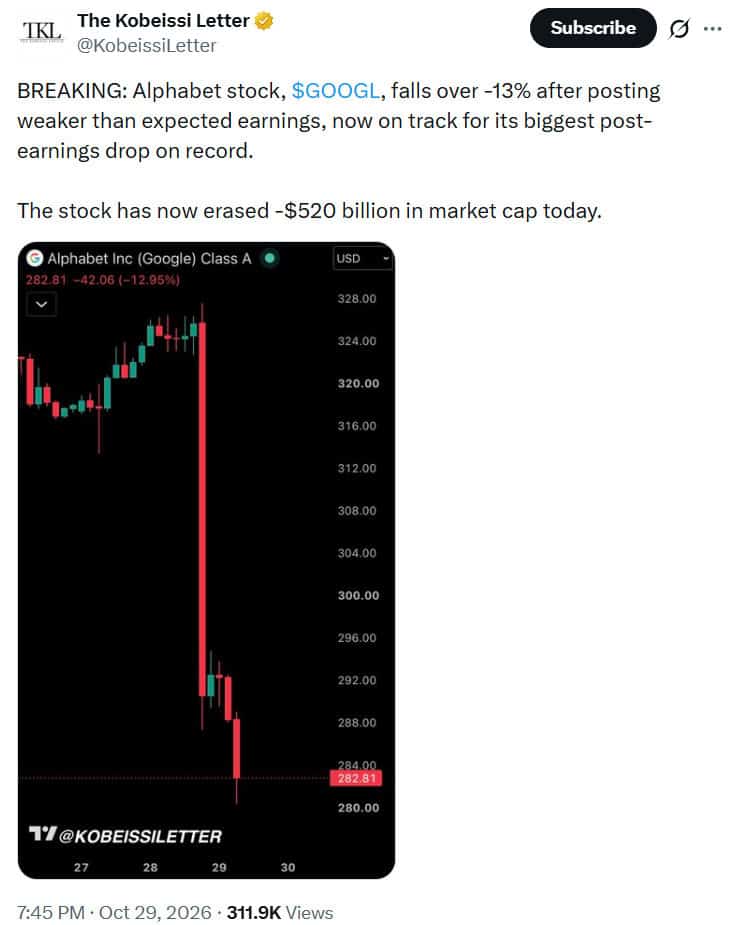
Alphabet ($GOOGL) fell nearly 13% after missing Q3 2026 revenue and EPS estimates, as slowing search ad growth and investment losses weighed on investor sentiment. Source: @KobeissiLetter via X
Cloud operating income more than tripled to $11.1 billion, while its operating margin expanded to 36.2%, compared with 23.7% in the same quarter last year. Alphabet also reported a $561 billion cloud backlog, reflecting substantial contracted demand for its services.
The company’s AI products showed further growth. Alphabet’s first-party model APIs were processing nearly 32 billion tokens per minute, representing a 40% increase from the previous quarter. The Gemini app also reached one billion users, while the company introduced additional models through its Gemini 4 Argon and Carbon lineup.
CEO Sundar Pichai pointed to increased search engagement as evidence that the company’s AI investments were supporting product usage. He said the year-over-year Search query growth rate was “the highest it’s been in the last five years.”
These developments offer a different perspective from the market’s reaction. Google Cloud is benefiting from enterprise demand, while Gemini adoption and AI-powered search are expanding the company’s reach.
However, the immediate challenge remains monetization. Alphabet must demonstrate that increased AI usage can generate enough advertising and subscription revenue to justify the substantial costs of building and operating its infrastructure.
Alphabet’s Class C shares (NASDAQ: GOOG) closed at approximately $282.32 on October 29, down 12.29% during the session. The stock also traded near $278.29 at its intraday low, reflecting strong selling pressure following the earnings announcement.
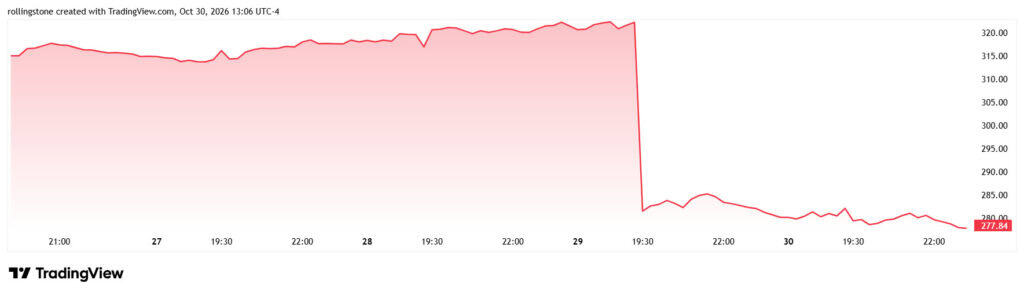
Alphabet Inc (Google) Class C price chart. Source: TradingView
The decline pushed shares below several important short- and medium-term moving averages. TradingView’s technical indicators point to a bearish short-term structure, with downward-sloping averages reinforcing the recent selling pressure. The Relative Strength Index (RSI) has also moved toward oversold territory.
However, an oversold RSI reading does not independently confirm a bullish reversal. Traders may look for stabilization and a confirmed recovery above nearby resistance before treating the decline as a potential trend change.
On the downside, the $275-$280 region represents an immediate support area. A sustained break below this zone could expose the stock to additional historical demand levels.
On the upside, the $290 level represents initial resistance, followed by the psychological $300 mark. A broader resistance region extends toward $328.50, where previously broken support levels could influence future price movements.
A sustained recovery above $300 would provide an early indication that selling pressure is easing. Until then, the technical structure remains under pressure, with buyers needing to defend the lower support region.
Alphabet’s latest earnings highlight the growing gap between AI demand and the financial cost of meeting it. Google Cloud, Gemini, and AI infrastructure services are attracting customers, but the company is also committing increasingly large sums to data centers, servers, networking equipment, and custom processors.
The pressure could continue into 2027. Management has already indicated that capital expenditure will rise significantly, while greater use of third-party computing capacity could weigh on cloud margins in the near term.
For investors, the central question is whether AI can strengthen Google’s existing businesses without weakening the economics of traditional search advertising. Alphabet’s expanding cloud business offers an important source of growth, but its search operations remain critical to overall revenue generation.
The latest sell-off shows that investors are increasingly focused on the financial returns from AI rather than spending commitments and product launches alone. Alphabet’s ability to convert growing AI adoption into higher revenue, improved margins, and positive free cash flow could become an important factor in determining the stock’s next direction.





No evento LINK:NYC, o co-fundador da Chainlink, Sergey Nazarov, destacou a missão da empresa de integrar as finanças tradicionais com as finanças descentralizadas (DeFi). Ele
The company plans to announce results before the U.S. market opens Monday, Nov. 2.
The company is scheduled to report before U.S. markets open Monday, Nov. 2. The revenue consensus is $3.25 billion, up 0.7% year over year.

Google’s satellite AI haiku highlights potential for scalable space-based data centers, but faces challenges in power and thermal management. The post Google’s Suncatcher satellite sends