

Bitcoin and XRP are often compared from a price perspective, but this is not the only lens through which they can be looked at. Both cryptocurrencies are native to first-mover blockchain networks, which have survived for more than a decade, have processed large amounts of value, and have built strong investor communities.
However, both blockchain networks are also different in their operation, and that difference is where the comparison becomes very interesting.
Bitcoin is the first decentralized monetary network secured by proof-of-work, giving it unmatched strength as a store-of-value system. The XRP Ledger, on the other hand, was built for fast settlement, low transaction costs, and a payments-focused utility.
Network reliability is the baseline by which any financial infrastructure is judged. Based on this measure, both Bitcoin and the Ledger carry strong records, but one has a better record than the other. According to data from one XRP market commentator that goes by the name Rob Cunningham on the social media platform X, the XRP Ledger has less documented downtime compared to the Bitcoin network.
Bitcoin’s documented downtime history runs to roughly 888 minutes, concentrated in two notable incidents that are now more than a decade in the past. These were an 8.5-hour outage in 2010 caused by a value overflow bug and a 6.3-hour disruption in 2013 stemming from a consensus fork. Since 2013, Bitcoin has maintained a clean 100% operational record, over 13 years of unbroken uptime as of mid-2026, with an overall historical uptime of approximately 99.988%.
The XRP Ledger’s documented downtime is much lower, at approximately 74 minutes in total. This downtime is concentrated in two brief events: a 10-minute disruption in November 2024 affecting some nodes due to a software bug, and a 64-minute consensus drift in February 2025 that self-healed without external coordination. The Ledger claims an uptime figure of approximately 99.999%, which puts it ahead of Bitcoin in this metric.
XRPL outpaces Bitcoin in terms of uptime, utility, speed, cost efficiency, and energy usage. Bitcoin processes blocks roughly every 10 minutes, with fees that fluctuate significantly during periods of network congestion. The XRP Ledger, on the other hand, processes transactions in three to five seconds, with consistent throughput. Transaction costs on the Ledger run to fractions of a cent, which is also consistently low regardless of network demand.
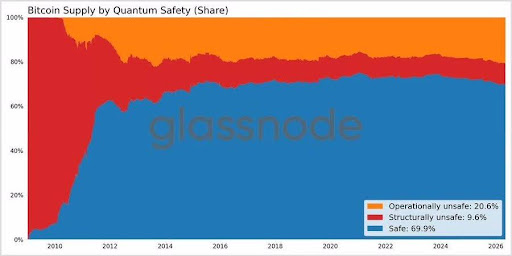
Perhaps the most forward-looking dimension of the comparison between the Bitcoin network and the XRP Ledger is how each network is positioning itself against the long-term threat of quantum computing. Bitcoin currently has no formal roadmap for post-quantum cryptography, but the Ledger is moving in a different direction.
Ripple published a detailed four-phase roadmap in April 2026 to prepare the XRP Ledger for a post-quantum future, targeting full readiness by 2028. The plan responds to recent research from Google Quantum AI that shows quantum computers could break current blockchain cryptography with fewer resources and on a faster timeline than previously estimated, with some scenarios placing a credible threat window as early as 2032.







Bitcoin’s long-term security model is once again under the spotlight following new data from Glassnode suggesting that the network could face theoretical risks in a
The case highlights the urgent need for robust regulatory frameworks in prediction markets, paralleling traditional finance’s legal standards. The post Google engineer charged with insider
Stalled US-Iran talks heighten market volatility, intertwining oil and crypto dynamics, and spotlighting geopolitical risk in trading strategies. The post Oil steadies near $89 as
With bitcoin down roughly 2.8% over the past seven days and the price touching a weekly low of $74,530 per coin, sleeping bitcoin wallets continue