
DFINITY launched MULTI/DEX, a fully onchain, multi-chain exchange on Internet Computer (ICP), in Play Mode on July 11. Simulated trading volume passed $243 million in 24 hours by July 13, according to the platform’s public dashboard.
All balances on the exchange are dummy assets, so no real money is at risk. The trial will decide whether the community hands the platform to the Network Nervous System (NNS) for ownerless execution.
MULTI/DEX runs entirely on the Internet Computer and lists Bitcoin (BTC), Ethereum (ETH), Solana (SOL), and ICP against an ICPUSD quote asset. It combines a central limit order book with a market-making automated market maker (AMM), according to the project’s documentation.
Traders can place spot orders or open margin positions with up to 10x leverage. An insurance fund built from 5% liquidation penalties absorbs bad debt. Meanwhile, every balance change writes to a hash-chained public ledger that anyone can verify in the browser.
DFINITY founder Dominic Williams announced the release on July 6 and positioned it as a direct challenge to centralized exchanges.
“MULTI/DEX — the world’s most advanced DeFi — will be released in game mode later this week, together with source code for ICP community eval. Players to get $100k dummy assets to compete. Will be offered to the NNS for autonomous/ownerless execution. *True* DeFi that mimics CEXs.”
Each player starts with $100,000 in simulated assets and competes on a public leaderboard. The exchange recorded over $162 million in volume and more than $129,000 in fees on its first day.
The launch followed a visible governance trail. NNS proposal 142,743 created a second SEV-enabled subnet with confidential computing to host MULTI/DEX. The subnet spans seven nodes across seven independent providers and seven jurisdictions.
A follow-up proposal on July 9 authorized the deployment of the exchange canisters on that subnet, according to the developer forum. However, the decisive vote that would make MULTI/DEX autonomous and ownerless has no date yet.
Activity has accelerated since launch rather than faded. The dashboard showed $243.2 million in 24-hour volume on July 13, alongside $352,061 in lifetime fees and $2.7 million in total value locked across four seeded pools.
The SOL market led with $85.9 million in daily volume, ahead of BTC at $75.3 million, ETH at $51.5 million, and ICP at $30.5 million. For scale, Robinhood Chain’s DEX record stood at $563.9 million in real trading last week.
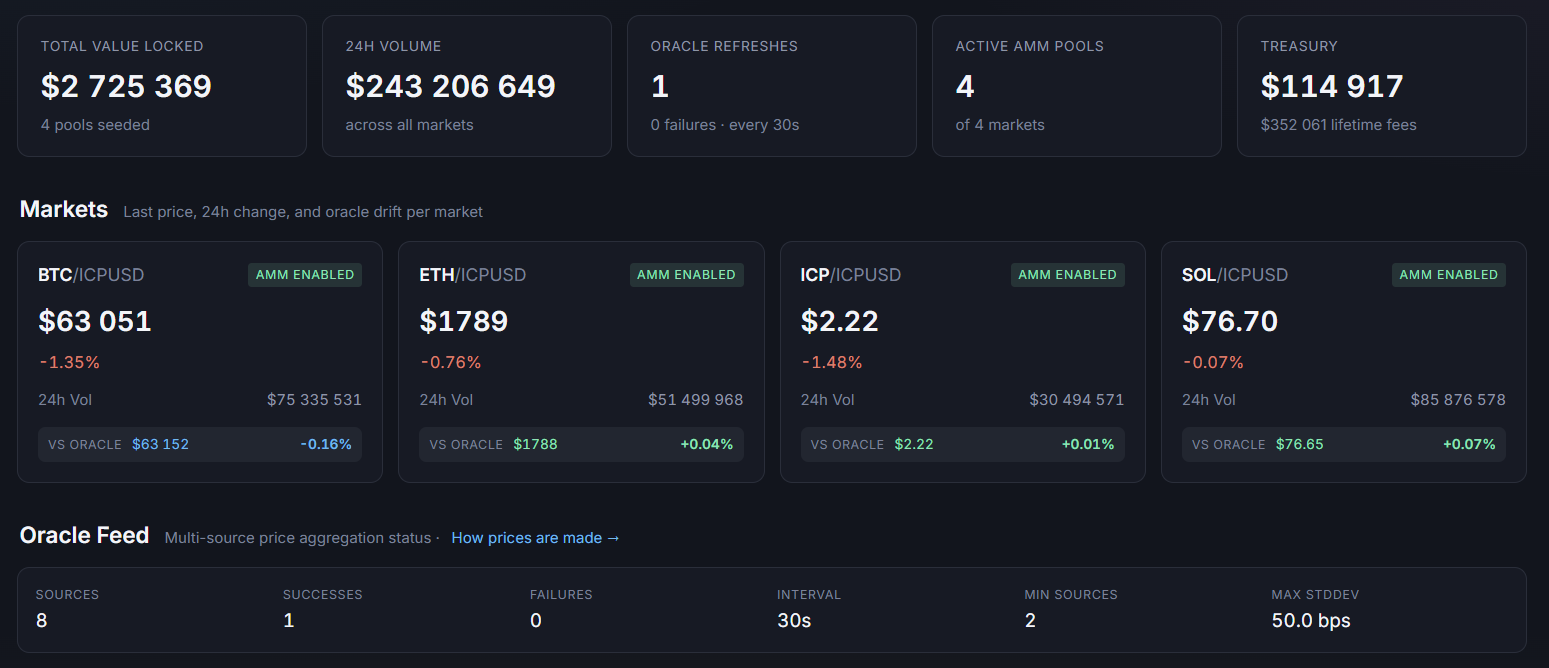
These figures measure engagement rather than economic demand, since every balance comes from a free play allowance. Still, the pace suggests traders are stress-testing the venue in numbers well beyond a typical testnet.
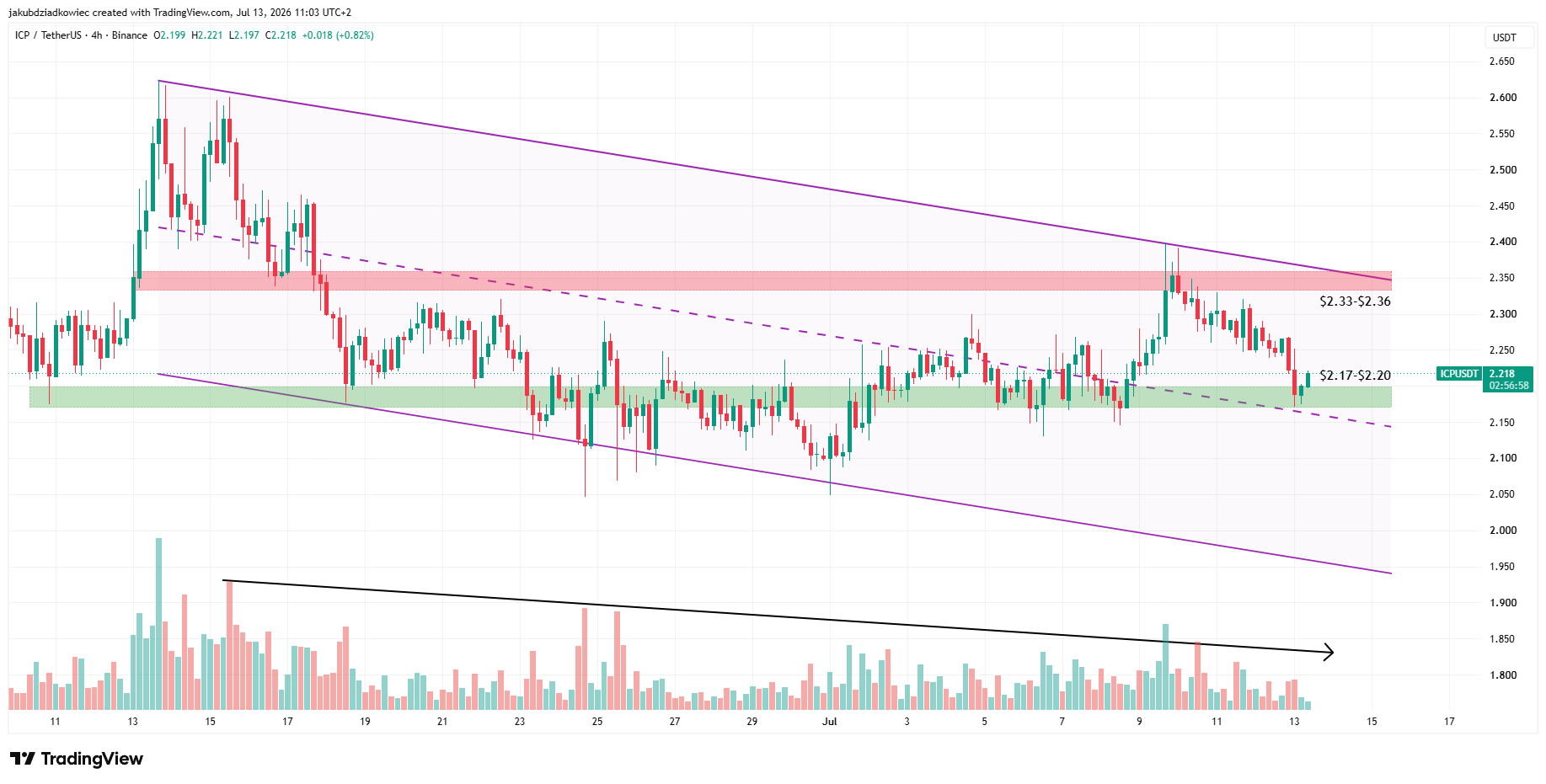
The token has not followed the excitement. According to BeInCrypto’s Internet Computer price data, ICP traded near $2.22 at press time, down 1.5% in 24 hours, with a $1.23 billion market cap at rank 60. The price sits just above its all-time low of $2.02, set in February 2026.
On the 4-hour chart, ICP has moved inside a descending parallel channel since mid-June. Sellers rejected the token at the $2.33 to $2.36 resistance zone on July 9, two days before the launch. The price then slid back to the $2.17 to $2.20 support area, where it bounced on Sunday.
Declining volume has accompanied the whole structure, signaling fading participation despite the launch news.
The weak price contrasts with strong network fundamentals. Internet Computer processed a record 98.3 million transactions in one day on July 8, per Chainspect data. The network already beat Solana in transactions over a 30-day stretch in May, and ICP joined June’s AI token rotation with double-digit gains.
Skeptics remain vocal on DFINITY’s own forum. One user described ICP DeFi as a thin market with years of low volume. Others criticized the Google sign-in requirement and flagged missing security headers on the MULTI/DEX site.
The real test arrives when DFINITY submits the exchange to the NNS vote. Whether play-mode engagement converts into real deposits, and whether an ownerless order book can hold up under real money, will define the experiment’s next phase.
The post ICP Traders Pile $243 Million Into Multi/DEX Where Nobody Can Lose a Cent appeared first on BeInCrypto.






Cardano trades near $0.1616, retesting the 20-day EMA after Iran-triggered volatility. Kraken’s $1B stake pool registration and 233 weekly GitHub commits signal quiet institutional confidence.
Binance posted an 80% monthly jump in futures volume in June 2026, outpacing rivals OKX and Bybit as CEX spot markets fell to a two-year
LeBron’s free agency stirs market speculation, potentially reshaping NBA dynamics and impacting team strategies as decision looms. The post LeBron James leaves Lakers, free agent
The Senate’s decision on the Clarity Act could significantly influence regulatory stability and investor confidence in digital assets. The post Senate faces four-week deadline for