
There were two scoreboards running on Monday. One was inside Vancouver’s BC Place, where New Zealand’s Finn Surman rose to meet a curling corner in the 15th minute and headed the All Whites into a 1-0 lead over Egypt in their Group G clash. The other was on-chain, where the World Cup has quietly become one of the largest live-betting and token-speculation events crypto has ever hosted. Halfway through the second half, Egypt evened the score with a headed goal of its own. 1 all. Game on.
The 2026 FIFA World Cup — 48 teams, 104 matches, 16 host cities across the United States, Canada and Mexico — is the biggest edition in the tournament’s history. It is also the first to come with a crypto exchange logo bolted onto the official sponsor board. For an industry that spent the last cycle fighting for legitimacy, that is the headline. The question for investors is whether the attention converts into anything durable, or whether this is 2022 with a fresh coat of paint.
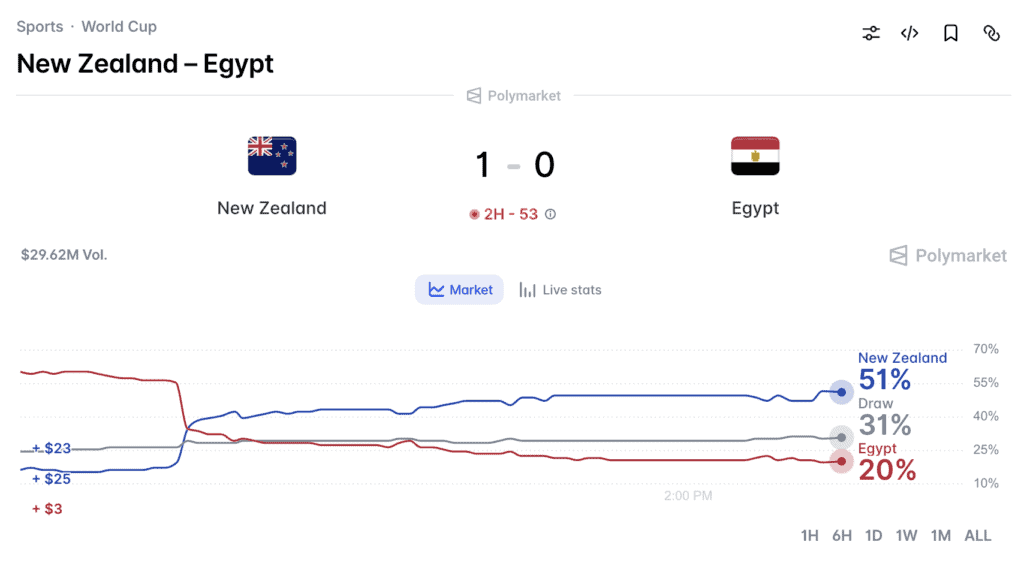
New Zealand are on the verge of history, can they win their frst ever world cup game? Source: Polymarket
On June 9, two days before kickoff, FIFA named Kraken — operated by Payward — as the Official Crypto Exchange Supporter of the 2026 World Cup. The deal puts a digital-asset brand alongside the soft-drink and credit-card names that have defined football sponsorship for decades, with activations planned across all 16 host cities and a launch tied to the Countdown Concert series that opened on June 10.
The language matters. Kraken is a “supporter,” not a top-tier “partner” — a carefully graded title that tells you FIFA is leaning in without betting the house. Even so, the reach is enormous: FIFA expects the tournament to engage more than six billion people worldwide.
Payward and Kraken co-CEO Arjun Sethi framed it in characteristically expansive terms. “Football is the one thing that moves the whole planet at once,” he said in FIFA’s announcement. “Money should work the same way.” FIFA’s chief business officer, Romy Gai, was more measured, pointing to a “shared commitment to innovation and technology” and new ways to “connect supporters with the tournament.”
Strip away the slogans and the logic is straightforward. Sports fans skew young, live on mobile and already spend freely on digital goods — fantasy leagues, in-game purchases, ticket resale. Kraken is paying for distribution to exactly the demographic crypto exchanges most want to acquire. Whether those eyeballs become funded accounts is the only metric that will matter when the confetti settles.
The clearest evidence that crypto is woven into this tournament is the prediction-market volume. Polymarket, which settles in USDC and accepts crypto deposits, has run more than 130 active World Cup markets with cumulative volume north of $2.9 billion, including over $1.8 billion on the outright winner market alone.
As of Monday, that winner market priced France as favorite at roughly 20%, following a 3-1 opening win over Senegal powered by Kylian Mbappé. Spain sat second near 14% after a flat 0-0 draw with Cape Verde, with England (~13%) and defending champion Argentina (~12%) tightly bunched behind. The compression at the top is a feature of the expanded 48-team format: more elite squads, more comparable depth, less separation.
For the home crowd reading from Auckland, the numbers are sobering. In Group G, prediction markets give Belgium — with Kevin De Bruyne and Romelu Lukaku — about a 62% chance of topping the group, Egypt around 27%, Iran roughly 8%, and New Zealand a distant ~4%. The All Whites to win the tournament outright trades at effectively zero, around a tenth of a cent. Monday’s lead over Egypt is meaningful for qualification math, not for the futures book.
The broader point is structural. Polymarket and rivals such as Kalshi have turned a football tournament into a high-frequency, crypto-settled financial market that reprices after every goal — exactly the kind of real-time, event-driven activity the prediction-market sector has been promising would arrive at scale.
The third leg is the most speculative. Chiliz (CHZ), the token underpinning the Socios fan-token ecosystem, has rallied around 28% during the tournament and is up roughly 46% over the past month, trading near $0.044. The mechanics are unusual: for every win by a participating national team, Chiliz burns up to 10% of its treasury-held fan tokens for that side, tying on-pitch results directly to token supply.
National-team tokens have multiplied ahead of the event. Belgium’s $BELG token launched on June 3 through a Socios offering with the Royal Belgian Football Association — two million tokens at $1 each — joining existing tokens for Argentina, Portugal and Italy. Notably, neither New Zealand nor Egypt has an active fan token, a reminder that the speculative layer clusters around the game’s commercial heavyweights, not its underdogs.
Here is where institutional memory should kick in. Ahead of the 2022 Qatar World Cup, CHZ surged roughly 380% — then dropped about 40% on the day the tournament kicked off, a textbook “buy the rumor, sell the news” unwind. The 2026 setup looks structurally larger and is supported by a new buyback-and-burn mechanism that did not exist three years ago, but the core risk is unchanged: these are date-specific catalysts with a scheduled expiry. Whale wallets reportedly control close to 69% of CHZ supply, which can amplify both the rally and the eventual exit.
All of this is unfolding against a soft crypto tape. Bitcoin is trading around $64,000, well off its highs, amid record monthly outflows from US spot Bitcoin ETFs and renewed jitters over Federal Reserve policy. The World Cup narrative is, in effect, a pocket of risk-on enthusiasm inside an otherwise cautious market — which is precisely why the seasonal tokens can run hard even as majors drift.
For investors, the framing is the takeaway. Kraken’s sponsorship is a long-term distribution play and should be judged on user acquisition, not match results. Polymarket’s volumes are real and sticky in a way fan tokens historically are not. And the Chiliz trade is exactly that — a trade, with a known catalyst, a known crowd, and a known history of reversing the moment the football actually starts mattering more than the speculation around it.


Recent data reveals that spot Bitcoin ETFs have experienced $227 million in net outflows from June 14 to June 18, marking the sixth consecutive week
On June 19, Toss Bank, South Korea’s third-largest internet-only bank, signed a memorandum of understanding with the Solana Foundation. This partnership aims to test global
Egypt’s historic World Cup win boosts fan token interest, highlighting the growing intersection of sports success and crypto market dynamics. The post Egypt secures first-ever
GoMining’s GoBTC Pay Bitcoin checkout system now has a live integration surface for its biggest claim: BTC payments that feel instant when settlement is routed