


MergeStorm AI is betting that developers have a review problem, not a writing problem. AI has quietly rewired how developers write code.
Copilot, Cursor, and a growing list of assistants can spit out hundreds of lines in the time it takes to grab coffee. Code gets written faster than ever. But somewhere along the way, a new problem snuck in: nobody quite figured out who’s supposed to review all of it.
The old model assumed a human would sit down, read through a pull request line by line, flag bugs, check style, and make sure the code actually does what it’s supposed to do. That worked fine when PRs trickled in. It doesn’t work nearly as well when AI tools are cranking out submissions faster than any team can keep up with.
MergeStorm AI is built around that exact gap. It’s not trying to replace the people doing code review, it’s trying to take the boring, repetitive parts off their plate so they can spend their attention on the stuff that actually needs a human brain: architecture decisions, business logic, the messy judgment calls.
So does it deliver? I spent a week pointing it at a few real repos to find out.
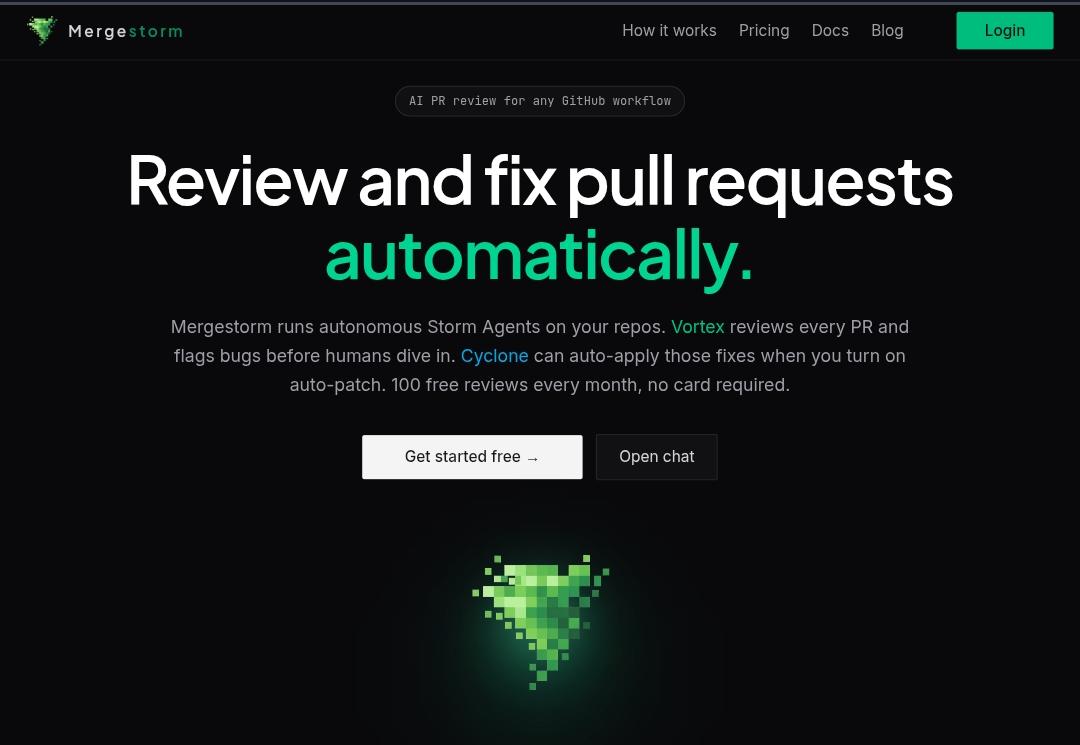
Primarily, MergeStorm is an automated review tool that lives inside GitHub. Connect it to a repo, and it starts reviewing pull requests the moment they’re opened or pushed to, no extra steps required.
What sets it apart from a typical linter is scope. Linters check syntax. They flag formatting issues and rule violations, but they have no idea what your code is actually trying to accomplish. MergeStorm claims to go further, reading the structure of your repo, parsing what changed in a given PR, and cross-checking that against what the task was supposed to solve in the first place.
The pitch isn’t “we’ll catch your typos.” It’s closer to “we’ll help you ship cleaner code without burning an extra hour of someone’s day.”
MergeStorm splits its work between a pair of AI agents, and the division of labor is one of the more sensible design choices in the product.
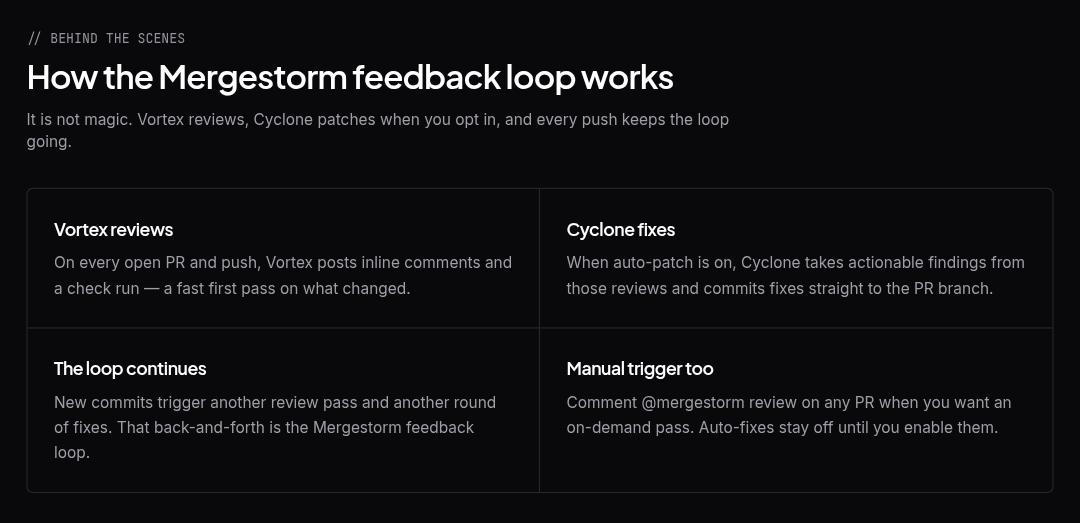
Vortex handles the actual reviewing. Push code to a PR, and Vortex goes through it looking for bugs, security gaps, sloppy implementations, anything that would normally earn a comment from a teammate. It doesn’t generate some separate report you have to go dig up, it drops comments straight into the PR thread, which makes the whole thing feel less like a tool and more like a colleague chiming in. If you’d rather trigger a review manually, commenting @mergestorm review does the trick, which I ended up using more than I expected on a couple of one-off branches I wasn’t ready to fully automate.
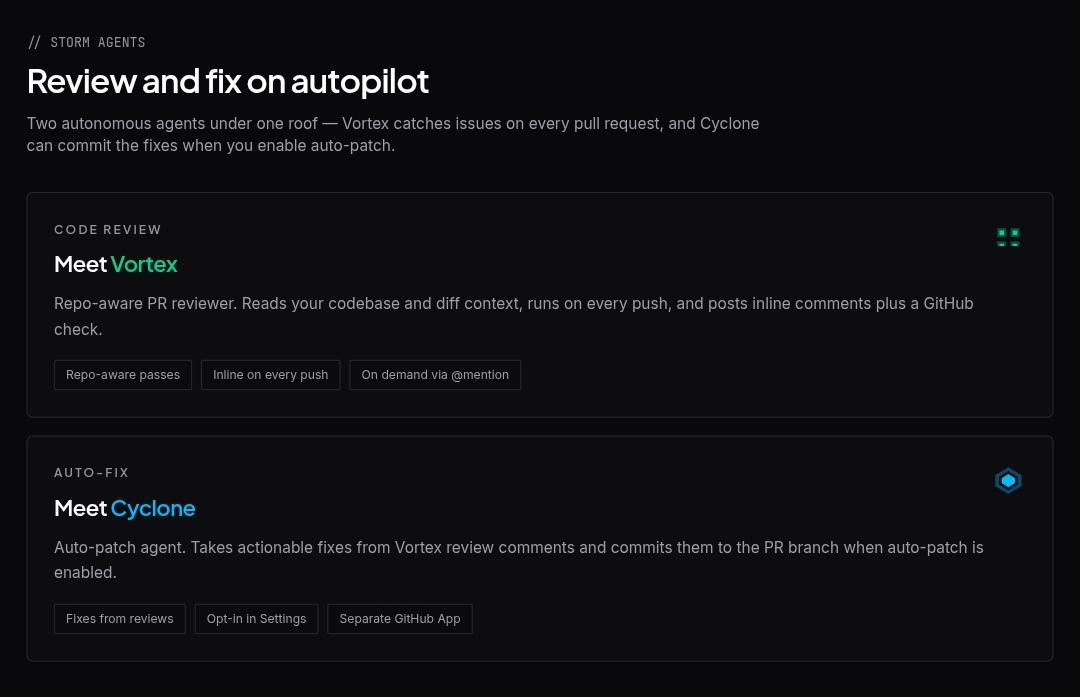
Cyclone is the more aggressive of the two. Instead of just pointing out problems, it tries to fix them, writing patches and committing them directly to the pull request. That’s obviously a bigger ask of trust, so it’s switched off by default. A team has to deliberately turn it on before Cyclone touches any code, and I left it off for the first few days just to see what Vortex flagged on its own before I let anything near auto-commit.
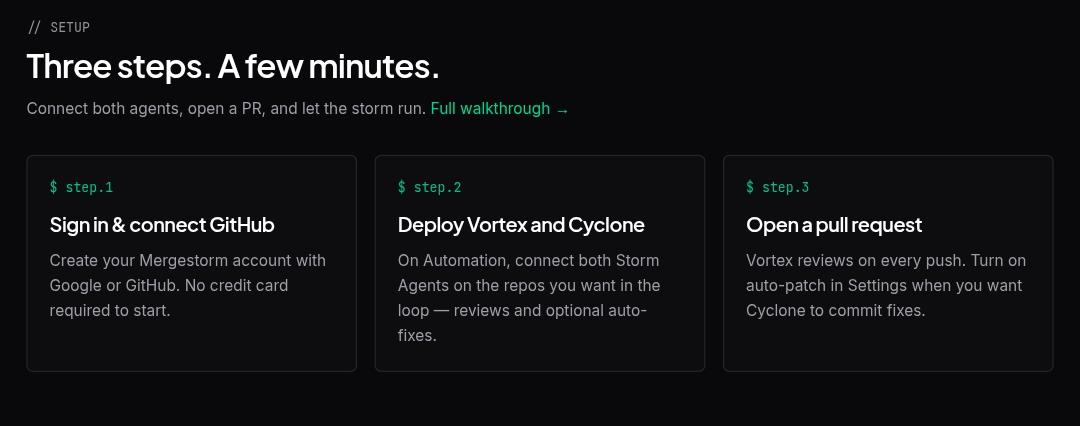
There’s not much friction here, and I mean that literally, I was signed in, connected, and watching Vortex comment on a live PR in under five minutes. Sign in with GitHub or Google (no card required), install the app on whichever repos you want covered, and connect both agents from the Automation tab. Vortex starts reviewing on the very next push.
If you want Cyclone in the loop too, that’s a separate toggle in Settings, not a bundled default, a distinction I appreciated once I understood how the two actually work together. Every new commit restarts the cycle: Vortex reviews again, and Cyclone patches again if auto-fix is on. No config files to write, no rules to define manually.
What’s happening under the hood is a bit more involved than a typical scanner. MergeStorm tries to figure out the broader context of the repo, work out what problem the PR is trying to solve, check whether the code actually solves it, and then run a more traditional pass looking for bugs, security holes, and risky patterns. The company calls this being “repo-aware,” and honestly, that’s the feature doing most of the heavy lifting in terms of differentiating it from older tools.
MergeStorm’s pricing turned out simpler than I expected going in, every tier gets the identical feature set (inline comments, GitHub checks, full-repo context, Cyclone auto-patch), and the only thing that changes as you climb the ladder is how many reviews you get per month. The free tier gives you 100 reviews with no card required, which was plenty for the scope of repos I was testing against. Starter runs $9.99/month for 400 reviews, Growth is $19.99/month for 1,000, and Scale tops out at $49.99/month for 3,000, priced, it seems, for teams running CI-heavy pipelines all day rather than solo devs. Nobody’s paying more to unlock Cyclone or repo context; you’re strictly paying for volume.
The contextual awareness is the real selling point. A lot of automated review tools look at a diff in isolation and miss how that change ripples through the rest of the codebase. MergeStorm’s attempt to understand the bigger picture means fewer irrelevant flags and, in theory, fewer false positives and in my own testing, the comments Vortex left felt noticeably more tied to what the PR was actually trying to do than the generic “consider refactoring this” notes I’ve gotten from other tools.
The automation angle matters too. If a bot catches the obvious stuff, the missed null check, the inefficient loop, the leftover debug line, before a human even opens the PR, that human gets to spend their time on the conversations that are actually worth having: is this the right architecture, will this scale, does this match what the product needs.
Splitting Vortex and Cyclone into separate, opt-in pieces was a smart call. A team that’s not ready to let an AI commit code can still get the review benefits without handing over the keys. And for a solo developer working without a team to lean on, having something checking your work before it ships is genuinely useful, even if it’s not a substitute for a second human opinion.
This isn’t an empty market. CodeRabbit, GitHub’s own Copilot Reviews, and Greptile are all chasing the same problem from slightly different angles.
CodeRabbit leans into detailed, conversational explanations, it reads more like a teammate walking you through their reasoning. Copilot Reviews has the obvious advantage of being baked into the Microsoft/GitHub ecosystem already. Greptile’s strength is handling large, tangled codebases with deep dependency chains.
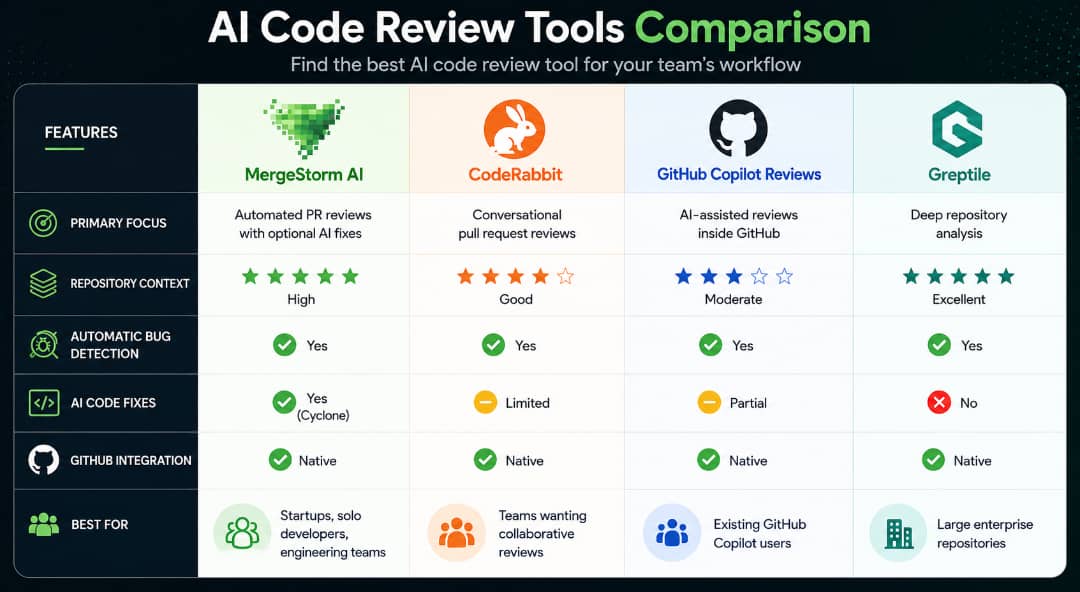
MergeStorm’s angle is trying to do more of the lifecycle itself, catching issues and, if you let it, fixing them, while still keeping enough repo context to make its feedback feel relevant rather than generic. It’s a reasonable middle ground if you want speed without completely giving up human oversight.
MergeStorm isn’t trying to replace developers, and it’s upfront about that. What it’s actually doing is cutting down the repetitive part of review so engineers can spend their time where it counts.
The repo-aware analysis, the GitHub-native setup, the two-agent split, the optional auto-fix, and the volume-based pricing that doesn’t gate features behind higher tiers, all of it adds up to something that makes sense for solo developers, small teams, or startups trying to move fast without sacrificing too much quality control.
That said, no tool like this should be the last line of defense. Architecture decisions, security trade-offs, long-term maintainability, those still need an experienced human looking at them. MergeStorm works best as a first pass, not a final word. By the end of my week with it, that’s exactly how I’d started treating it, not as a gatekeeper, but as the colleague who reads every PR before I have to.
If your team lives in GitHub and you’re tired of burning review cycles on things a bot could’ve caught, it’s worth trying out. AI isn’t replacing code review here, it’s just clearing out the noise so the humans can focus on what actually matters.

Disclosure: This is not trading or investment advice. Always do your research before buying any cryptocurrency or investing in any services. Follow us on X @nulltxnews






The attack exacerbates tensions, diminishing ceasefire prospects and highlighting the strategic shift towards aerial dominance and infrastructure targeting. The post Russian bombing in Kiev kills
Ayar Labs’ funding surge highlights a shift towards optical tech in AI semiconductors, signaling a potential industry-wide transformation. The post Ayar Labs raises $500M at
Gillibrand’s push for crypto ethics laws could reshape political accountability, impacting bipartisan support and future crypto regulations. The post Kirsten Gillibrand calls for ban on
The shrinking workforce complicates the Fed’s balancing act between controlling inflation and supporting employment, impacting market dynamics. The post US unemployment rate falls in June