

The comments came during a CNBC interview on June 27, where Garlinghouse questioned Strategy’s reliance on debt and preferred stock offerings such as STRC to finance additional Bitcoin purchases. While he maintained a bullish outlook on Bitcoin itself, he argued that the financing approach behind the company’s accumulation strategy presents broader risks for the crypto market.
Garlinghouse took direct aim at Strategy, formerly known as MicroStrategy, and Executive Chairman Michael Saylor for raising capital through perpetual preferred shares, including STRC, to expand the company’s Bitcoin holdings.
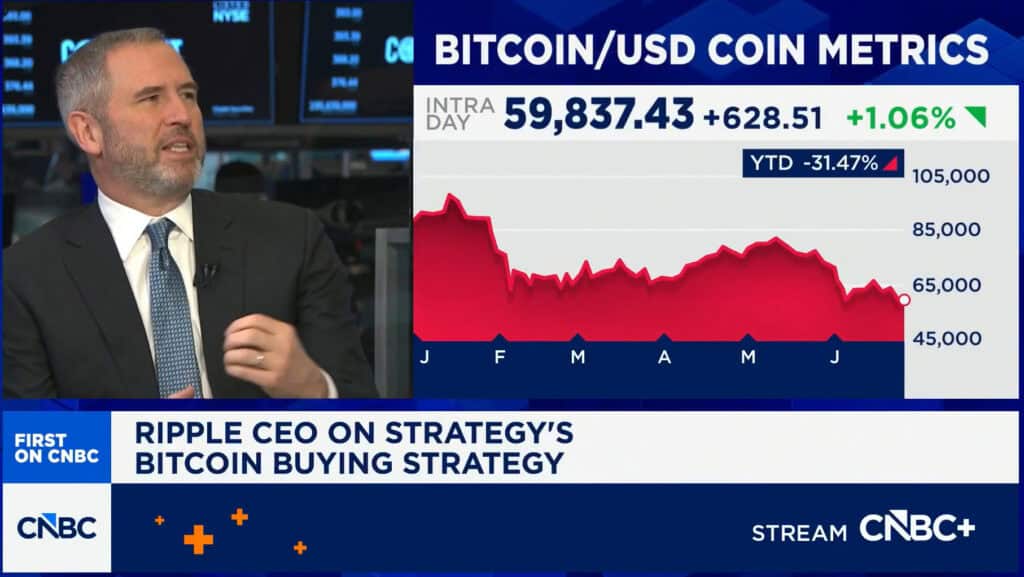
During a CNBC interview, Ripple CEO Brad Garlinghouse said Strategy’s aggressive use of debt and preferred stock to finance Bitcoin purchases is hurting the broader crypto market. Source: @cryptogoos via X
According to Garlinghouse, relying on high-yield securities to purchase additional BTC amounts to “financial engineering” rather than creating value through blockchain adoption and real-world use cases.
He specifically pointed to the performance of STRC, which launched with an 11.5% dividend and a target par value of $100 but has since traded roughly 25% below that level.
Calling the decline a “damning indictment,” Garlinghouse argued that investor demand has failed to support the structure as intended.
“It’s financial engineering,” Garlinghouse said during the interview, adding that the model has “hurt the broader crypto market” by shifting attention away from utility-driven innovation.
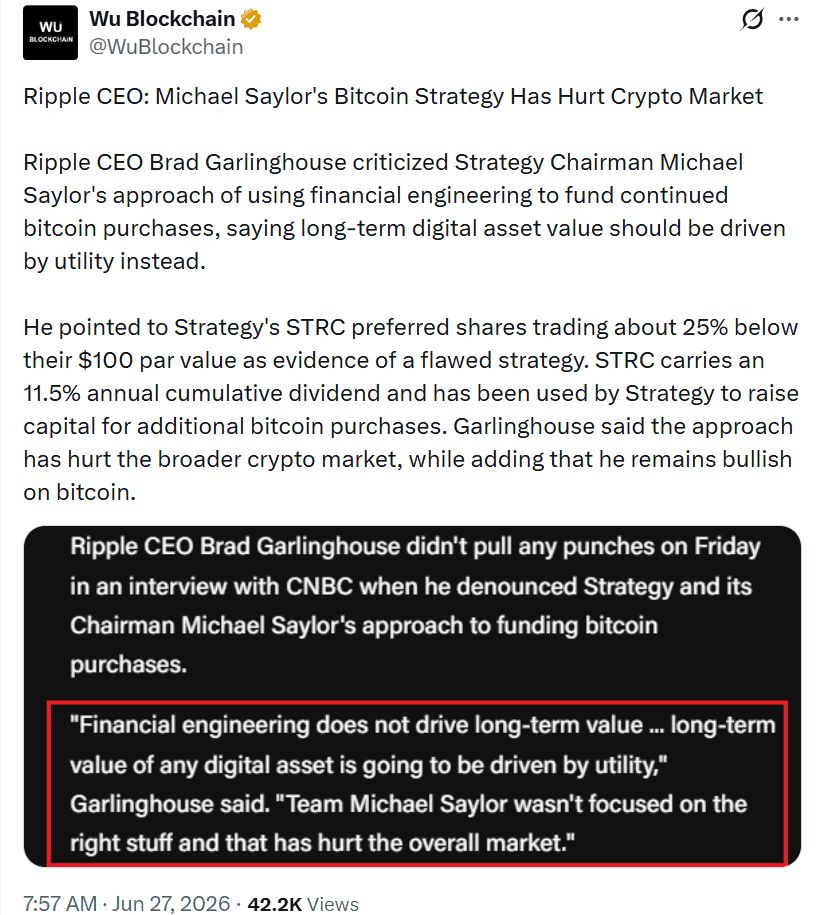
During his CNBC interview, Brad Garlinghouse said STRC trading about 25% below its $100 par value despite its 11.5% dividend is a “damning indictment” of Strategy’s financing model. Source: @WuBlockchain via X
Despite the criticism, the Ripple CEO made it clear that his comments were directed at the financing strategy rather than Bitcoin itself.
“I remain very bullish on Bitcoin over the long term,” Garlinghouse said, noting that growing institutional participation and broader adoption continue to strengthen the asset’s long-term investment case.
His remarks have renewed discussion about whether aggressive corporate treasury models create lasting shareholder value or introduce unnecessary financial risk through leverage.
Garlinghouse’s comments come as Michael Saylor continues to defend Strategy’s aggressive Bitcoin accumulation plan despite recent market pressure.
In recent public remarks, Saylor reiterated that the company intends to hold its Bitcoin for “100 years,” emphasizing that previous market crashes reinforced conviction among long-term investors rather than weakening it.

Michael Saylor said Strategy plans to hold Bitcoin for 100 years, arguing that the crash from $66,000 to $16,000 eliminated short-term investors while reinforcing long-term conviction. Source: Vivek Sen via X
Reflecting on Bitcoin’s decline from approximately $66,000 to $16,000 during the 2022 bear market, Saylor said the correction removed speculative participants while committed holders remained focused on the long-term thesis.
“The tourists left. The believers stayed,” Saylor said, describing severe market drawdowns as a test of conviction rather than a reason to abandon the strategy.
As of June 2026, Strategy holds more than 847,000 BTC. However, the company has also faced increasing scrutiny as Bitcoin trades near $60,000, below its reported average acquisition cost of more than $75,000 per coin. Investors have also been watching the firm’s preferred stock obligations following a small sale of 32 BTC to help fund dividend payments.
The differing viewpoints illustrate an ongoing divide within the digital asset industry. Supporters argue that Strategy has created one of the most successful corporate Bitcoin treasury models to date, while critics question whether continued leverage can remain sustainable during prolonged market downturns.
Bitcoin traded around $60,064 in late June, posting a modest intraday gain of roughly 0.21%, but the broader technical picture continues to reflect cautious sentiment.
TradingView’s composite technical summary currently rates Bitcoin as Neutral, based on 14 Sell, 8 Neutral, and 4 Buy signals. However, the longer-term outlook remains weaker, with a Strong Sell reading on the one-week timeframe and a Sell rating on the one-month chart.
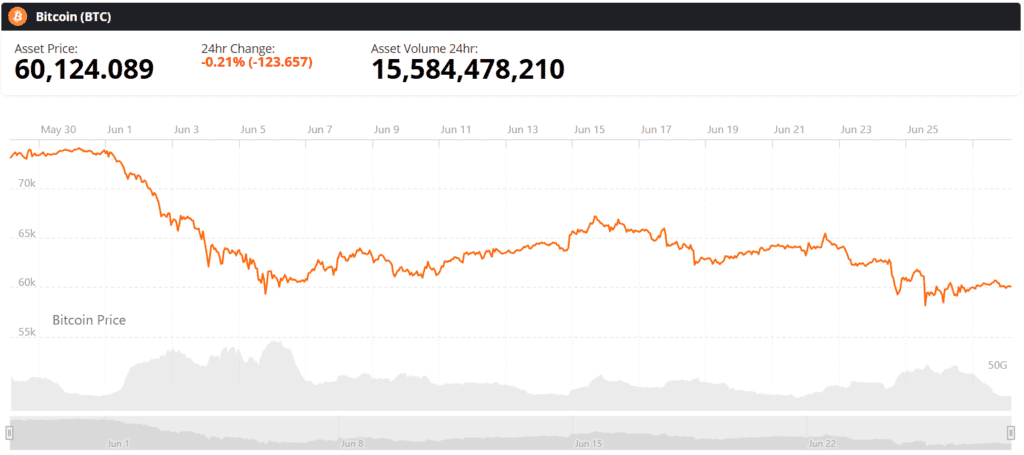
Bitcoin (BTC) was trading at around $60,124, down 0.21% in the last 24 hours at press time. Source: Bitcoin price via Brave New Coin
Momentum indicators present a more balanced picture. The Relative Strength Index (RSI 14) stands at 32, approaching oversold territory without yet confirming a reversal. The Stochastic %K (14,3,3) reads 21, while the Commodity Channel Index (CCI 20) sits at -118, generating a Buy signal that may indicate oversold conditions.
Meanwhile, the MACD (12,26) remains negative at -2,317, reflecting persistent bearish momentum. However, Momentum (10) at -2,827 and the Stochastic RSI Fast reading of 12 suggest selling pressure could be gradually easing.
Moving averages continue to present the biggest obstacle for bulls. TradingView shows a Strong Sell consensus across moving averages, with 13 Sell, 1 Neutral, and 1 Buy signals. Bitcoin remains below nearly all major EMAs and SMAs.
Short-term moving averages between $61,000 and $64,000 now form an important resistance zone. Longer-term averages, including the 50-day, 100-day, and 200-day measures, remain substantially higher between $67,000 and above $76,000, reinforcing the prevailing bearish trend.
The Hull Moving Average (9) at $59,031 is currently the only major indicator issuing a Buy signal, acting as nearby dynamic support.
From a price structure perspective, traders continue monitoring the $59,000-$62,000 support region. Holding above this area could allow Bitcoin to attempt a recovery toward the $61,500-$63,000 resistance cluster. Failure to maintain support, however, may expose BTC to another move toward the $55,000-$57,000 range.
While several momentum indicators hint that the recent sell-off may be losing strength, technical evidence still favors caution until Bitcoin reclaims key moving average resistance levels and confirms a stronger trend reversal.






The REX-Osprey SOL + Staking ETF is set to launch soon, marking a pivotal moment in the U.S. ETF landscape. This ETF aims to provide
A recent tweet by user tier10k reveals that 127,271 BTC, valued at approximately $14 billion, is sought for forfeiture. This Bitcoin is linked to the

The European Securities and Markets Authority (ESMA) has directed unauthorized crypto asset service providers to stop accepting new EU clients and begin exiting the market
Uniswap has recently reported a significant liquidity migration, with Spark moving $150M to its protocol. This migration is a notable event in DeFi history, as