

Three weeks, that’s all it took for Robinhood Chain to cross $700 million in onchain assets, and I still don’t think enough people have clocked how fast that actually is.
I’ve watched new chains launch with all the fanfare in the world and quietly die within a month. This one didn’t die. It sped up. And now Trust Wallet has made it free to move money in and out of, at least for a little while longer.
Trust Wallet confirmed that swaps on Robinhood Chain are running 24/7 through its built-in dex feature, with every cross-chain swap into the network, plus token-to-token swaps already on the chain, sitting at zero fees until July 28, 2026. I didn’t want to just repeat that headline without checking it myself, so I actually ran the swap start to finish.
Split the number up and the picture gets more interesting than the topline figure suggests. Stablecoins account for $430 million of it, DeFi protocols hold $500 million, and $200 million is actively earning yield through Morpho at a 7% rate.
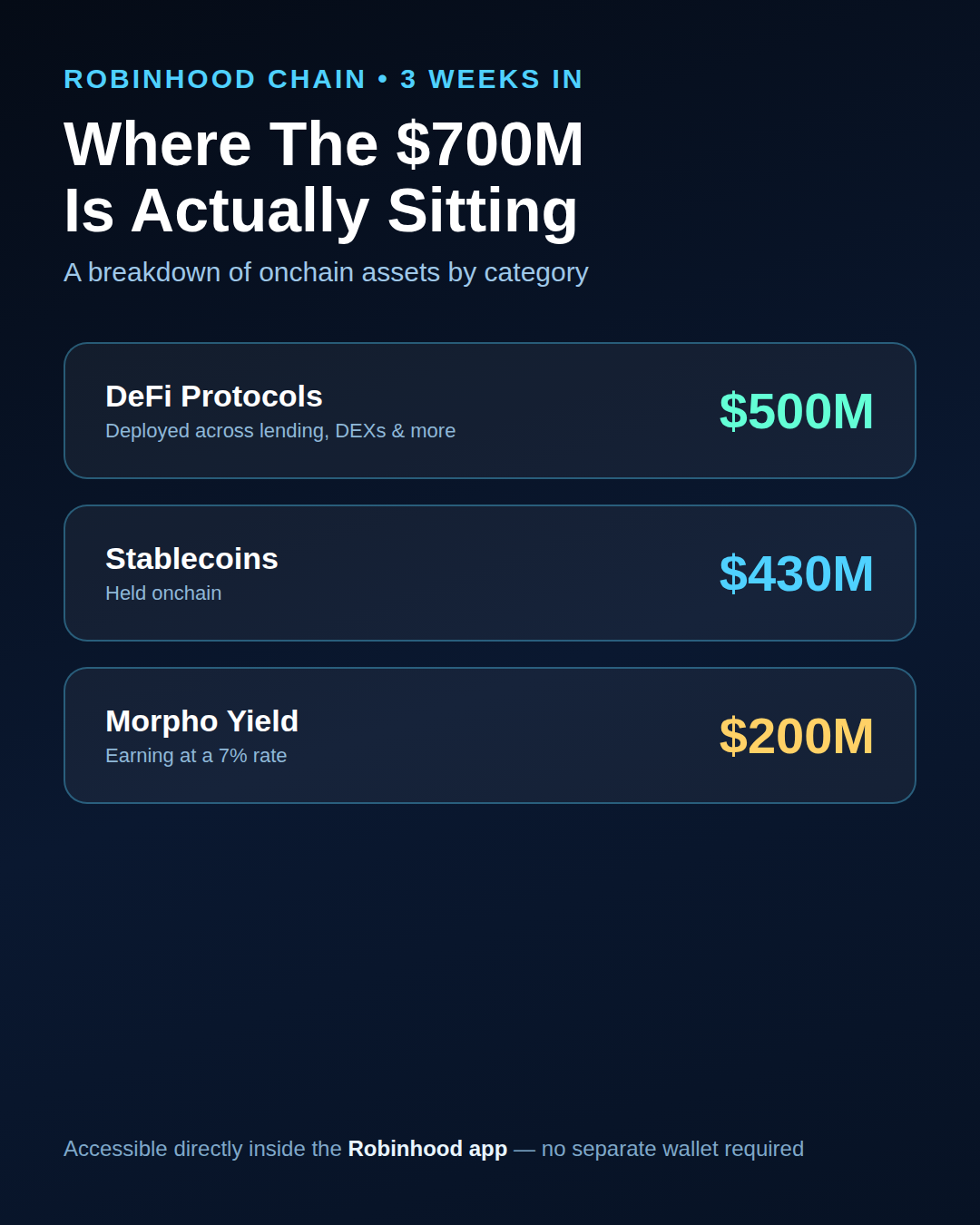
That last figure is the smallest of the three, but I’d argue it’s the one that actually matters most.
Users can tap into that Morpho yield straight from inside the Robinhood app, no separate wallet required, no bridging, no wrestling with an unfamiliar DeFi interface. If you’ve ever tried walking a non-crypto friend through connecting a wallet just so they could earn yield on a stablecoin, you know exactly how big a wall that used to be. Robinhood just knocked it down for its entire existing user base in one move.
I opened Trust Wallet and went through the process the way an average user would.
Step 1: Open the Swap tab.
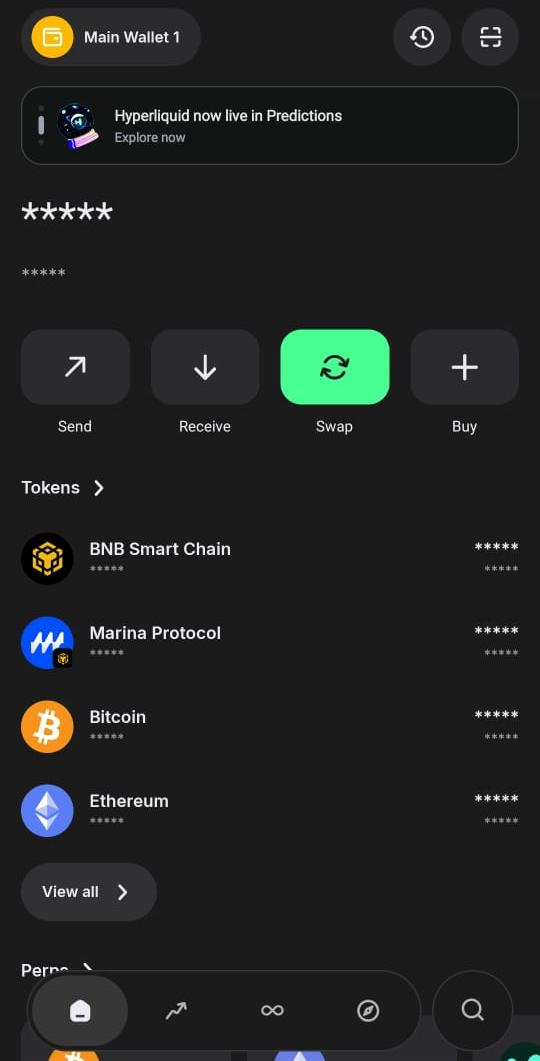
From the Trust Wallet home screen, tap the Swap icon. This drops you into Trust Wallet’s built-in dex aggregator, the same feature you’d normally use to swap tokens on any supported chain.
Step 2: Switch the network to Robinhood Chain.
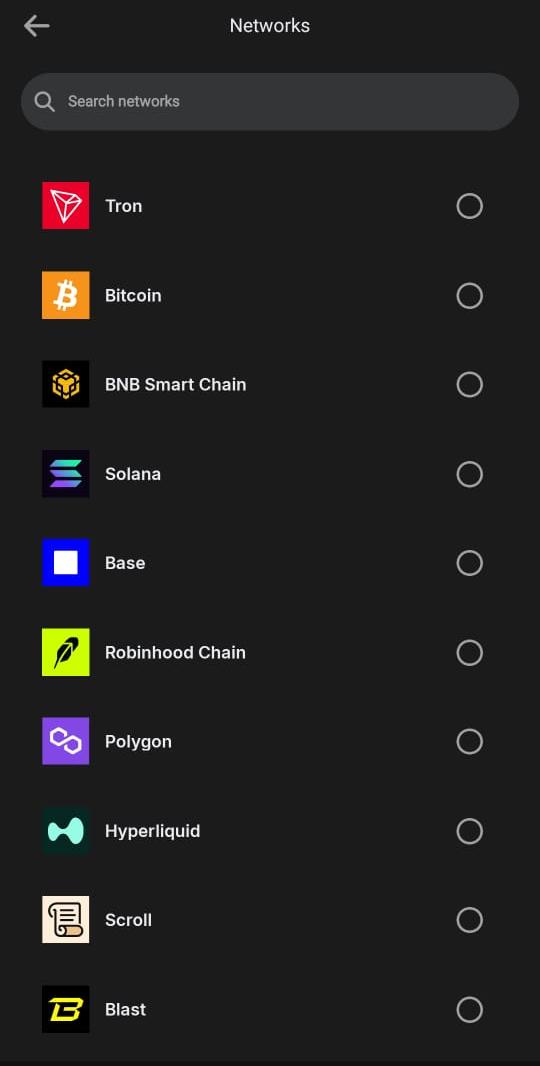
By default, Trust Wallet will show whatever network you last used. Tap the network selector at the top of the swap screen and choose Robinhood Chain from the list. This is the step I’d guess most people miss the first time, since it’s easy to assume the wallet defaults to the right chain automatically. It doesn’t. You have to select it manually.
Step 3: Choose what you’re swapping from.
If you’re bridging in from another chain, like Ethereum or Base, select your source asset and source network. This is the cross-chain swap scenario, moving an asset from wherever it currently lives directly onto Robinhood Chain in a single transaction. If you’re already holding assets on Robinhood Chain and just want to trade between tokens on the chain itself, both your source and destination should be set to Robinhood Chain.
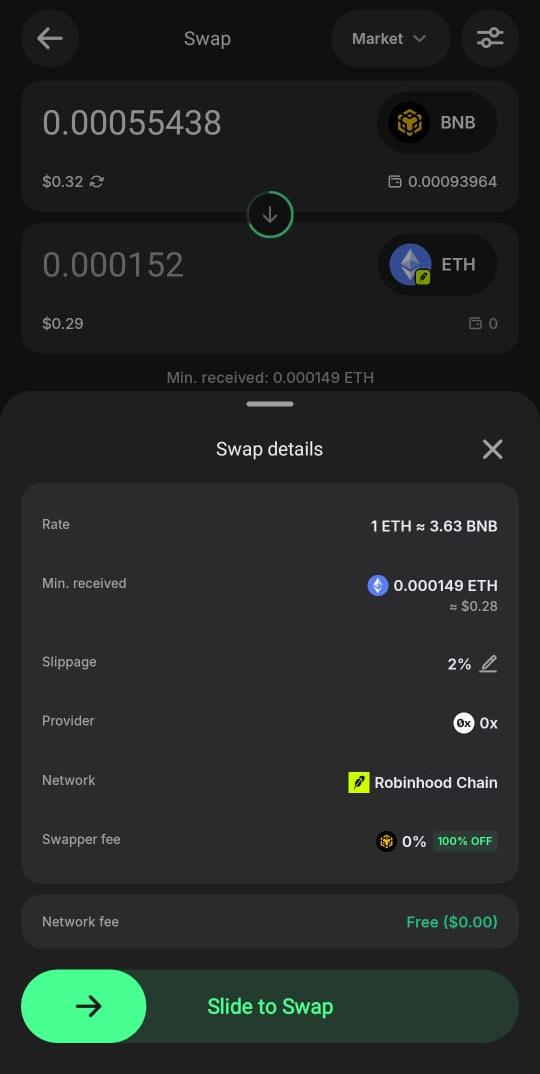
Step 4: Choose what you want to receive.
Select your destination asset in the “Receiving” field. Trust Wallet will pull a quote showing the exchange rate and estimated amount you’ll receive.
Step 5: Check the fee breakdown before confirming.
This is the part worth actually looking at rather than skipping past. Through July 28, 2026, Trust Wallet is waiving its swap fee entirely for both cross-chain swaps into Robinhood Chain and swaps within tokens on Robinhood Chain. You should see that reflected in the quote as a 0% platform fee. One thing to keep in mind: you’ll still see standard network gas costs, since Robinhood Chain runs on ETH for gas. The fee being waived is Trust Wallet’s own swap fee, not the underlying network cost of processing the transaction, though gas on Robinhood Chain is minimal given its 100 millisecond block times.
Step 6: Review and confirm.
Once the quote looks right, confirm the swap. Because Robinhood Chain’s block times are so fast, I noticed the transaction settled almost immediately compared to the wait I’m used to on slower chains.
Step 7: Verify the asset landed.
After confirming, check your Trust Wallet balance on Robinhood Chain to make sure the swapped asset shows up correctly. If you swapped into a stablecoin with the intention of earning yield through Morpho, this is the point where you’d move on to depositing it.
Worth flagging plainly: this fee waiver has a hard expiration on July 28, 2026. It’s a promotional push tied to the chain’s early growth, not a permanent feature. And double-check you’re actually selecting Robinhood Chain rather than something with a similar name, since wallet interfaces have a habit of listing chains with confusingly overlapping labels.
None of this activity happened by accident. Robinhood launched this chain earlier in the month as an Ethereum layer 2 built on Arbitrum, running 100 millisecond blocks, gas paid in ETH rather than some new native token, permissionless for any builder, and live across more than 120 countries. On paper it reads like infrastructure purpose-built for tokenized stocks and real-world assets. In practice, the degens found it first.
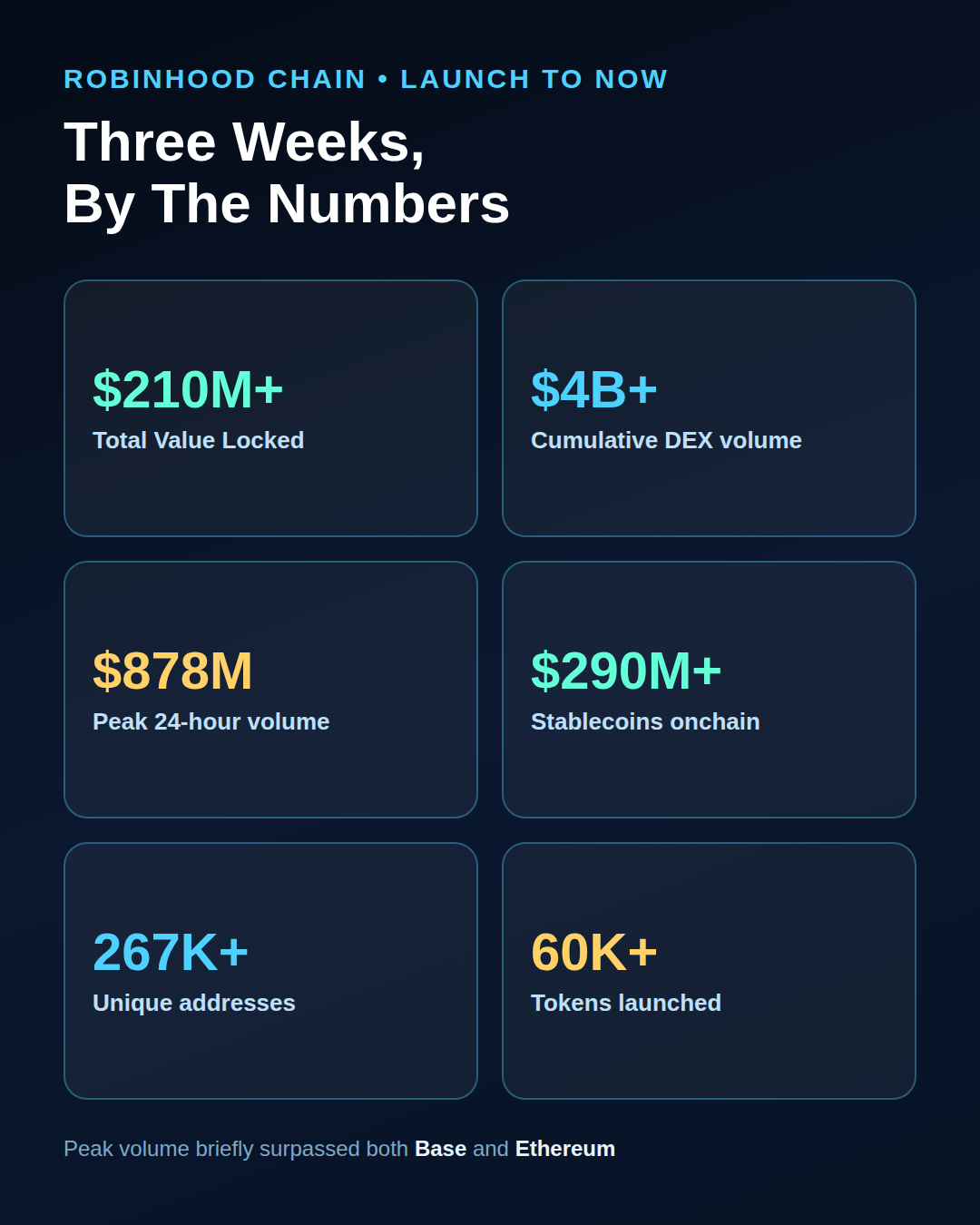
Three weeks in, the chain is carrying more than $210 million in TVL, cumulative DEX volume above $4 billion, a peak 24-hour volume of $878 million that briefly outran both Base and Ethereum, over $290 million in stablecoins, more than 267,000 unique addresses, and upward of 60,000 tokens launched. I’ve watched chains chase numbers like that for months and never get close. This one hit them before its third week was even over.
Robinhood CEO Vlad Tenev addressed the mismatch head-on, saying the chain is meant to be the best option for real-world assets while admitting it’s working just as well for memes. That’s an unusually honest thing for a CEO to say about watching his own infrastructure get hijacked by speculation before its intended use case even got off the ground.
The token activity backs it up. $CASHCAT, apparently named after an option Robinhood itself nearly went with, ran to a $230 million market cap before settling back around $80 million. $PONS, the top launchpad token, is holding above $20 million after starting from almost nothing. $Hoodrat had its own major run alongside them. DEX volume went from $200,000 to more than $500 million in nine days flat after Tenev’s tweet went out. I don’t think that number needs much explaining. Jumps like that don’t happen on chains without real, if chaotic, organic attention behind them.
With that much speculative money moving through so quickly, a fight over launchpad dominance was inevitable, and it’s already underway. Whichever platform produces the next $100 million memecoin effectively wins the attention, volume, and fees that come with becoming the default place degens go first. It’s worth watching closely, because these launchpad wars tend to concentrate liquidity around an early leader fast, and challengers rarely close that gap once it opens.
Underneath the memecoin noise, the more durable number keeps climbing regardless. Assets deposited into applications on Robinhood Chain have surpassed $480 million, up roughly 50% in the past week alone, with lending protocols, spot exchanges, and perpetual DEXs leading the pack. That tells me there’s real financial infrastructure forming here, not just a speculative wave riding on nothing.
Most chains get one or the other: genuine financial activity, or memecoin volume. Rarely both at meaningful scale, and rarely at the same time. Robinhood Chain has managed both in parallel for three weeks straight, and now a major exchange has thrown open zero-fee access to the whole thing. Whether that balance survives once the free swap window closes on July 28 is the part I’ll be watching closest from here.
Some visuals in this article are AI-generated illustrations created to demonstrate Trust Wallet features and are not actual screenshots of the app. For accurate, up-to-date information or to interact directly with the wallet, please visit https://trustwallet.com/.
Disclosure: This is not trading or investment advice. Always do your research before buying any cryptocurrency or investing in any services. Follow us on X @nulltxnews


Iran activates air defenses in Tehran amid rising tensions. Full airspace closure by July 31 at 30.5% YES, by August 31 at 44% YES. The
Azerbaijan confirms secret talks between Germany and Russia on Ukraine. Ceasefire agreement by December 31, 2026 at 35.5% YES. The post Azerbaijan confirms secret German-Russian
Iran escalates attacks on US Navy vessels in the Strait of Hormuz. US invasion of Iran before 2027 at 27.5% YES. The post Iran escalates
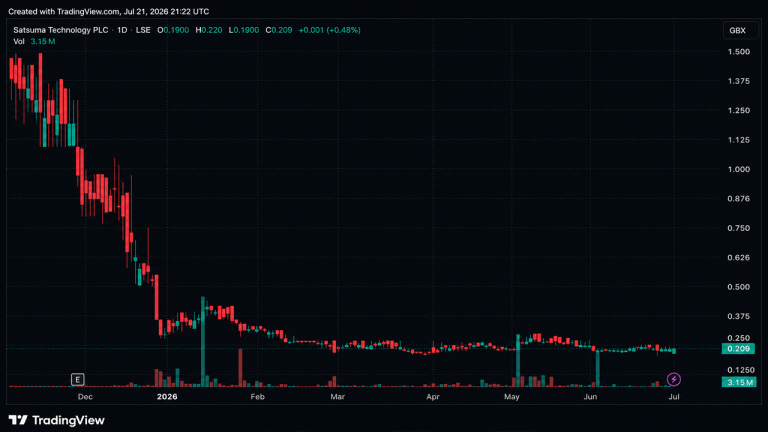
Satsuma Technology shareholders voted overwhelmingly to liquidate the London-listed company, sell its remaining 668 bitcoin and return capital to investors after a treasury strategy unraveled