



Green’s central argument is that the digital gold narrative, while true, is incomplete and increasingly expensive to leave unchallenged. There is roughly $260 billion in Bitcoin sitting idle on corporate treasuries, ETF balance sheets and miner books, paying 10 to 50 basis points a year in custody fees and earning nothing. That, he says, is what pristine collateral looks like when it has nowhere productive to go. Rootstock’s pitch is to change the denominator: keep the security model of Bitcoin, but give holders the ability to borrow against their stack, run it through tokenized real-world asset vaults, or deploy it into native yield strategies without selling a single satoshi. The first product out of the new institutional unit, launching in the next month, is a Bitcoin-collateralized loan aimed squarely at miners who are sitting on inventory but still need to pay the power bill.
The proof points are no longer theoretical. Mercado Bitcoin recently deployed $20 million of tokenized private credit on Rootstock, with a $100 million target by April, giving Bitcoin holders Brazilian receivables and corporate debt exposure they would otherwise struggle to access. In Japan, where Green sees an unusually crypto-curious institutional base, Rootstock has partnered with Animoca Brands Japan to bring corporate treasury and BTCFi tooling to a market that historically follows rather than leads but is now reportedly seeing 80% of investors plan crypto allocations within the year. Midas, Hyperithm and other ecosystem builders are stacking institutional-grade vaults on top of the chain, with custody handled through the usual professional suspects — Fireblocks, Fordefi and Utila — and Green argues spreading risk across providers and protocols is the obvious lesson from a year of high-profile DeFi hacks.
Where the conversation gets provocative is on what Bitcoin actually competes with. Green draws on Bitwise CIO Matt Hougan’s framing of Bitcoin as an out-of-the-money call option on becoming a payment instrument, and argues that the real prize is the roughly half of global savings parked in fine art and real estate — illiquid stores of value that Bitcoin, once composable through chains like Rootstock, can simply do better. He is candid about the risks, too: concentration in a handful of ETFs and the dominance of Strategy as the largest non-Satoshi holder are not trivial, even if he thinks the diversification of providers is happening fast enough. His closing critique is one the institutional crowd will recognize — DeFi has an institutional-grade communications problem, and until protocols learn to handle incidents the way Circle handled its de-peg, the larger pools of capital will keep migrating to centralized custody. Stick around for his sketch of what a five-year transition to Bitcoin-backed mortgages and productive retail BTC actually requires.
If you enjoyed the show please subscribe to the Crypto Conversation and give us a 5-star rating and a positive review in whatever podcast app you are using.







Oil markets slid over the Memorial Day weekend as President Trump said a deal to reopen the Strait of Hormuz is “largely negotiated,” pulling Brent
After a handful of winning trades, many crypto investors begin to believe they have a special ability to “read the market.” But behavioral economists warn
Vitalik Buterin laid out a direct case on Sunday for why the Ethereum Foundation must become a leaner, more opinionated organization focused on the properties
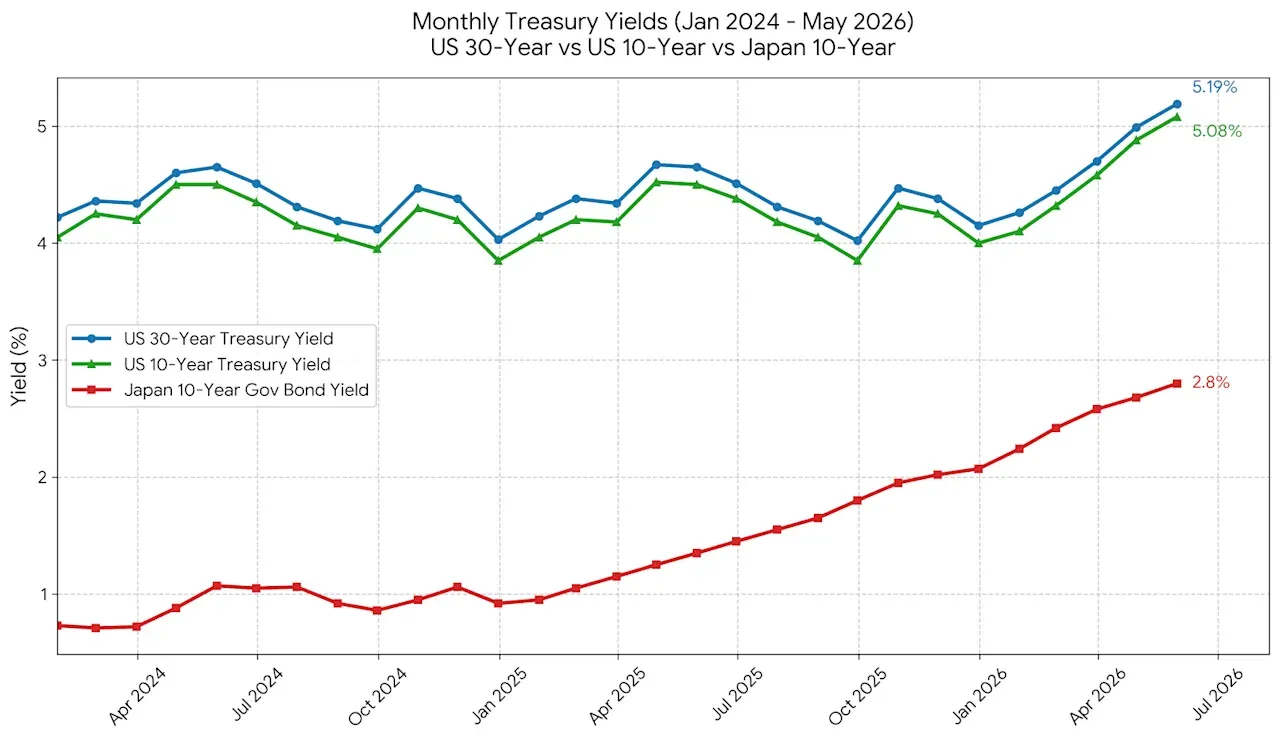
Rising government bond yields signal a coming “structural” shift that will create a Bitcoin “supercycle” of rising prices, as investors flee debasing assets for one that cannot be inflated, according to Shang Wu, a senior research analyst at crypto exchange BitMEX.The yield on the 30-year US Treasury broke past 5.14% on Tuesday, while the Bank of Japan’s 10-year government bond yield touched 2.8%, Wu said. These yields are unsustainable in the long-term and will force governments to choose between debasing their currencies and a “sovereign debt collapse,” Wu said.Bond yields for US and Japanese government debt from April 2024 to May 2026. Source: BitMEX“Central banks are backed into a corner. They must choose between a sovereign debt collapse and debasing their currencies,” Wu said. According to the analyst:“For Bitcoin, the upcoming volatility will be chaotic in the short term, but it serves as the ultimate structural tailwind for a long-term supercycle.” The analysis comes as the US national debt crosses $39 trillion, and growing geopolitical tensions threaten to boost government spending, while the ongoing war in Iran causes a surge in energy prices and a corresponding inflationary spike.Related: Bitcoin bounces as Trump prepares to announce ‘negotiated’ Iran dealRate hike won’t solve problem, it will simply bankrupt the governmentCentral banks typically use higher yields to tamp down inflation by restricting access to credit; when borrowing costs are high, consumers and investors borrow less, and asset prices fall.However, the $39 trillion US national debt, which continues to grow due to deficit spending, makes it impossible to control inflation by raising interest rates, as the higher rates would also increase the government’s debt servicing costs, Wu said.A forecast of what the annual US budget would look like if bond yields spike to 7%. Source: BitMEX“With the national debt at $39 trillion, keeping rates at these levels means the annualized interest expense of the government will soon consume the entire federal tax base,” according to the analyst.Wu and others, including macroeconomist Lyn Alden, say that the government and central banks will attempt to disguise quantitative easing by adding liquidity through other methods like yield curve control and unannounced buybacks of US government debt. Magazine: Big Questions: Can Bitcoin save you from the dreaded Cantillon Effect?