

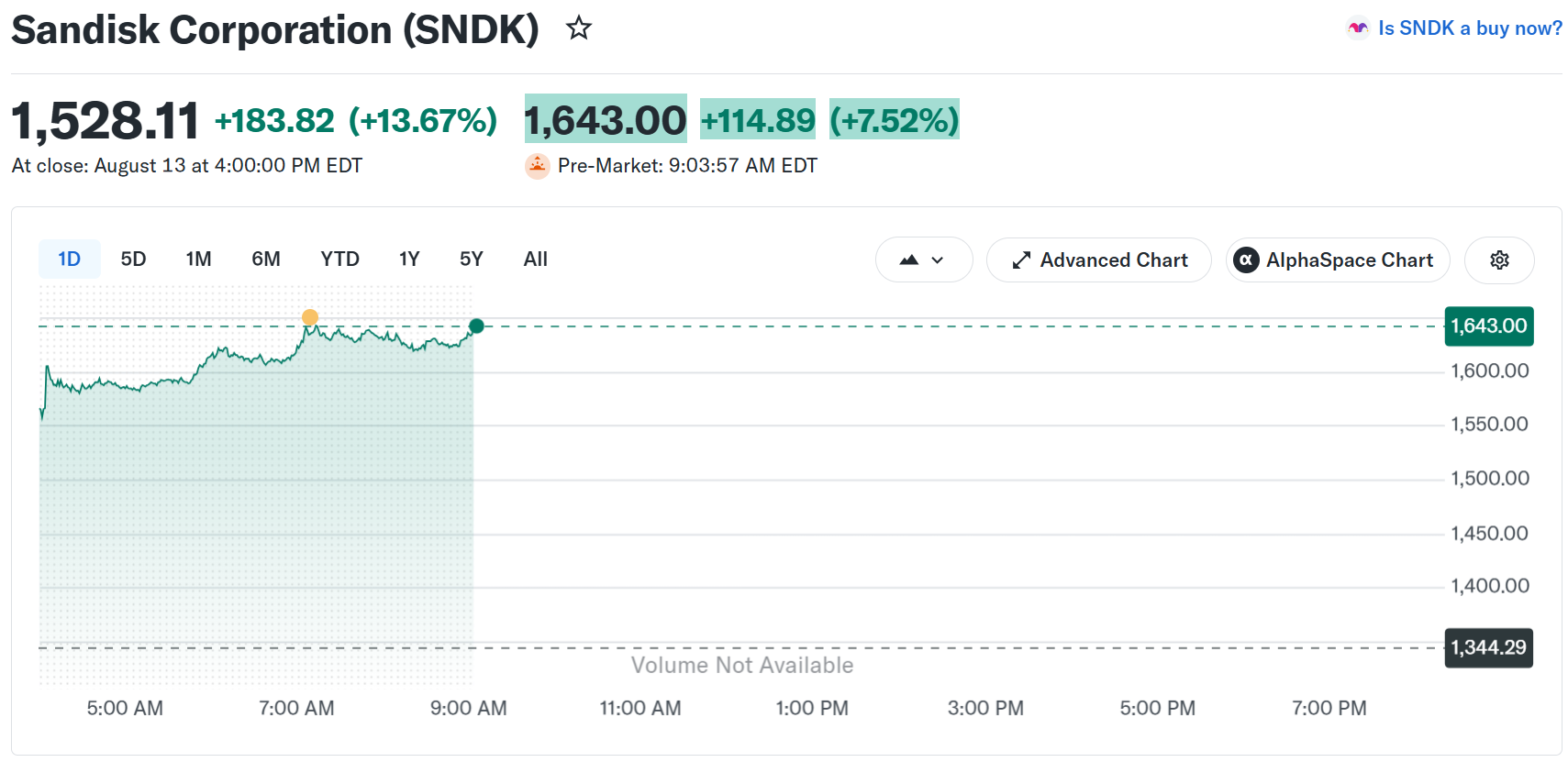
SanDisk guided investors toward 80% gross margins through fiscal 2030. It earns 84.6% today. The stock rose 13.67% anyway.
Guiding margins lower normally punishes a share price. The reason it did not sits in the company’s own recent numbers.
Gross margin is the profit left after production costs. SanDisk reported 84.6% for the quarter ended July 3. Three months earlier it was 78.4%. The new target of roughly 80% sits below both figures.
Now look further back. In the quarter ended March 2025, the same margin was 22.5%. It then climbed to 26.2%, 29.8%, 50.9%, 78.4% and 84.6%. The number almost quadrupled in five quarters.
So the guidance is not really a downgrade. Management is claiming a spike can become permanent. Shares closed at $1,528.11 on Thursday. Investors treated 80% as a floor rather than a ceiling.
SanDisk makes NAND flash, the memory chips inside solid-state drives. AI data centers buy them in enormous volumes. Revenue reached $8.97 billion last quarter, up 51% in three months and 372% in a year. Full-year revenue hit $20.2 billion.
However, the company told the SEC where that growth came from. About two-thirds of the increase came from higher prices. Only one-third came from shipping more chips.
Prices built these margins. Prices can also remove them.
The precedent is recent. The NAND market shrank almost 40% in 2023 to $36.7 billion, one of the steepest declines in semiconductor history.
SanDisk’s margins bottomed near 22% in the aftermath. Warnings about the AI memory stock rally have pointed at that same cycle.
Management’s answer is contracts. Eight customers have signed multi-year deals covering about half of fiscal 2027 shipments, rising to two-thirds in fiscal 2028.
Those deals set price floors. Chief Executive David Goeckeler pointed to them when reporting fourth-quarter results.
“We closed fiscal 2026 with a leading technology portfolio, established datacenter as a key growth pillar, and deepened our customer partnerships.”
Follow us on X to get the latest news as it happens
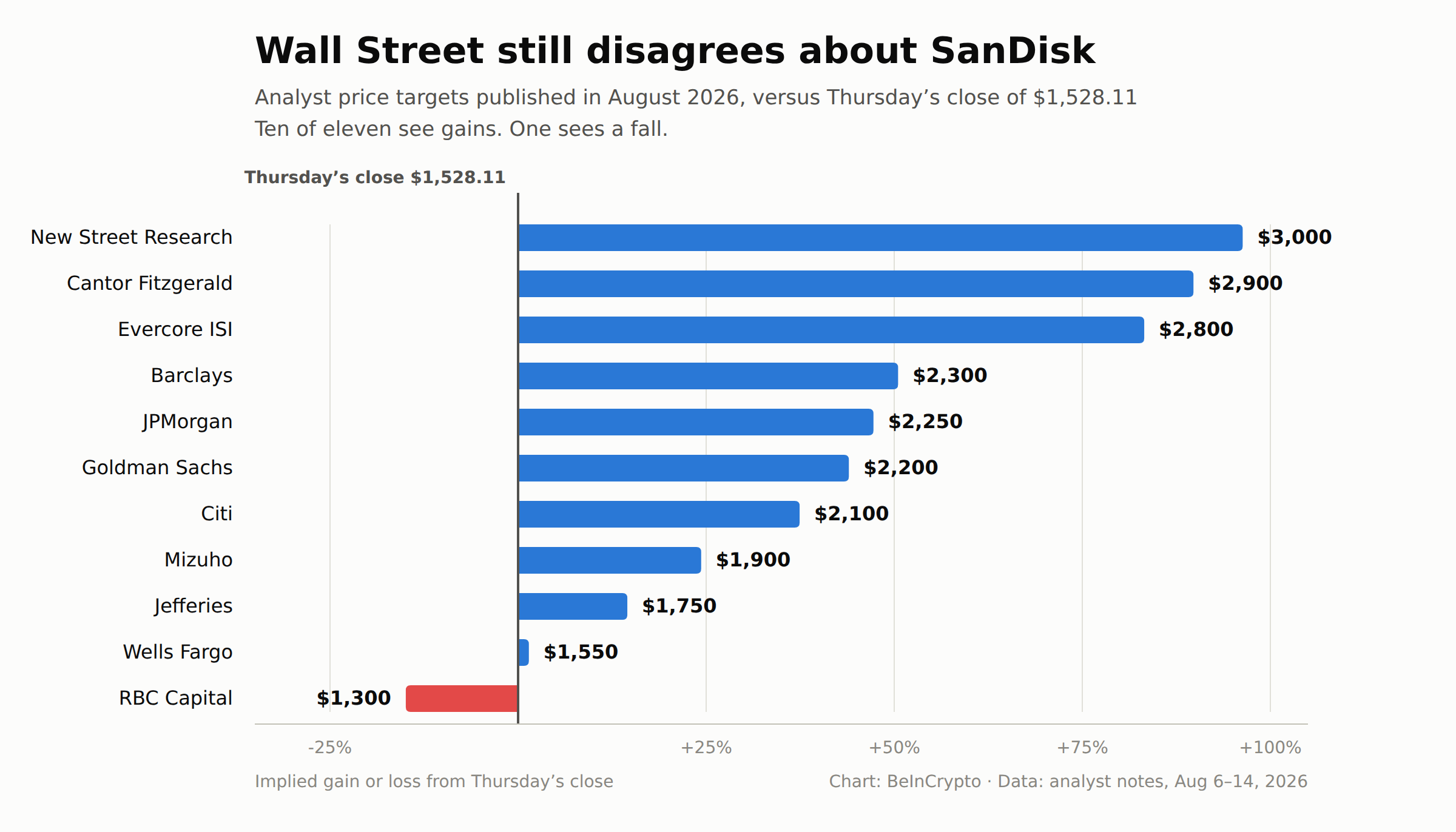
Wall Street says no, and it says so unanimously. JPMorgan resumed coverage at Overweight with a $2,250 target, about 47% above Thursday’s close.
Susquehanna sits at $3,250. Even the cautious end is bullish, with Jefferies at $1,750, still 15% above the current price.
No major bank publishes a target below where the stock trades. That unanimity is itself worth noting.
The valuation carries the same assumption. Shares change hands at 20.7 times past earnings, but only 7.2 times expected earnings.
That gap only makes sense if profits keep climbing. Most of the best AI stocks of 2026 trade on less optimistic math.
Timing has been brutal for anyone who guessed wrong. Shares peaked at $2,335 on June 25, then closed at $1,015.89 on July 29.
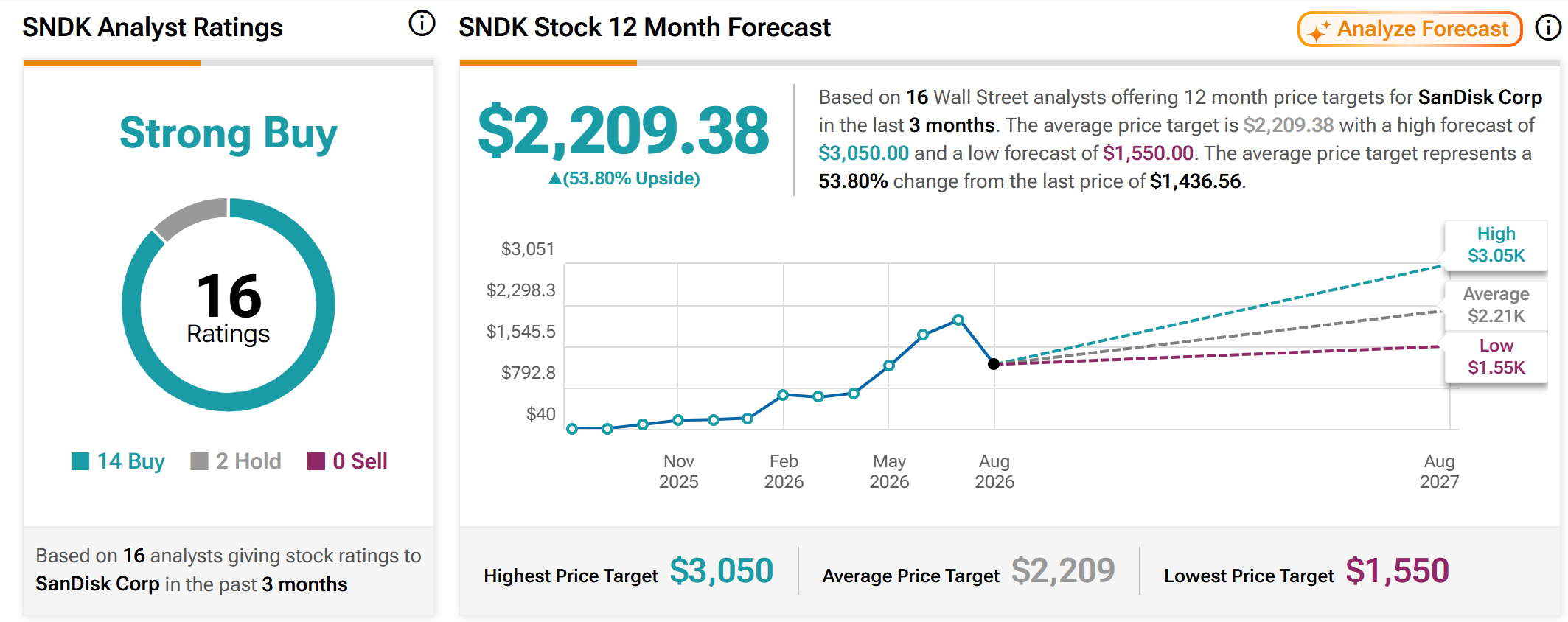
That is a 56% fall in five weeks, followed by a 50% bounce. The stock is up 541% this year and still 35% below its June high, but analysts assign a strong buy rating.
China is the clearest threat. Manufacturer YMTC could reach 10% of global NAND capacity as soon as next year.
Its third Wuhan plant starts mass production in 2027. Cheaper Chinese supply would hit the prices doing two-thirds of the work.
Concentration is the other risk. Investor Steve Eisman has argued the AI trade’s weak spot is its reliance on a handful of buyers.
SanDisk has contracted with eight. The open question is whether 80% proves to be its floor or its memory of a very good year.
The post SanDisk Told Investors Margins Will Fall, SNDK Stock Rose 14% Anyway appeared first on BeInCrypto.





Bitgo reported $4.3 billion in second-quarter revenue, up nearly 80% from a year earlier, as trading and stablecoin activity increased. The company still posted a

The Securities and Exchange Board of India (SEBI) has announced a proposal to relax Know Your Customer (KYC) regulations aimed at simplifying investment from abroad
Banco Central BR has announced new regulations aimed at combating fraud related to virtual asset transfers. This initiative was shared in a tweet, emphasizing the
A wallet associated with Monetalis has deposited 3.72 million UNI tokens, valued at approximately $13 million, into leading exchanges such as Binance, Coinbase, Bybit, and