
Key Takeaways:
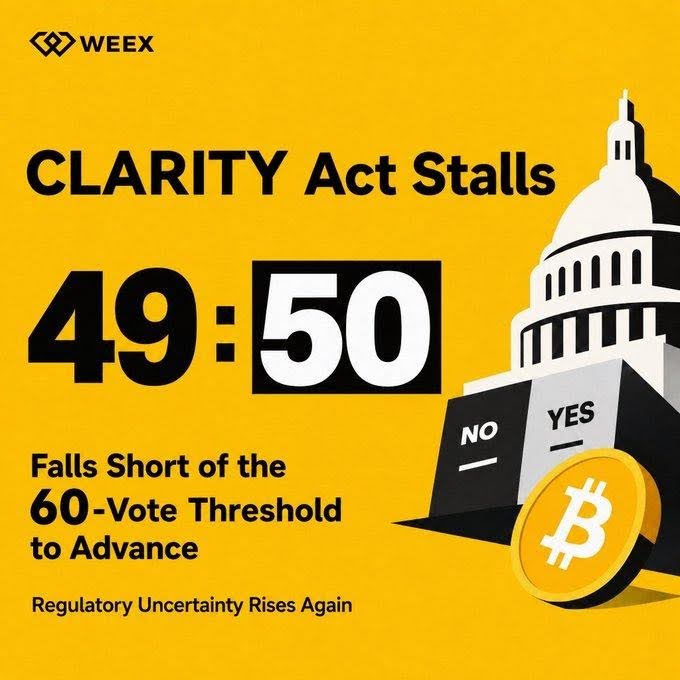
One of the crypto industry’s largest legislative initiatives has fallen under new pressure after the U.S. Senate blocked the next step forward in enacting the CLARITY Act. That was the procedural vote on Sept. 15, when it was defeated, 49-50, which did not meet the 51-49 threshold required to start the bill on the floor.

The Digital Asset Market Clarity Act, introduced as H.R. 3633, seeks to establish clearer federal rules for digital assets and define how crypto markets would be overseen by U.S. regulators.
One of its main ideals is to establish clearer walls within the Securities and Exchange Commission (SEC) and Commodity Futures Trading Commission (CFTC). The supporters noted that exchanges and other crypto firms could face less regulatory uncertainty with more clear jurisdiction.
The vote of the Senate was not a vote to pass the bill; it was another screening vote. Instead, it was serving to consider action on the bill; that is, moving it to a vote. Needing 60 votes, it got 49 votes in favor and 50 against. There were four Republicans who joined Democrats in voting against the motion.
Read More: CLARITY Act Vote Set for May 14 as Coinbase and US Senators Push Crypto Rules

The law had been heavily amended before it was presented to the Senate. Democrats have requested 126 substantive changes in the final Republican draft, which was made available on Sept. 14.
The updated version contained new ethics stipulations, more enforcement authority for state attorneys general and extra power for the Treasury Department on stablecoin deposit flows.
The bill’s supporters had been negotiating adjustments for more than a year, adding a range of articles such as those on decentralized finance, stablecoins, oversight of digital-asset markets and protections for the developers. Those revisions were still not enough to get the Senate to approve.
The Senate blow was briefing fast in the cryptocurrency. Bitcoin lost more than $77,000 to about $75,600 and shares of Coinbase and Circle dropped sharply throughout the session. The reaction shone a light on lingering doubts over when comprehensive, U.S. crypto legislation might be ready.
The market response is particularly relevant for crypto companies that have been positioning the CLARITY Act as a potential foundation for longer-term regulatory certainty. In the absence of congressional law, important matters around the treatment and oversight of digital assets are now left in limbo to the existing laws, agency rules, and any future regulatory decisions.
The defeated vote doesn’t necessarily mean that all U.S. crypto rulemaking has fallen apart. Regulators, including the SEC and CFTC, still have authority in places where they have jurisdiction, and lawmakers may take a second look at the legislation soon.
The vote and the resulting 49-50 mark, however, represent an even bigger setback for the crypto industry in terms of moving towards a unified federal market-structure framework for digital assets.
Read More: 67M Crypto Holders Put Pressure on Senate as Ripple Pushes CLARITY Act Showdown
The post Senate Blocks $2.3T Crypto CLARITY Act in 49-50 Vote, Bitcoin Slides Fast Below $76K appeared first on CryptoNinjas.