


When Celsius collapsed, its Earn customers learned that the crypto in their accounts belonged to the bankruptcy estate, not to them. Sen. Cynthia Lummis cast the CLARITY Act as a fix on July 20, boiling its promise down to four words.
“Your crypto stays yours.”

Her X post, which had drawn a lot of attention, said the CLARITY Act would change the outcome she associated with the failures of Celsius and Voyager.
Celsius is probably the best legal example because a federal court ruled directly on ownership of its Earn balances.
The May 12 Senate Banking manager’s substitute supports the direction of Lummis’s claim while attaching several conditions. Section 701 would put qualifying ancillary assets and digital commodities into federal customer-property rules when they are “held for customers” in specified Chapter 7 liquidations.
The protection may not apply if the asset, account terms, or bankruptcy process falls outside the bill’s boundaries. A qualifying token held in custody for a customer fits the language more naturally than a balance created after the customer lends an asset or transfers title to the platform. The text leaves that lending boundary open for final legislation and future courts.
Section 701 will rewrite the bankruptcy rules for liquidating failed stockbrokers. It adds ancillary assets and digital commodities to relevant definitions of customers, customer claims, and customer property. It also directs liquidations under subchapters III or IV of Chapter 7 to treat those assets as customer property when held for customers and to distribute them under Title 11.
The official section-by-section summary describes Section 701 as defining ancillary assets and digital commodities as customer property under Chapter 7. The operative text supplies the boundaries behind that summary.
The bill’s protection also depends on how the asset is classified. Section 701 names ancillary assets and digital commodities. Securities and cash held by a broker-dealer remain governed by the Securities Investor Protection Act. Bank deposits and commodity contracts remain under their other applicable laws.
Payment stablecoins appear separately in Section 804, which would require broker-dealer disclosures about the insolvency treatment of payment stablecoins, digital commodities, and a security involving a unit of a digital commodity. That structure leaves Section 701 unable, by itself, to support one rule for every stablecoin balance.
Account terms matter just as much. “Held for customers” points to custody, where the customer keeps ownership. Lending and yield products can work differently. If the contract transfers ownership to the platform, the customer may be left with only a claim for repayment.
Celsius showed how costly that distinction can be. In a Jan. 4, 2023 order, the U.S. Bankruptcy Court for the Southern District of New York said Celsius had approximately 600,000 Earn accounts holding about $4.2 billion in crypto as of July 10, 2022.
For the court, ownership came down to the contract. Celsius’s terms gave the company “all right and title” to crypto deposited in Earn. The court held that the crypto remaining in those accounts belonged to the bankruptcy estates. Earn users were generally unsecured creditors whose recovery depended on the bankruptcy distribution. Its app would show the same familiar balance even after a customer had traded ownership of the crypto for an IOU from Celsius.
Celsius involved title-transferring Earn terms, while Section 701 addresses qualifying customer property in specified Chapter 7 proceedings. The case therefore illustrates the ownership question at stake without establishing how Section 701 would apply to a similar yield product.
The proposed categories produce different risk profiles:
| Account relationship | Section 701 relevance | Main limit |
|---|---|---|
| Qualifying intermediary custody | The clearest fit when an ancillary asset or digital commodity is held for the customer in a covered Chapter 7 liquidation. | The asset, intermediary and liquidation must fall within the provision’s definitions and scope. |
| Lending, Earn or yield account | Coverage remains unresolved when the agreement transfers title or makes the platform a borrower. | Contract language can turn the customer’s balance into an unsecured claim, as Celsius demonstrated. |
| Independently controlled self-custody | Section 605 governs this relationship separately by protecting lawful self-custody for a defined covered user. | The provision preserves illicit-finance, anti-money-laundering, terrorism-financing and sanctions enforcement. |
| Broker-dealer securities or cash, bank deposits and commodity contracts | Section 701 assigns these categories to other legal regimes. | Protection follows SIPA, banking law, commodities law or another applicable framework. |
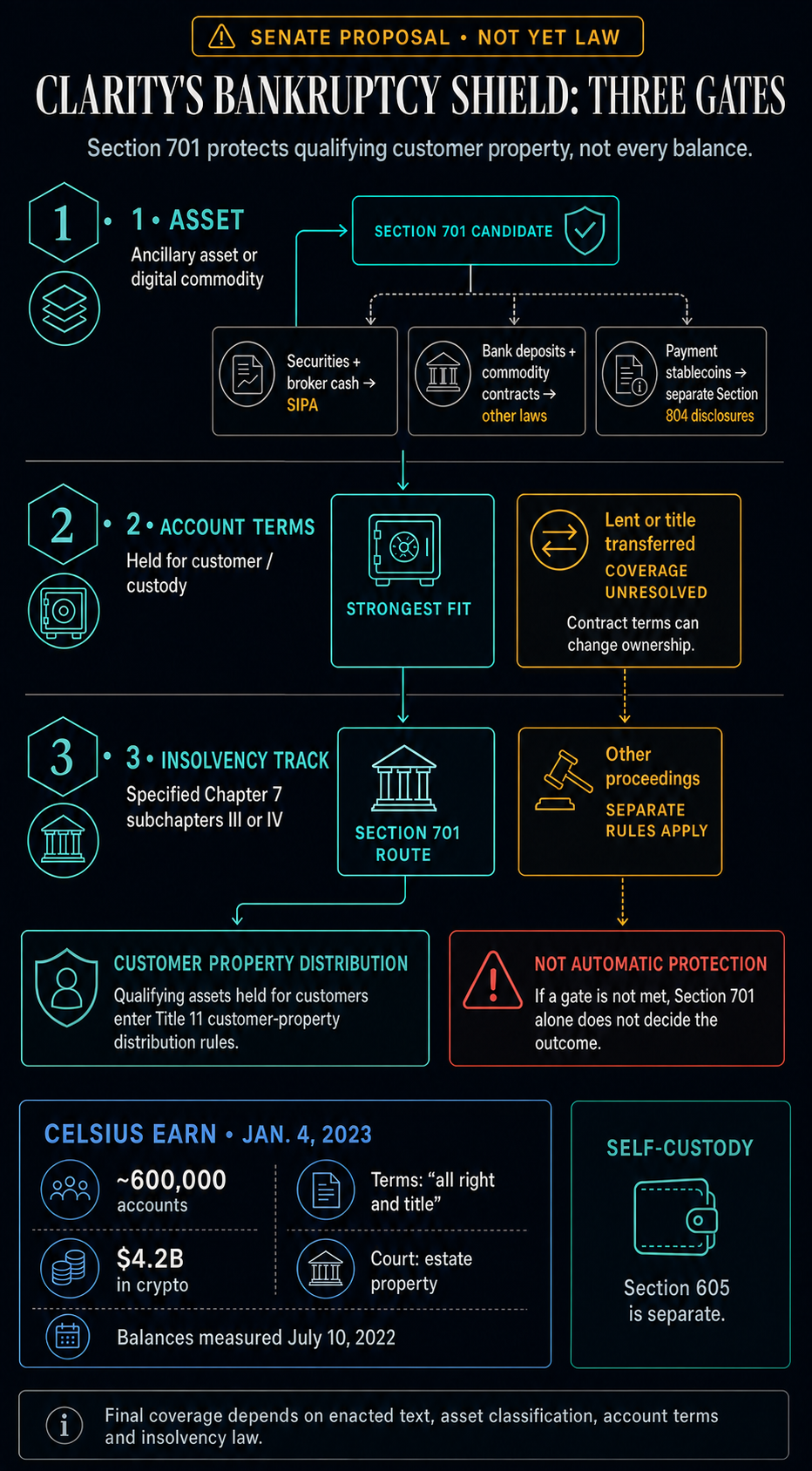
If a platform is simply holding qualifying crypto for a customer, Section 701 will place it in the customer-property pool during bankruptcy. Loans are murkier. Once a contract hands ownership to the platform, a judge may have to decide whether the customer still owns crypto or merely holds an IOU.
Self-custody sits outside that intermediary relationship. Section 605 separately protects lawful self-custody by defined covered users through self-hosted wallets while retaining existing enforcement authorities. Its presence reinforces the bill’s distinction between assets controlled by their owner and assets placed with a financial intermediary.
The Senate Banking Committee advanced H.R. 3633 by a 15-9 vote on May 14. Committee passage left Senate floor approval and subsequent legislative steps outstanding.
As CryptoSlate reported on July 14, the wider Senate package remains unfinished, and no floor vote has been scheduled.
The customer-property provision is just one part of a broader market-structure effort whose May 12 text also addresses token classification, stablecoin rewards, decentralized finance and banking powers.
The next legislative test is whether Section 701 retains its current wording as the package moves forward. The pragmatic test would follow in platform contracts: whether exchanges describe balances as custody, lending or another relationship, and whether those terms say the platform holds the asset for the customer or receives ownership of it.
Lummis’s promise captures the provision’s purpose and compresses its conditions. Qualifying ancillary assets and digital commodities held as customer property would enter the customer-property distribution rules. A balance created by a title-transferring loan would still require the asset classification, contract, and insolvency regime to align before “your crypto stays yours” becomes the legal result.
The post Senator Lummis says with CLARITY “your crypto stays yours” – but bankruptcy shields have limits appeared first on CryptoSlate.


Iran activates air defenses in Tehran amid rising tensions. Full airspace closure by July 31 at 30.5% YES, by August 31 at 44% YES. The
Azerbaijan confirms secret talks between Germany and Russia on Ukraine. Ceasefire agreement by December 31, 2026 at 35.5% YES. The post Azerbaijan confirms secret German-Russian
Iran escalates attacks on US Navy vessels in the Strait of Hormuz. US invasion of Iran before 2027 at 27.5% YES. The post Iran escalates
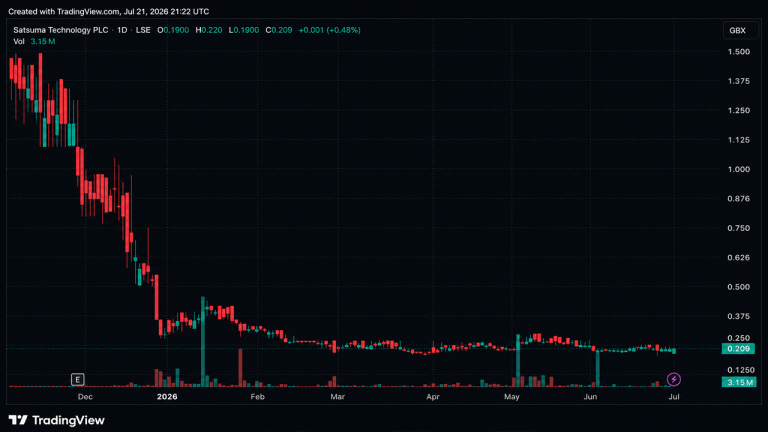
Satsuma Technology shareholders voted overwhelmingly to liquidate the London-listed company, sell its remaining 668 bitcoin and return capital to investors after a treasury strategy unraveled