


September 9 came and went, and BitMart did technically keep its word. An update landed, right on schedule, exactly as promised back on August 21.
But for the thousands of users who’ve spent nearly two months locked out of their own funds, reading through it felt less like an answer and more like watching the goalposts move three weeks further down the field. Here’s what actually changed, what didn’t, and why the community’s response has been anything but patient.
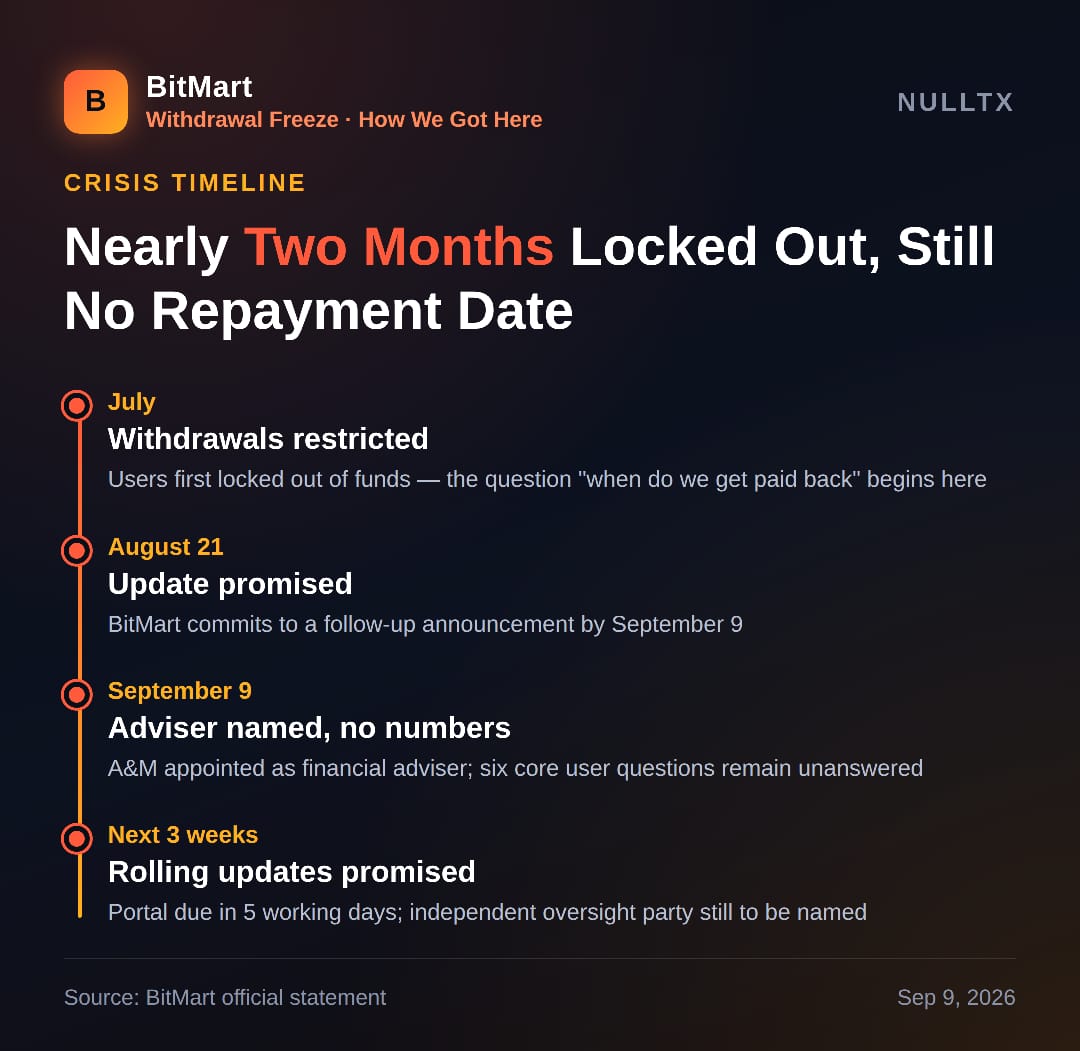
The update, posted directly to BitMart’s official account, centered on one concrete development: the appointment of Alvarez & Marsal (“A&M”) as the exchange’s external financial adviser.
According to the announcement, A&M will work alongside BitMart’s legal advisers to assess the company’s financial position, evaluate stakeholder issues, and help arrange for what the company called “orderly withdrawals.”
The firm is also tasked with evaluating available options and supporting the development of what BitMart described as a “near-term action plan.” With A&M now formally engaged, BitMart said it intends to provide further updates on a rolling basis over the next three weeks, covering user feedback channels, the collection of user concerns, and progress on the action plan itself.
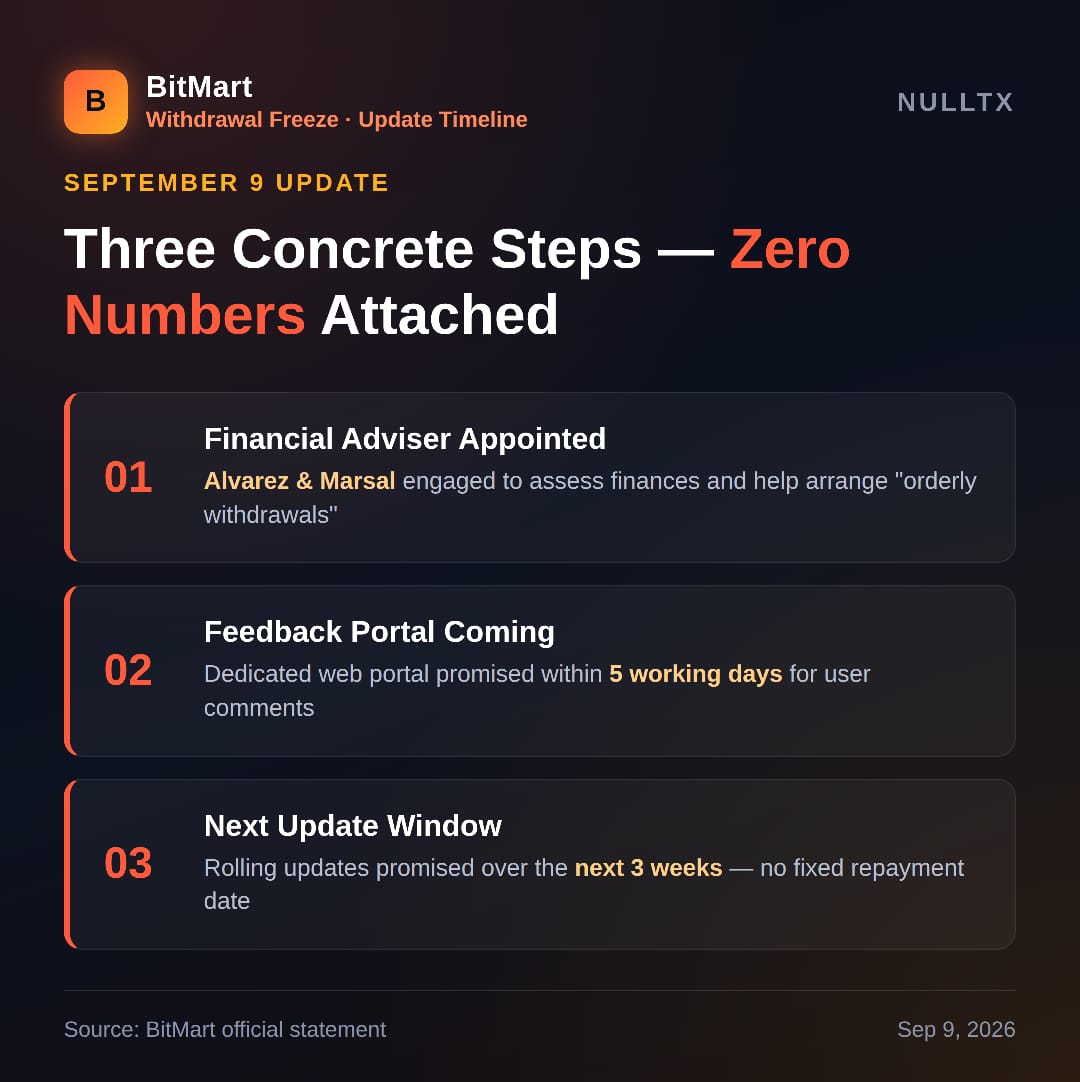
Beneath the broader language, BitMart did lay out two specific, near-term commitments.
First, the company said it will establish a dedicated web portal within five working days, intended as a centralized channel where users can submit feedback and comments on the company’s action plan and future direction. BitMart said feedback collected there would be incorporated into its ongoing assessment and planning, and that responses to widely shared concerns would come through subsequent announcements.
Second, BitMart said it intends to appoint an independent third party in the near term specifically to provide oversight of the company’s operations and the safekeeping of user assets during this period. The company framed both steps as evidence that user interests remain protected while the broader assessment plays out, and closed the statement with an appeal for what it called rational, lawful communication from its user base, explicitly asking that individual employees not be subjected to harassment, threats, or privacy violations.
I think the reaction to this update says more about where trust currently sits than the statement itself does. Crypto commentator Umut Aktu captured the mood bluntly, pointing out that after nearly two months of restricted withdrawals, BitMart is only now acknowledging the scale of the problem, and doing so with language built entirely around “we intend,” “we will assess,” and “we are considering,” rather than anything resembling a firm commitment.
The warning that followed was direct: if BitMart continues withholding funds without producing a clear repayment timeline, affected users say they’ll pursue every available legal and creditor remedy, and that lawyers and restructuring professionals are already involved on the user side as well. The demand was reduced to three words: publish the numbers, publish the withdrawal plan, return the funds. I think that’s a fair summary of where a lot of the community’s patience has landed after two full cycles of update-then-wait.
A second wave of community response zeroed in on something I think is genuinely hard to argue with: for all the detail in BitMart’s announcement, it doesn’t answer a single one of the questions users actually need answered. One widely shared response laid those questions out plainly:
The critique that followed was pointed and, I’d argue, reasonable. Bringing on a financial adviser, launching a feedback portal five working days from now, and asking users to wait another three weeks for the next update doesn’t move the needle on any of those six core questions.
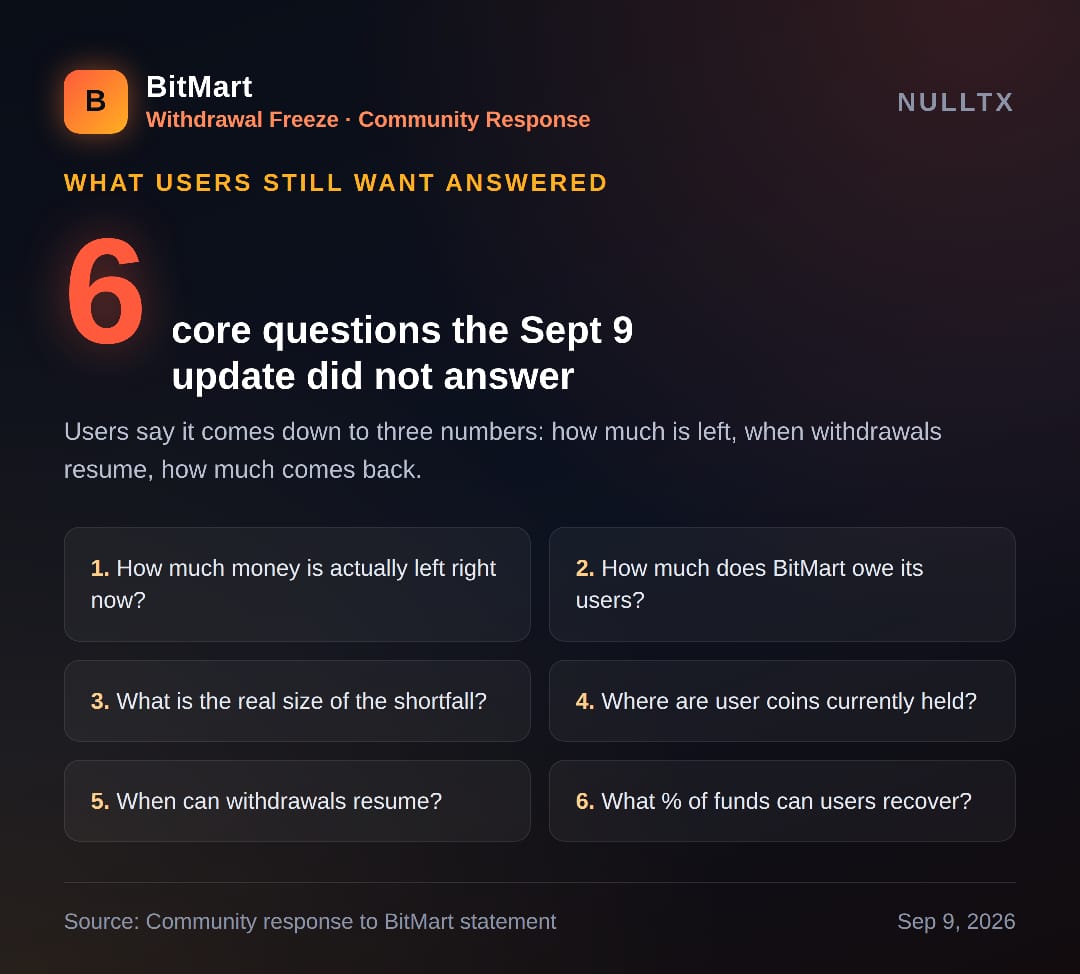
As the response put it, what’s missing right now isn’t another financial adviser or another multi-thousand-word announcement, it’s three simple answers: how much money is left, when withdrawals resume, and how much users can actually get back. Everything else, in this framing, is process dressed up as progress.
I want to flag one phrase from BitMart’s own statement that I think deserves more scrutiny than it’s gotten so far: the reference to arrangements for “orderly withdrawals.” That phrasing implies withdrawals are expected to resume in some structured, sequenced form, rather than being fully restored all at once. It’s a meaningfully different outcome than what most users are hoping for, and BitMart hasn’t clarified what “orderly” actually means in practice, whether that means partial withdrawals, tiered access based on balance size, a queue system, or something else entirely.
BitMart’s explanation for why it hasn’t disclosed specific financial figures yet is worth noting too. The company said all relevant data must be independently verified by A&M before being shared externally, specifically to ensure accuracy rather than releasing unverified numbers that could later prove wrong. That’s a defensible process argument on its own. But I think it’s exactly the kind of explanation that satisfies a corporate audit trail far more than it satisfies someone who’s been unable to access their own money for going on two months.
The real test now shifts to whether BitMart’s rolling updates over the next three weeks actually narrow the gap between “we intend to assess” and a concrete number users can hold onto. The feedback portal, due within five working days, will be the first tangible thing to watch, not because a comment form solves anything on its own, but because it’s the first structural channel BitMart has offered users to register their concerns formally rather than shouting into the same public reply threads that have carried this entire story so far.
Beyond that, the appointment of an independent party to oversee asset safekeeping is worth watching closely too, since it’s the closest thing in this update to an actual accountability mechanism rather than a communications commitment. Whether that oversight role gets filled quickly, and by whom, may end up mattering more than anything BitMart has said so far. For now, though, the community’s verdict on this update looks fairly unanimous: it was on time, it was detailed, and it still didn’t tell anyone the one thing they’ve been asking for since July, when, and how much of, their money is coming back.
Disclosure: This is not trading or investment advice. Always do your research before buying any cryptocurrency or investing in any services. Follow us on X @nulltxnews






The $1B investment in AI satellite expansion could enhance real-time data processing, boosting UAE’s space capabilities and economic diversification. The post Marlan Space and Loft
Escalating tensions in the Persian Gulf could lead to prolonged oil supply disruptions, potentially driving prices to new all-time highs. The post Iran attacks ten
Besxar’s innovative approach could revolutionize semiconductor manufacturing, reducing costs and timelines while enhancing material purity for advanced tech. The post Besxar builds sub-orbital semiconductor fab
Rising capital costs shift financing to less regulated private markets, increasing systemic risk and potentially destabilizing the economy. The post Franklin Templeton CEO warns rising