

The ink was barely dry on our story about today’s cloture vote on the CLARITY Act before the drama took another turn.
Our own newsroom sourcing has Senate Democrats rejecting the latest GOP draft of the bill over what they see as unresolved gaps in the ethics language, with a counterproposal now headed back the other way, even as the procedural vote remains locked in for 2:15 PM ET today.
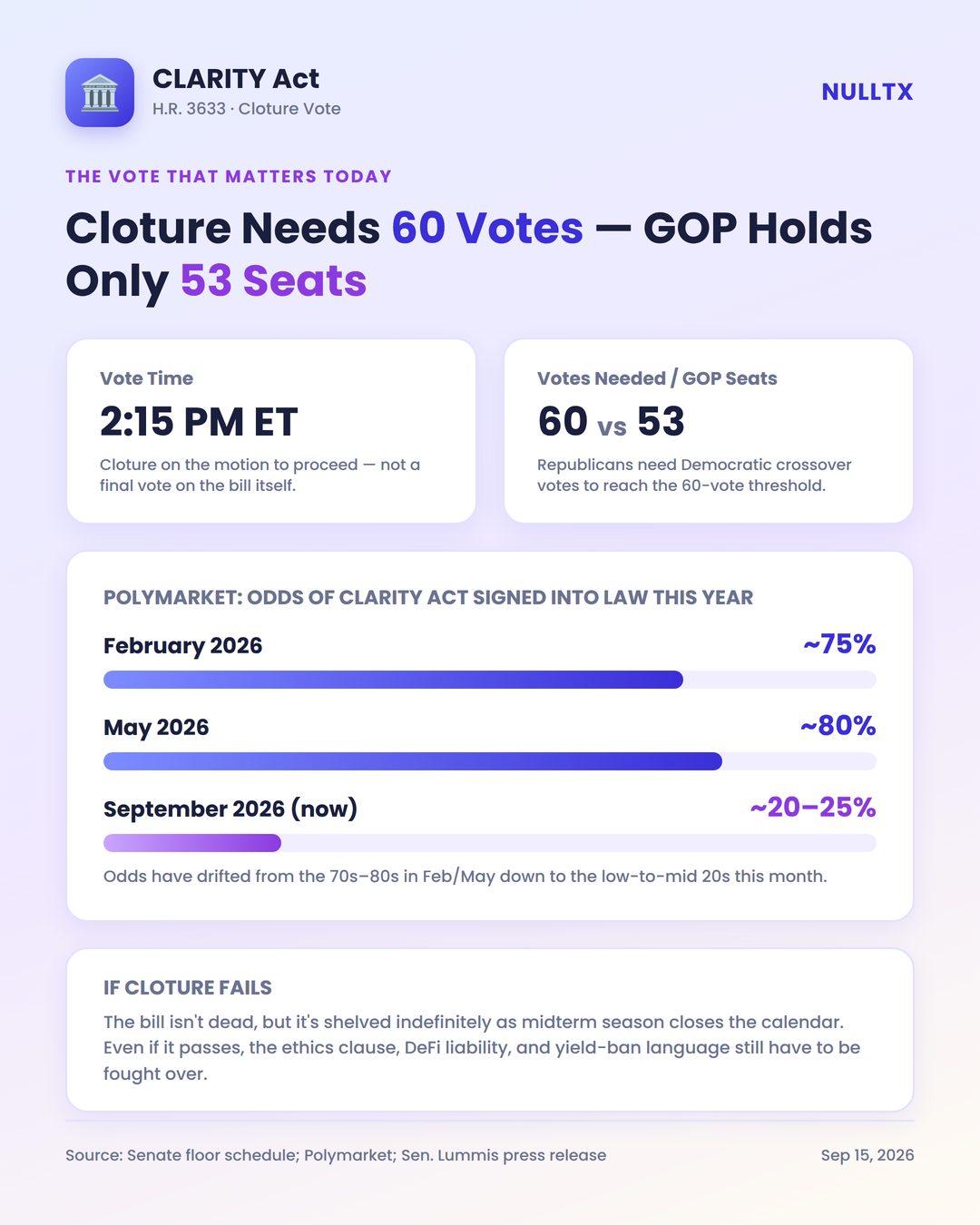
That’s the vote that decides whether H.R. 3633, the Digital Asset Market Clarity Act, gets to move to full floor debate at all and it still needs 60 votes in a chamber where Republicans hold only 53 seats. Nothing about the ethics dispute changes that math or that deadline.
I want to be precise about what’s actually being decided here, because a lot of timeline confusion is doing the rounds. This isn’t a final up-or-down vote on whether America gets a crypto market structure law. It’s cloture on a motion to proceed, a vote about whether the Senate is even willing to open debate. Fail it, and the bill isn’t dead exactly, but it’s shelved indefinitely with midterm season closing the legislative calendar behind it. Pass it, and senators still have to fight over the ethics clause, the Section 604 DeFi liability language, and the Section 404 yield ban before anything reaches a president’s desk. Senators Cynthia Lummis, John Boozman, and Tim Scott released what they called “final” bill text this week incorporating most of a bipartisan ethics compromise from Senators Thom Tillis and Ruben Gallego, confirmation that this fight was very much alive right up to the wire, according to Senator Lummis’s official press release.
Prediction markets have already made their peace with a rocky outcome. Polymarket’s own contract on whether the CLARITY Act gets signed into law this year touched the 70s and 80s back in February and May, and has spent this month sitting in the low-to-mid 20s, which tells you the market has spent months pre-pricing disappointment rather than waiting for it.
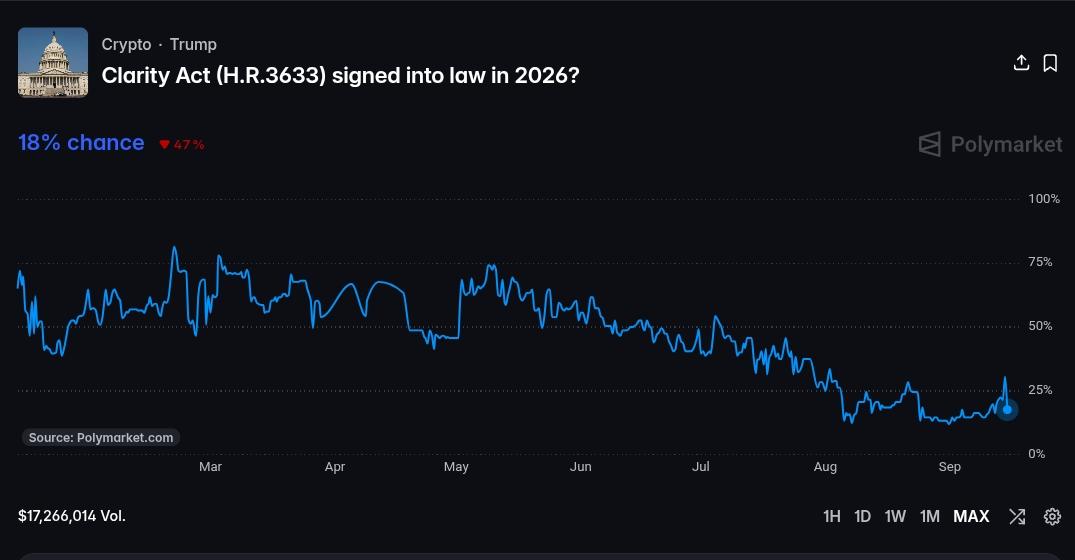
That matters for how you should read whatever happens this afternoon. If cloture fails, it will not be a surprise to anyone who has been paying attention, it will be a confirmation of a trend that has been building since summer.
So the real question isn’t “will the market dump.” Some of it will, reflexively, because headlines move algorithms before anyone reads past them. The better question is which assets have built a floor that has nothing to do with a Senate procedural vote at all. I went looking for tokens where the bull case rests on something that already happened, a signed deal, an approved filing, a shipped product, rather than something Congress might get around to eventually. Here’s what I found, sourced directly from the companies and regulators involved.
XRP’s resilience case doesn’t depend on CLARITY passing because Ripple already won its own regulatory war. The SEC dropped its appeal in the SEC v. Ripple case back in 2025, leaving the ruling on secondary-market XRP sales intact, the overhang that depressed this token for four years is gone regardless of what the Senate does today. On top of that, the SEC has now formally folded XRP into its updated commodity-based trust framework: an SEC order approving amendments to Nasdaq Rule 5711(d) explicitly names XRP alongside Bitcoin, Ether and Solana as qualifying assets for commodity-based ETF trusts, a regulatory status that exists independently of anything in H.R. 3633.
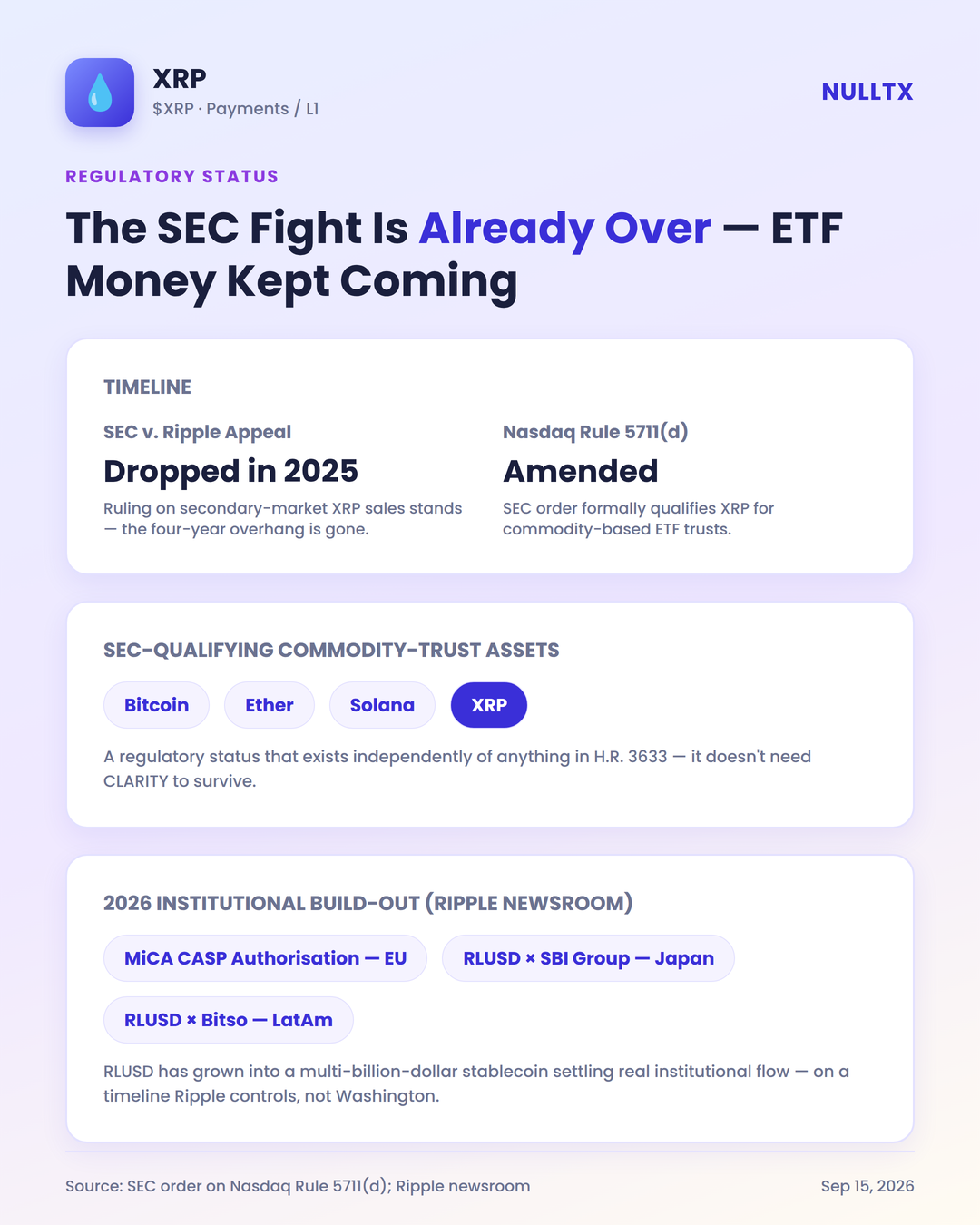
Ripple’s own newsroom tells the rest of the story. Its press releases page shows a company that spent 2026 stacking institutional wins that have nothing to do with Washington’s timeline, full MiCA CASP authorisation in Europe, an RLUSD launch partnership with SBI Group in Japan, expanded enterprise stablecoin settlement work with Bitso in Latin America, and continued build-out of its Washington policy presence. RLUSD itself, Ripple’s own stablecoin, has grown into a multi-billion-dollar asset that settles real institutional flow whether or not the CLARITY Act clears cloture this afternoon. That’s a company building revenue-generating infrastructure on a timeline it controls, not one waiting on a committee markup.
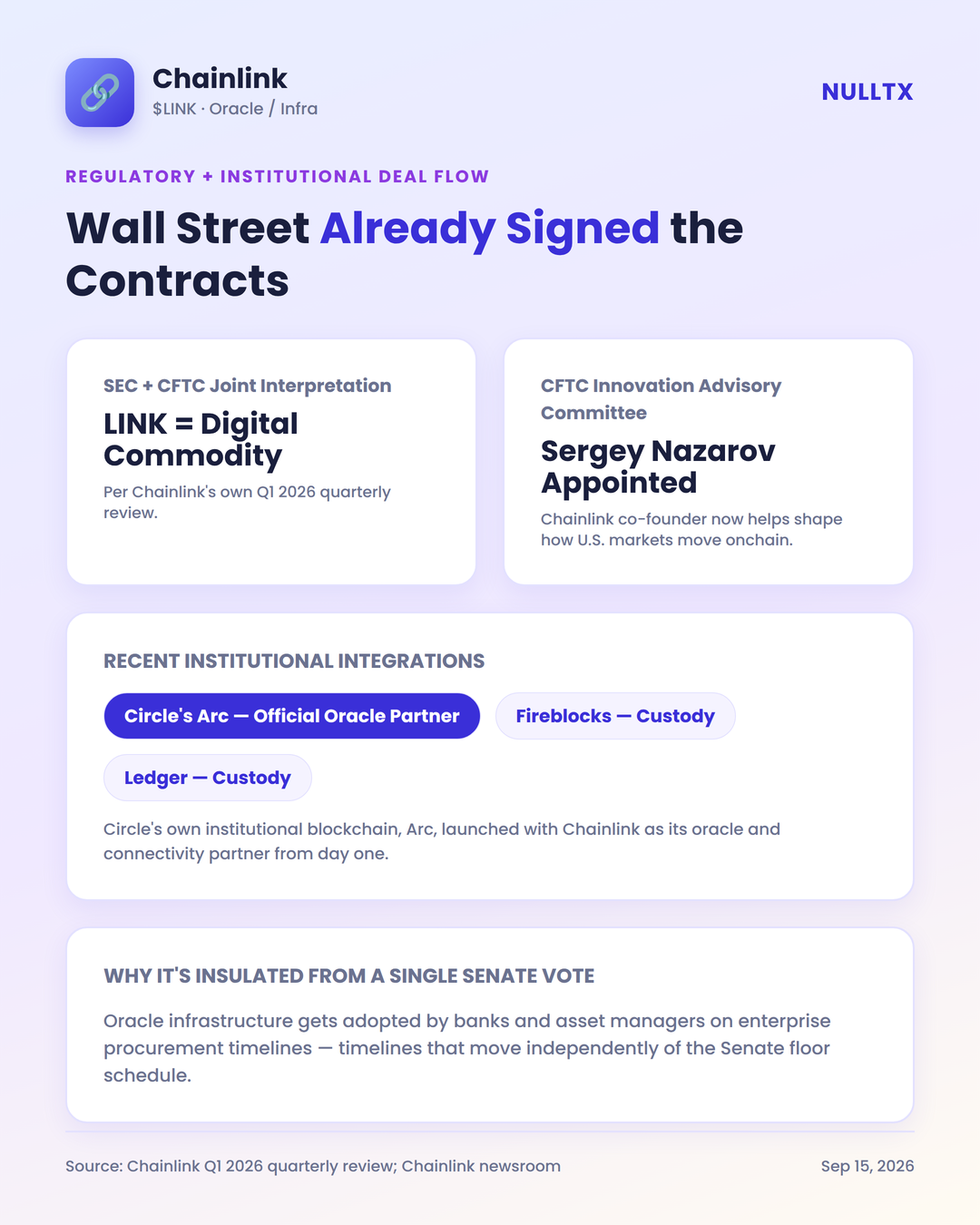
If there’s one project whose fortunes look almost deliberately insulated from a single Senate vote, it’s Chainlink. Its own Q1 2026 quarterly review documents that the SEC and CFTC issued a joint interpretation classifying LINK itself as a digital commodity, and that Chainlink co-founder Sergey Nazarov was appointed to the CFTC’s own Innovation Advisory Committee to help shape how U.S. markets move onchain, Chainlink has, in effect, already been pulled inside the regulatory tent that CLARITY is trying to formally build.
The deal flow backs that up. Chainlink’s own newsroom tracks a steady cadence of institutional integrations, and the ecosystem has recently added Circle’s Arc, Circle’s own institutional blockchain, with Chainlink serving as its official oracle and connectivity partner from day one, alongside custody players like Fireblocks and Ledger. None of that required Congress to do anything. Oracle infrastructure gets adopted by banks and asset managers on enterprise procurement timelines, which move independently of Senate floor schedules, which is exactly the kind of demand driver that doesn’t evaporate on a failed cloture vote.
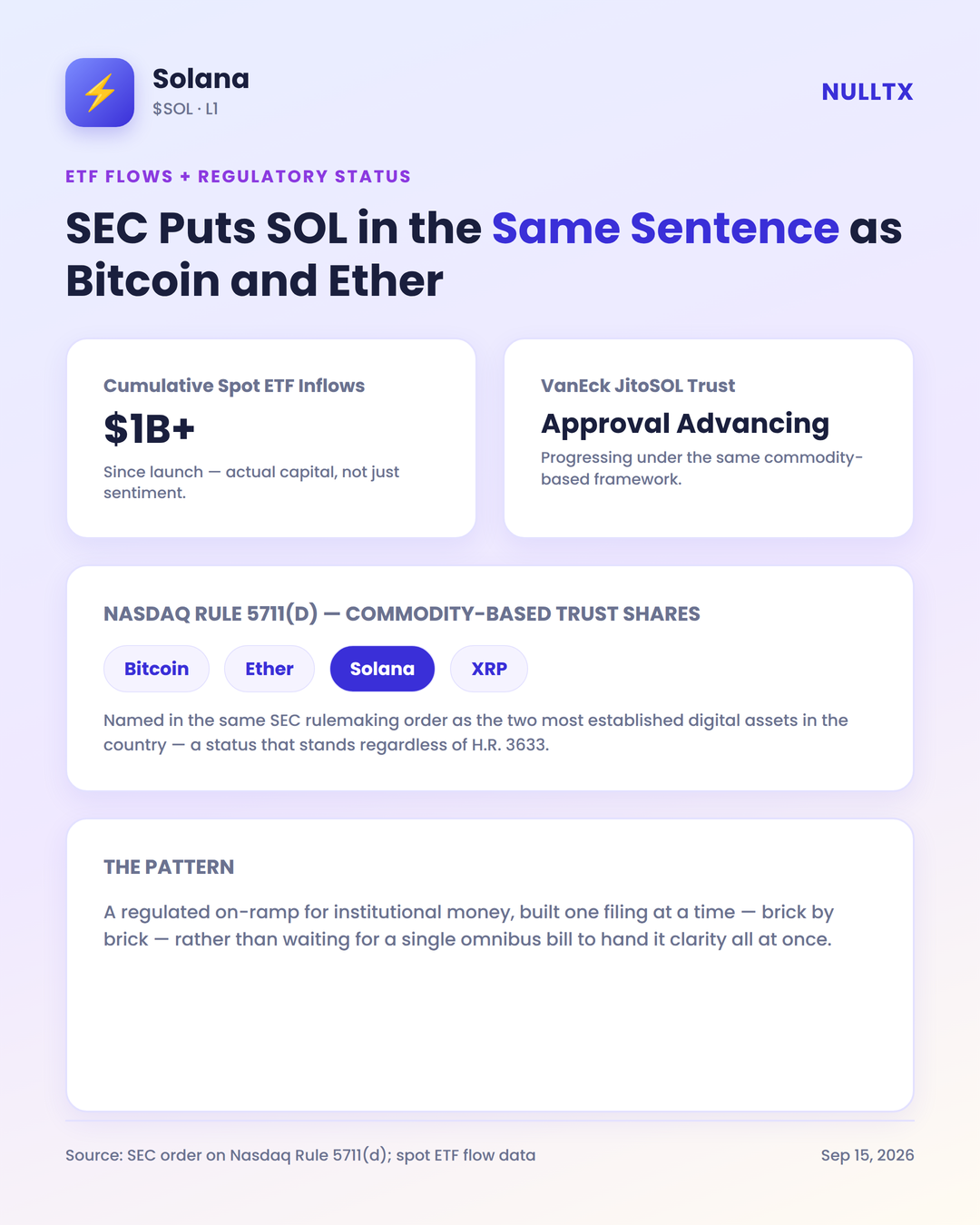
Solana’s case for resilience is almost identical to XRP’s, and it comes from the same document. That same SEC order amending Nasdaq’s generic listing standards for Commodity-Based Trust Shares names Solana alongside Bitcoin, Ether and XRP as an asset meeting the exchange’s threshold for commodity-based ETF trusts. That’s the SEC, in a formal rulemaking order, treating SOL as belonging in the same regulatory bucket as the two most established digital assets in the country, a designation that stands regardless of what happens with H.R. 3633 this afternoon.
The market has responded with actual capital, not just sentiment. Solana’s spot ETF complex has pulled in over a billion dollars in cumulative inflows since launch, and the SEC separately advanced approval proceedings for products like the VanEck JitoSOL trust under that same commodity-based framework. That’s a network that has built a regulated on-ramp for institutional money one filing at a time, brick by brick, rather than waiting for a single omnibus bill to hand it clarity all at once.
Hedera’s investment case has always rested less on U.S. legislative clarity and more on its governing council, the roster of global enterprises that literally run its network nodes. That council keeps expanding on its own schedule. Hedera’s own Council blog announced The Institutes’ RiskStream Collaborative, the insurance industry’s largest not-for-profit emerging-technology consortium, representing more than 30 carriers, brokers and reinsurers, as a new Strategic Partner, alongside additional Community Partners spanning AI governance and enterprise infrastructure. None of that partnership activity is contingent on a Senate procedural vote; it’s driven by enterprises with their own multi-year technology roadmaps.
I’ll be straight with you about the other side of this: Hedera’s daily active wallet counts remain small relative to networks like Solana, and skeptics are right to point out that council partnerships don’t always translate into production-scale transaction volume. But that’s precisely why Hedera’s resilience case doesn’t hinge on Washington. Its downside risk and its upside catalyst are both determined by enterprise execution timelines that run parallel to, not through, U.S. crypto legislation.
ICP is the contrarian pick on this list, and I’m including it because our readers have followed this token’s swings closely and the underlying policy shift is genuinely primary-sourced. DFINITY’s own Mission 70 whitepaper, authored by founder Dominic Williams, lays out a plan to cut ICP’s annual token inflation from 9.72% toward roughly 2.92% through a combination of reduced voting rewards, reduced node-provider incentives, and a sharp increase in the rate at which ICP gets burned for onchain compute. That proposal was put to the network’s own governance system and passed as an NNS proposal with majority support from ICP’s neuron holders, a tokenomics overhaul that lives entirely inside DFINITY’s own governance process, immune to whatever the Senate decides about digital asset market structure.
I want to be fair to the skepticism here too. ICP trades near its all-time low, and Mission 70 is a bet on a supply-side fix working before demand catches up, that’s a real risk, not a footnote. But the reason it belongs on a “resilient to a failed CLARITY vote” list is that its catalyst is mechanical and self-directed: token burn tied to actual network compute usage, not a hope that Washington finishes a bill on schedule.
None of these five tokens are immune to a broad market selloff, nothing is, and if today’s vote fails and the news cycle turns risk-off, correlated selling will drag almost everything down for a few hours or days. What separates this group is that their medium-term catalysts were built by companies, regulators, and protocol governance processes acting independently of Congress’s calendar. Ripple’s stablecoin deals, Chainlink’s Wall Street integrations, Solana’s SEC commodity-trust status, Hedera’s enterprise council, and ICP’s own inflation overhaul all happened, or are happening, regardless of whether 60 senators show up today. That’s a very different kind of durability than a token whose entire thesis depends on a single procedural vote going the industry’s way.
I’ll be watching the roll call as closely as you are.
Disclosure: This is not trading or investment advice. Always do your research before buying any cryptocurrency or investing in any services. Follow us on X @nulltxnews






Years of AI-driven gains increased technology exposure inside index trackers, workplace pensions, and other mainstream holdings, according to Devere CEO Nigel Green. Monday’s sell-off showed
Uniswap has launched a new API designed to enhance liquidity and streamline cross-chain swaps, as highlighted by @haydenzadams on Twitter. This innovative approach aims to
Senator Cynthia Lummis is emphasizing the broader implications of the CLARITY Act, linking it to America’s competitive edge in the digital economy. She argues that
Ethereum continues to assert its dominance in decentralized finance, as highlighted by the recent announcement from Uniswap’s Hayden Adams. He revealed that the new stable