







The pace of digital markets is accelerating rapidly, and many users no longer debate whether artificial intelligence should venture into the realm of trading; instead,
Telegram founder Pavel Durov shared data showing The Open Network (TON) finalizes transactions in 0.6 seconds. That places TON first among Layer 1 blockchains, far
Alongside over 500 speakers, many of whom are high-profile names like CZ, Michael Saylor, Brad Garlinghouse, and a few senators, one of Pi Network’s co-founders,
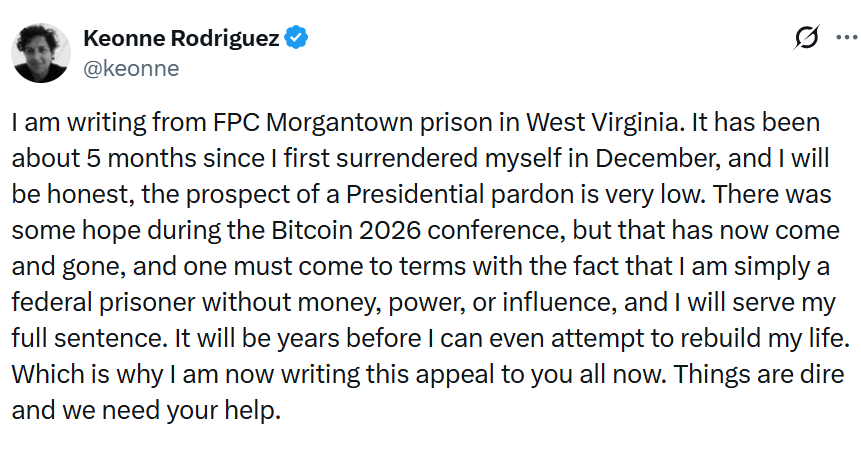
Keonne Rodriguez, one of the developers behind the crypto-mixing protocol Samourai Wallet, is appealing to the crypto community for donations to help cover legal bills and fines tied to his trial over money laundering. Samourai Wallet co-founders Rodriguez and William Lonergan Hill were sentenced on Nov. 19 to five and four years in prison, respectively, on charges stemming from their involvement in the protocol.Rodriguez said in an X post on Wednesday that he desperately needs help after being “financially wiped out,” accruing $2 million in debt from legal fees and a $250,000 fine imposed by the sentencing judge.Source: Keonne Rodriguez“We are entirely out of options. We need to pay off these legal bills and other debts accrued attempting to defend myself. We desperately need your help. Now.”The case against Rodriguez and Hill, along with Tornado Cash co-founder Roman Storm, has been closely followed by crypto advocates, many of whom argue they shouldn’t be held responsible for the actions of third parties using their software. They also argue that their convictions risk criminalizing open-source privacy tools and restricting privacy rights.Costs racked up over long legal battleRodriguez and Hill were first charged with conspiracy to commit money laundering and conspiracy to operate an unlicensed money transmitting business in April 2024. They initially pleaded not guilty, but in July 2025, they agreed to plead guilty to one charge of operating an illegal money transmitter.Rodriguez said in an interview with journalist and Bitcoin educator Natalie Brunell last December that he pleaded guilty after crunching the numbers and finding that a conviction would mean significantly more jail time and millions more in legal fees.Online legal marketplace Lawful estimates a criminal defense lawyer can cost on average $200 to $500 per hour, with retainer fees exceeding $10,000. Rates increase based on the type of case, the overall complexity and the number of lawyers working on the case.Presidential pardon likely off the tableUS President Donald Trump said last December that he would review Rodriguez’s case and explore a pardon. There is also a petition for a pardon that had attracted 15,953 signatures as of Thursday.Related: US prosecutors seek Roman Storm retrial after mixed verdictHowever, Rodriguez said that, unlike Trump’s pardons of Binance founder Changpeng “CZ” Zhao and Silk Road founder Ross Ulbricht, his prospects are low.“There was some hope during the Bitcoin 2026 conference, but that has now come and gone, and one must come to terms with the fact that I am simply a federal prisoner without money, power, or influence, and I will serve my full sentence,” he said.“Perhaps it was denial or delusion, but I had hoped to do what I have always done and dig myself out of this hole myself – but with the reality of serving a full sentence that is not possible.”Magazine: Singapore isn’t a ‘crypto hub’ — it’s something better: StraitsX CEO Cointelegraph is committed to independent, transparent journalism. This news article is produced in accordance with Cointelegraph’s Editorial Policy and aims to provide accurate and timely information. Readers are encouraged to verify information independently.