Key Takeaways:
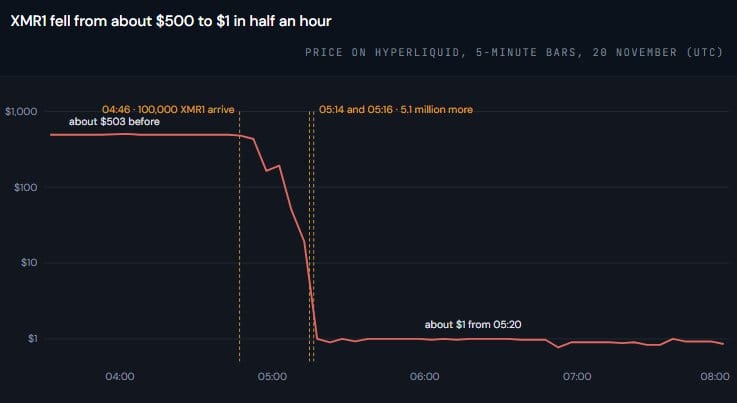
Monero’s token XMR1 fell from about $500 to about $1 on Nov. 20th after a new account entered the market with hundreds of thousands of tokens.
Bitquery was able to trace them through Hyperliquid and Arbitrum and Ethereum, while the XMR1’s service Wagyu traced the incident to a misused deployer key.
According to Bitquery’s updated analysis, the XMR1 deployer account transferred 5.2 million tokens to a fresh address in three transactions. In just 30 minutes, the receiving account then attempted to sell 369,623 XMR1 to 420 buyers at an average price of $13.51M, pushing the price of XMR down from around $500 to around $1.
The losses were skewed to larger market players. It turned out that 27 accounts that bought at least $100,000 accounted for 77% of all funding, and 75% of the funds raised were already on the order book.

The XMR1 sales were followed by the on-chain trail. Hyperliquid’s $13.28M of USDC was tracked by Bitquery to Arbitrum.Bitquery located the $13.28M of Hyperliquid’s USDC that was sent to Arbitrum. 0.9% of this $13.22 million was then swapped over from CoW on to 7,467 ETH for the majority of which was subsequently bridged to Ethereum through Socket, Mayan and Stargate.
7,348 ETH were left in three wallets at the time of Bitquery’s latest check. A single wallet held the most with 4,836 ETH and no other transactions were made.
Read More: Anthropic’s $83 IPO Fuels Hyperliquid Bets and Fresh Ether Liquidity Debate Before Nasdaq
PerpetualCow, representing Wagyu, claimed that the attackers acquired the XMR1 deployer key after a cyberattack on 1984.hosting, the Icelandic hosting provider.
The hosting company and the national cyber security unit of Iceland made two separate reports regarding a serious cyber security incident. But the transfers were impossible to trace by blockchain data as to whether the deployer key was acquired by accidents or processes, and who handled the key at the time of the transfers.
PerpetualCow has guaranteed to cash out those who’ve lost money and stated that Wagyu will be re-launched.
This incident involved XMR1 and not an actual Monero (XMR). Since native XMR can’t trade directly there, it’s found on an alternative privacy-focused blockchain which is why XMR1 is present on Hyperliquid as a representation of Monero. Wagyu has an additional bridge to deposit Monero, get XMR to trade with and then convert back to Monero at a later time.
That means the focus on the security is on the token issuance entity, the bridge’s infrastructure, and privileged keys more so than on the Monero system.
Bitquery also discovered that the same deployer account once again held 99.97% of the ZEC1 token used for representing Zcash, meaning another large supply of tokens, this time ZEC1, was under the same key used in the XMR1 transfers.
Read More: ICE Partners With Trade[XYZ] to Bring $650B Hyperliquid Futures Market to the U.S.
The post XMR1 Crashes 99.8% After $13.5M Hyperliquid Dump, Wagyu Pledges Full Refunds appeared first on CryptoNinjas.

Ethereum vs. Solana in 2027: Elon Musk’s Grok AI predicts which is positioned for bigger gains at the end of this article. As of mid-November

The proposal could stifle innovation and concentrate power, potentially leading to reduced competition and increased regulatory control. The post All-In Podcast’s David Friedberg slams Trump
Rapid AI advancements and high capital demands could disrupt current leaders, urging investors to adopt a cautious, adaptable strategy. The post Howard Marks warns OpenAI

While more companies attempted to challenge Bitmain’s dominance in the Bitcoin mining hardware market, these efforts—which are relevant to Bitcoin’s resilience—now appear to be on