





XRP is giving traders a contradiction that separates flow data from actual market control.
The token has been trading around the low-$1.30s after hitting its weakest level in roughly 15 weeks, even as two data points bulls often treat as supportive moved in the other direction.
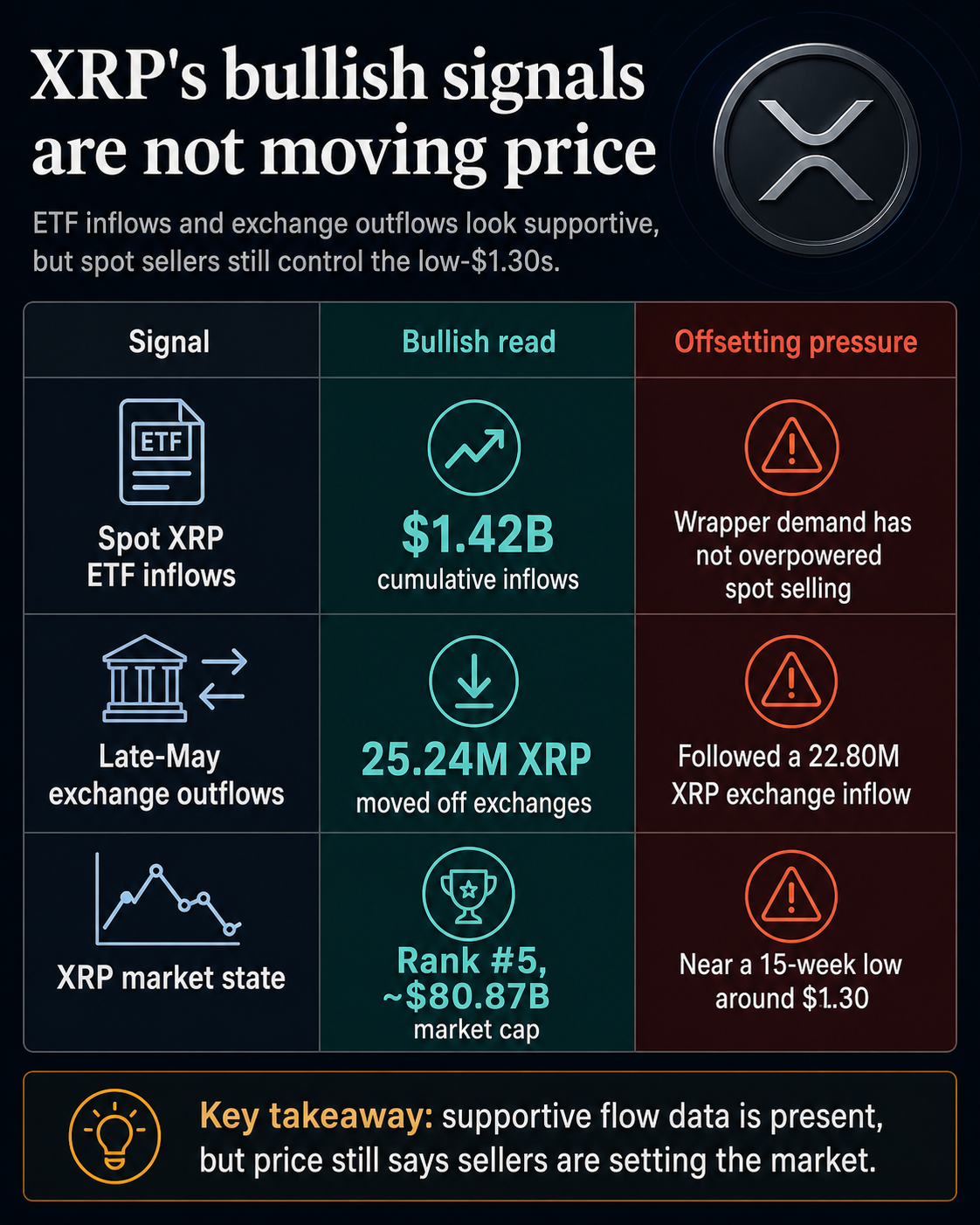
Spot XRP ETFs have continued to attract money, with cumulative inflows around $1.42 billion, while late-May exchange-flow data showed more than 25 million XRP moving off exchanges after a prior inflow.
That combination would normally invite a simple accumulation case. Less XRP on exchanges can mean less immediately available sell-side supply. ETF inflows can show that regulated wrappers are still drawing capital.
Yet price action points to something colder: neither signal has been enough to stop sellers from setting the marginal price.
CryptoSlate’s XRP market page showed the asset near $1.30 on June 1, with a market cap around $80.87 billion and roughly $1.62 billion in 24-hour volume.
The token remains a top-five crypto asset by market value, but that size has not protected it from a market where rebounds are still being sold.
The ETF side of the story has the clearest bullish potential.
SoSoValue data puts late-May spot XRP ETF inflows at roughly $11.8 million on May 29, taking cumulative net inflows to about $1.4 billion. Investor demand for XRP exposure through regulated products has continued during the latest drawdown.
ETF inflows are separate from immediate control of the spot market. They show that capital is entering a wrapper. They do not prove that enough aggressive buying is hitting exchange order books at the moment sellers are pressing sell orders through the market.
XRP has already spent much of May showing the same disconnect.
A recent analysis of XRP’s bullish signals found that ETF inflows, exchange withdrawals, and rising ledger activity had built a constructive setup, while price action still failed to follow.
The June 1 low moves that setup forward from a stalled bullish case to a clearer test of whether those flows can support the token before traders give up on the support zone.
| Signal | Bullish case | Offsetting pressure |
|---|---|---|
| Spot XRP ETF inflows | Regulated-product demand remains visible | Wrapper demand has yet to overpower spot selling |
| Late-May exchange outflows | Less XRP may be available for immediate selling | The flow followed a large exchange inflow and covers a short window |
| XRP still near the top of market rankings | Liquidity and attention remain deep relative to most altcoins | The token is still near a 15-week low |
| Prior accumulation signals | Bulls can argue that supply is being absorbed | Price keeps treating rebounds as sell zones |
The table shows the risk in reading ETF demand in isolation. Each constructive signal has a plausible bullish interpretation, but each also has an offsetting pressure that carries more weight for price right now.
What traders need to ask now is whether those flows are strong enough, direct enough, or immediate enough to change who controls spot trading.
The exchange-flow data shows the same tension.
Santiment showed a 22.80 million XRP exchange inflow before the balance reversed, with about 25.24 million XRP moving off exchanges in late May.
The second part of that sequence can look constructive. Coins leaving exchanges often reduce the supply available for fast selling and can point to custody, accumulation, or positioning away from trading venues.
In a stronger market, such a move could help confirm a bounce.
A 22.80 million XRP inflow shows that meaningful supply had also moved toward exchanges before the reversal.
The outflow that followed carries weight, but it leaves the earlier sign of sell-side pressure in the picture. It also cannot prove by itself that buyers are willing to absorb spot supply at higher prices.
The price response shows why the distinction counts. If XRP moves off exchanges and the price still falls to a multi-month low, visible exchange balances are only one part of the pressure.
Spot demand, order-book depth, leverage, and trader confidence can all carry more weight in the immediate window.
CryptoSlate’s XRP data also shows why centralized exchange behavior can be impactful: XRP’s 24-hour CEX volume was around $1.62 billion, compared with DEX volume of about $1.4 million.
For this market, the main price signal is still being formed on centralized venues, so exchange flows and liquidity conditions are where the ETF and accumulation narratives meet live selling.
The sell-zone pattern has been building for months. An earlier analysis found that XRP losses were forcing late buyers out and turning rebounds into fresh selling areas.
The latest low suggests that behavior has not fully cleared. Outflows can reduce potential supply, but they cannot repair sentiment if traders keep using every bounce to exit.
The strongest explanation for the contradiction is market structure.
XRP can keep some bullish signals and still leave sellers in control when liquidity is thin enough, and spot conviction weak enough, for marginal selling to push through supportive flow headlines.
A recent look at XRP liquidity found that Binance’s 30-day XRP liquidity index was near 0.043, its lowest level since January 2020, while all-exchange open interest hovered near $2.9 billion and futures volume ran at about 6.8 times spot volume.
Under those conditions, price can move sharply even when the broader story contains bullish data points.
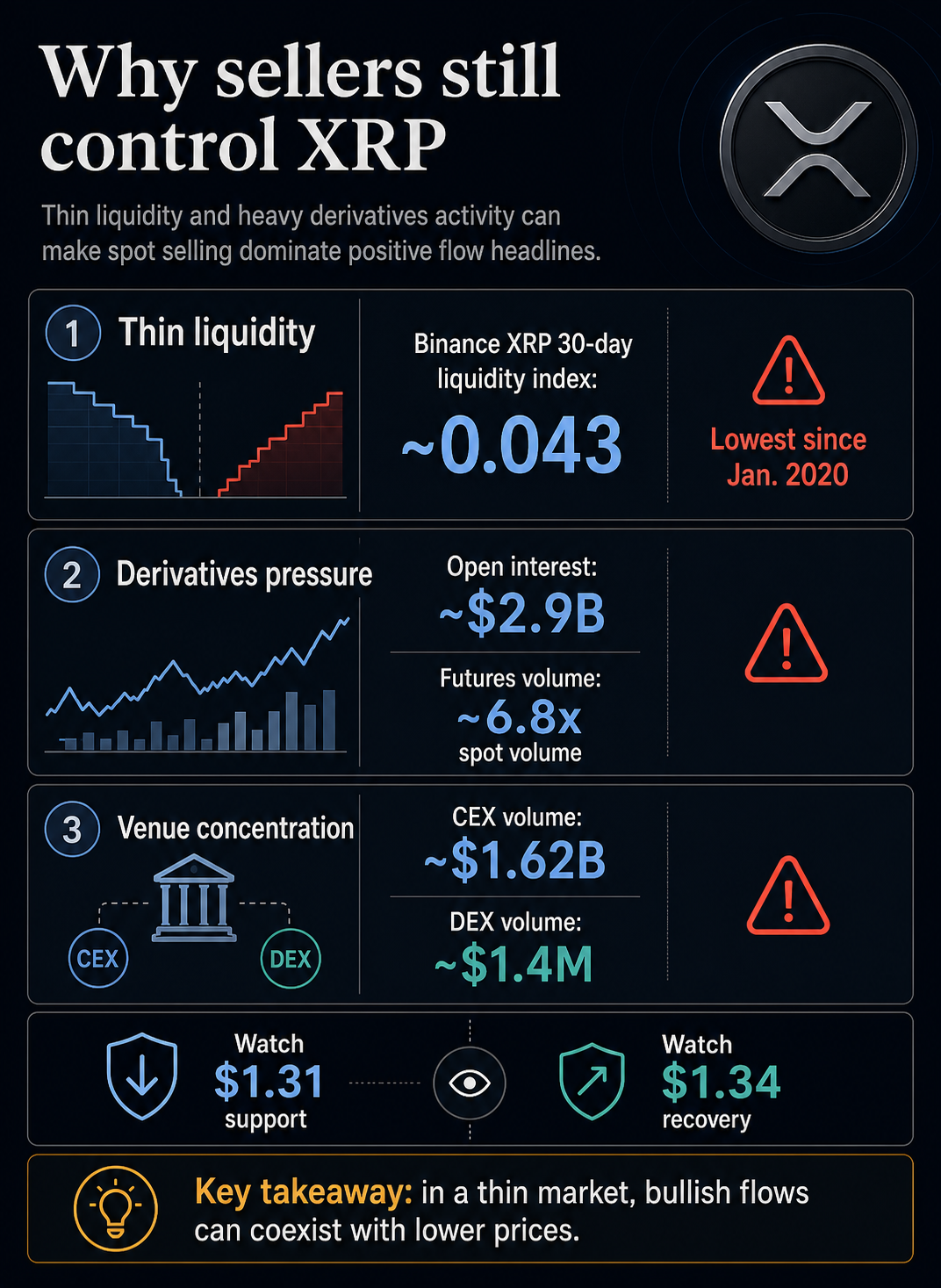
Thin liquidity changes how flow signals should be understood. In a deep market, ETF inflows and exchange outflows may help absorb selling pressure over time.
In a less liquid market, a smaller burst of spot selling can still move price, especially if derivatives activity is high and traders are leaning on the same levels.
Broader ETF rotation is less important here than it might look at first. XRP inflows have stood out at times while Bitcoin and Ethereum products faced pressure, and CryptoSlate has covered that ETF rotation.
Relative ETF strength is different from outright price strength. XRP can attract capital through one channel and still fall if the spot market is weaker, less liquid, or more leveraged than the inflow headline suggests.
For now, the next test is price, rather than another bullish data point. Buyers need to make the supportive flow signals visible in the chart.
A recovery through the low-$1.30s and a reclaim of the $1.34 area would show that buyers are finally absorbing visible sell pressure.
A loss of the $1.31 area while ETF inflows and exchange outflows remain constructive would strengthen the opposite case: XRP can have institutional wrapper demand and apparent accumulation without giving bulls control of the spot market.
So there is still a contradiction here. The flows say some capital is still moving toward XRP. The price says sellers are still winning.
The post XRP’s 15-week low puts ETF inflows to the spot-market test appeared first on CryptoSlate.





Kalshi files to list XRP, SOL, ETH, and DOGE perpetual futures as its regulated US crypto derivatives push expands beyond Bitcoin. The post Kalshi moves

Gold’s prices came under renewed selling pressure. At the moment of writing, XAU/USD is trading around $4,501. The trade was accompanied by reports from S.A.N.T.A.,
The smartphone market’s decline highlights a broader semiconductor shift, with AI demand reshaping chip allocation and pricing dynamics. The post Global smartphone market faces record
OranjeBTC’s strategic Bitcoin accumulation and share buybacks could enhance shareholder value, but hinge on Bitcoin’s long-term price growth. The post OranjeBTC buys additional 20 Bitcoin,