
I keep coming back to one detail in this story that makes it feel different from the usual crypto hack headline: this isn’t about an exchange getting drained.
It’s about retirement platforms, the kind of account someone opens specifically because it’s supposed to be the safe, boring, long-term option. According to a new investigation, two of those platforms may have quietly sat on data breaches for months, while at least one user reportedly lost over a million dollars to a scammer who seemingly knew exactly who to call.
The claims come from on-chain investigator ZachXBT, who published a community alert stating he has reviewed evidence suggesting two US-based investment platforms, BitcoinIRA and iTrustCapital, suffered data breaches this year that were never publicly disclosed. According to the investigation, the potentially exposed data spans a genuinely alarming range: personal information, wallet addresses and the amounts held within them, banking details, information tied to account custodians, and users’ account verification statuses.
I want to be precise about what’s actually being claimed here, because the specificity matters. This isn’t a vague “your email might be on a list somewhere” style breach notification. If accurate, this is the kind of dataset that tells a criminal exactly who holds crypto, roughly how much, which bank they use, and whether their account is fully verified, essentially a targeting list for anyone looking to run a convincing impersonation scam.
What turns this from a data privacy concern into something far more urgent is the incident ZachXBT ties directly to it. According to the investigation, in June 2026, a threat actor operating under the nickname “Tiffany” allegedly used the leaked BitcoinIRA data to target a specific user and steal more than $1.2 million from them. If that connection holds up, it means the breach wasn’t just sitting dormant somewhere on the dark web, it was reportedly already being actively weaponized against real account holders months before this alert became public.
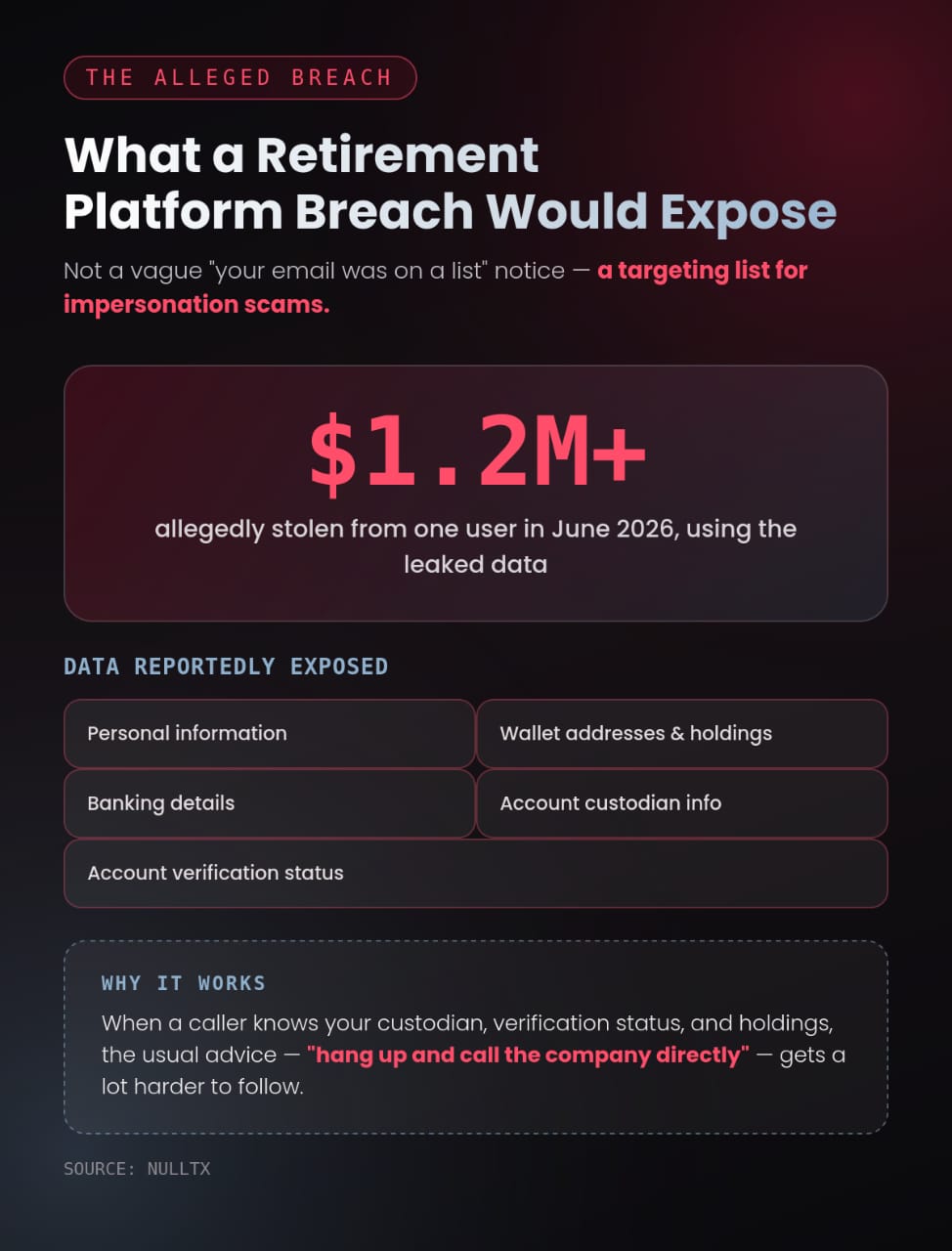
That detail lines up with a pattern that’s become depressingly familiar in crypto: a scammer who sounds legitimate because they have information they genuinely shouldn’t have. When a caller knows your custodian, your verification status, and roughly what you’re holding, the usual advice, “hang up and call the company directly”, becomes a lot harder to follow, because everything the caller says checks out against what you already know to be true about your own account.
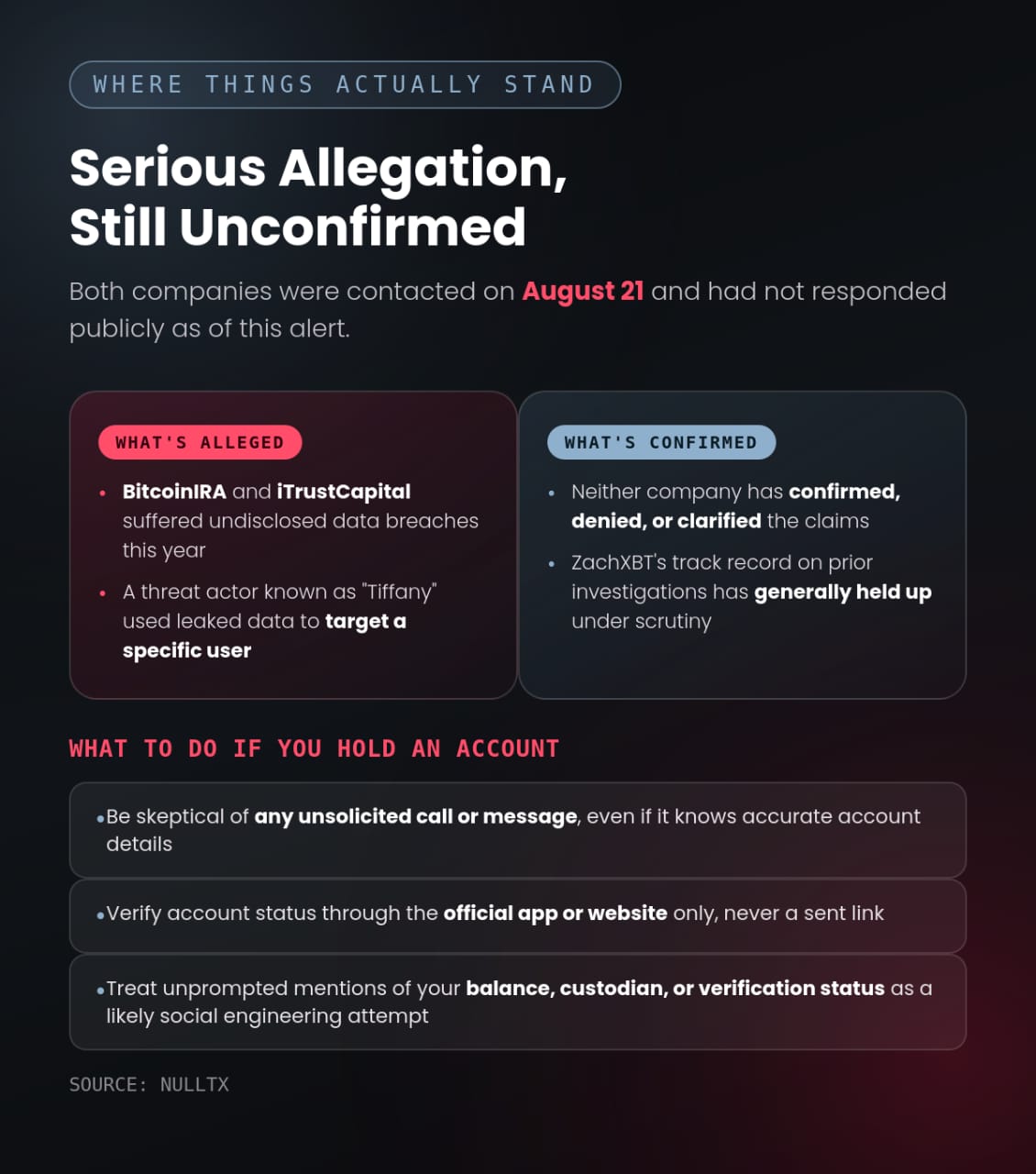
I think it’s important to be clear-eyed here: at this stage, everything in this story remains an allegation from a single investigator, not a confirmed or admitted breach from either company. ZachXBT’s community alert states plainly that both BitcoinIRA and iTrustCapital were contacted for comment on August 21, and that neither company had responded publicly as of the time the alert was published.
That silence doesn’t confirm the allegations, but it doesn’t clear anything up either, and in situations like this, the lack of a response tends to fuel exactly the kind of speculation companies would presumably want to avoid. As of this writing, neither BitcoinIRA nor iTrustCapital has issued a statement addressing the claims on their own official channels.
It’s worth sitting with why this specific category of platform makes these allegations feel heavier than a typical exchange breach story. Crypto IRA platforms like BitcoinIRA and iTrustCapital exist specifically to hold long-term retirement savings, meaning the accounts affected likely skew toward larger balances and older, less actively monitored positions, exactly the profile that makes a target attractive to a patient scammer. These platforms also inherently require more sensitive data than a typical exchange, since IRA custody involves banking details, identity verification for tax-advantaged accounts, and custodian relationships that a standard crypto exchange account simply doesn’t need to collect.
That combination, sensitive personal and banking data, custodial relationships, and balances people don’t check daily, is precisely why a breach at a platform like this could stay both undisclosed and undetected by users for far longer than a breach at a more actively monitored trading platform. If someone isn’t logging into their retirement account every day, a scammer with a full data profile has considerably more room to operate before anyone notices something is wrong.
Given where things currently stand, unconfirmed allegations, no public response, but a specific and detailed claim tied to a real, named financial loss, I’d treat this as a moment for caution rather than panic if you hold an account with either platform. That means being especially skeptical of any unsolicited call, email, or message claiming to be from BitcoinIRA or iTrustCapital support right now, even if the caller seems to know accurate details about your account, since that’s exactly the scenario this alert describes. It’s worth directly verifying your account status and reviewing recent activity through each platform’s official app or website rather than through any link sent to you, and reporting anything that looks like a targeted approach, someone referencing your specific balance, custodian, or verification status unprompted, as a likely social engineering attempt rather than a legitimate contact.
I’d also encourage some patience before treating this as settled fact in either direction. ZachXBT’s track record on prior investigations has generally held up under scrutiny, which is part of why this alert is spreading as quickly as it is, but “generally reliable” and “independently confirmed by the companies involved” are still two different standards, and only one of them has actually been met so far.
The honest answer right now is that we’re waiting, and the two companies named in this investigation are the only ones who can actually resolve the uncertainty. Until BitcoinIRA or iTrustCapital issue an official response confirming, denying, or clarifying what happened, everything here remains an allegation, a serious one, tied to a specific and substantial financial loss, but still unconfirmed by the parties best positioned to know the truth.
What makes this particular story worth watching closely isn’t just the scale of the alleged breach, it’s the pattern it fits into. Crypto users have spent years learning to distrust random phishing emails and fake support numbers. A breach at the platform level, if confirmed, represents something harder to defend against: a scammer armed with real, accurate account information, calling from what looks and sounds like a position of legitimate authority. That’s a fundamentally different threat than the usual crypto scam playbook, and it’s exactly why silence from two companies now sitting at the center of this allegation is going to keep drawing attention until they actually say something.
Disclosure: This is not trading or investment advice. Always do your research before buying any cryptocurrency or investing in any services. Follow us on X @nulltxnews